

Iron Mountain Bundle

Who Really Owns Iron Mountain?
Understanding the ownership structure of a company like Iron Mountain is key to unlocking its strategic vision and market influence. From its humble beginnings in 1951 as a Cold War-era storage solution, Iron Mountain has evolved into a global leader in information management. Its journey from a private venture to a publicly traded entity tells a compelling story of growth and adaptation.

Iron Mountain's initial public offering (IPO) on January 31, 1996, marked a pivotal shift, broadening its ownership base significantly. Today, Iron Mountain SWOT Analysis reveals a complex landscape of institutional investors and individual shareholders. This article explores the evolution of Iron Mountain ownership, from its founder to its current status as a publicly traded company, providing insights into Who owns Iron Mountain and the implications for its future. We will also delve into the Iron Mountain company history, including its Iron Mountain stock and the influence of Iron Mountain investors.
Who Founded Iron Mountain?
The story of Iron Mountain began in 1951, founded by Herman Knaust, a man known as 'The Mushroom King' due to his successful mushroom farming business. Knaust's vision was to provide secure storage, a concept that took root during the Cold War era. He saw an opportunity to protect vital corporate information.
Knaust, in 1936, had purchased a depleted iron ore mine in Kingston, New York, and initially used it for his mushroom business. However, as the mushroom market changed, he sought a new purpose for his mine, which he named 'Iron Mountain.' This led to the establishment of Iron Mountain Atomic Storage Corporation, offering bomb-resistant vaults.
The initial focus was on safeguarding critical information. The first client was East River Savings Bank. They stored microfilm copies of deposit records and duplicate signature cards at the underground facility. While the specific equity details of Knaust's ownership at the start are not publicly available, his focus on protecting essential information laid the groundwork for the company.

Early Ownership Shifts
By the early 1970s, the original iteration of the
- Herman Knaust founded Iron Mountain in 1951.
- The initial focus was on secure storage solutions.
- East River Savings Bank was the first client.
- Vincent J. Ryan acquired the company in the early 1970s.
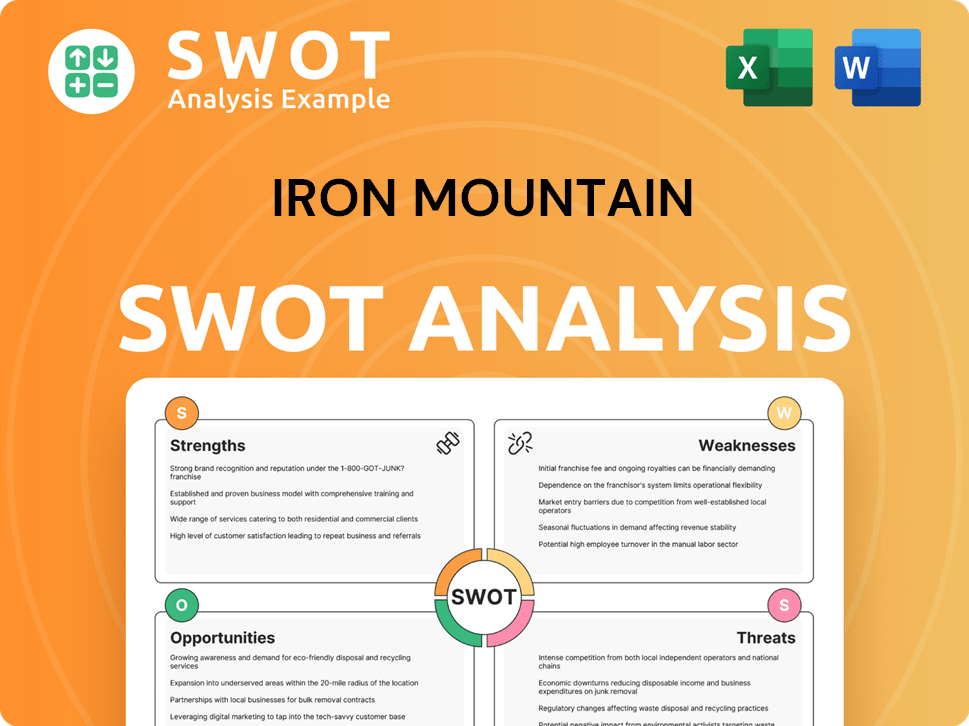
Iron Mountain SWOT Analysis
- Complete SWOT Breakdown
- Fully Customizable
- Editable in Excel & Word
- Professional Formatting
- Investor-Ready Format
How Has Iron Mountain’s Ownership Changed Over Time?
The evolution of Iron Mountain's ownership structure marks a significant journey since its initial public offering on January 31, 1996. The transition has largely shifted towards institutional investors and public shareholders, reflecting the company's growth and market position. This shift has influenced the company's strategic direction, particularly in expanding its services and global reach.
As of June 7, 2025, institutional investors hold a substantial portion of Iron Mountain's shares, accounting for approximately 82.79% of the total shares outstanding. Insiders hold a smaller percentage, around 1.96%. This distribution highlights the confidence institutional investors have in Iron Mountain's long-term prospects within the information management sector. This ownership structure is crucial when considering the Target Market of Iron Mountain.
| Shareholder | Shares (March 2025) | Value (March 2025) |
|---|---|---|
| Vanguard Group Inc. | 47 million | $4.0 billion |
| BlackRock, Inc. | 35 million | $3.0 billion |
| State Street Corp | 17 million (December 2024) | $1.8 billion (December 2024) |
Major institutional shareholders play a significant role in Iron Mountain's operations. Key investors include Vanguard Group Inc., BlackRock, Inc., and State Street Corp. These investors, along with others like Cohen & Steers, Inc., Geode Capital Management, LLC, and Fmr LLC, collectively influence the company's strategic decisions. Their substantial holdings underscore the company's importance in the information management sector.
Key Takeaways on Iron Mountain Ownership
Iron Mountain's ownership is primarily held by institutional investors.
- Institutional ownership is over 80%.
- Vanguard and BlackRock are major shareholders.
- The company's strategy is influenced by its investors.
- The company is a public company.
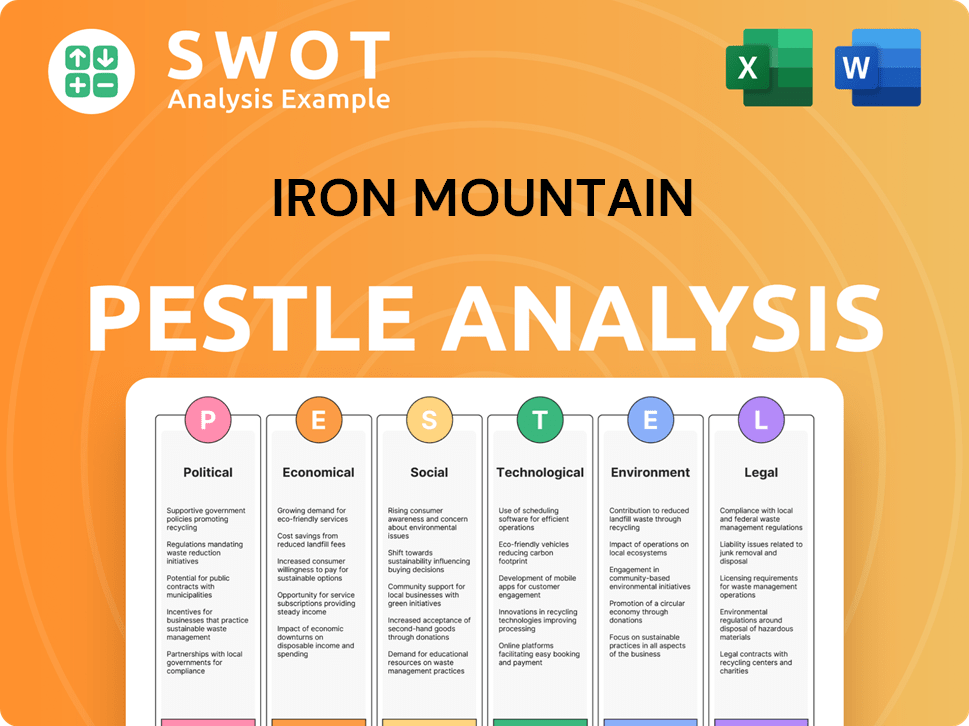
Iron Mountain PESTLE Analysis
- Covers All 6 PESTLE Categories
- No Research Needed – Save Hours of Work
- Built by Experts, Trusted by Consultants
- Instant Download, Ready to Use
- 100% Editable, Fully Customizable
Who Sits on Iron Mountain’s Board?
The Board of Directors at Iron Mountain oversees the company's strategic direction and decision-making. As of early 2025, William Meaney is the Chief Executive Officer. While a complete, real-time list of all board members and their specific affiliations for 2025 isn't explicitly detailed in the provided search results, SEC filings regularly update beneficial ownership and changes in board composition. Information about the board can be found in the company's annual reports and proxy statements, which are available on the Iron Mountain investor relations website.
For those interested in Iron Mountain ownership, it's important to consult the most recent SEC filings. These filings provide details on major shareholders and any shifts in insider holdings. The company's commitment to fostering an inclusive workplace and diverse talent, as highlighted in its 2024-2025 gender pay gap report, suggests a focus on broader governance principles. To understand the current composition of the board and the voting power of shareholders, reviewing the latest proxy statements is essential.
| Board Member | Title | Affiliation (as of latest filings) |
|---|---|---|
| William Meaney | Chief Executive Officer | N/A |
| (To be updated with latest filings) | (To be updated with latest filings) | (To be updated with latest filings) |
| (To be updated with latest filings) | (To be updated with latest filings) | (To be updated with latest filings) |
Generally, in publicly traded companies like Iron Mountain, the voting structure follows a one-share-one-vote principle, unless otherwise specified. There's no indication from the provided information of dual-class shares or special voting rights that would grant outsized control to specific individuals or entities beyond their proportional shareholdings. Recent SEC filings from June 2025 would reflect any significant shifts in insider holdings or those of major shareholders. For more information, you can also read more about the company's history and structure in this article: 0.
Key Takeaways on Iron Mountain's Governance
Understanding the board of directors and Iron Mountain ownership is crucial for investors.
- William Meaney is the current CEO.
- Voting typically follows a one-share-one-vote structure.
- Review the latest SEC filings for shareholder information.
- The company's governance emphasizes inclusivity and diversity.
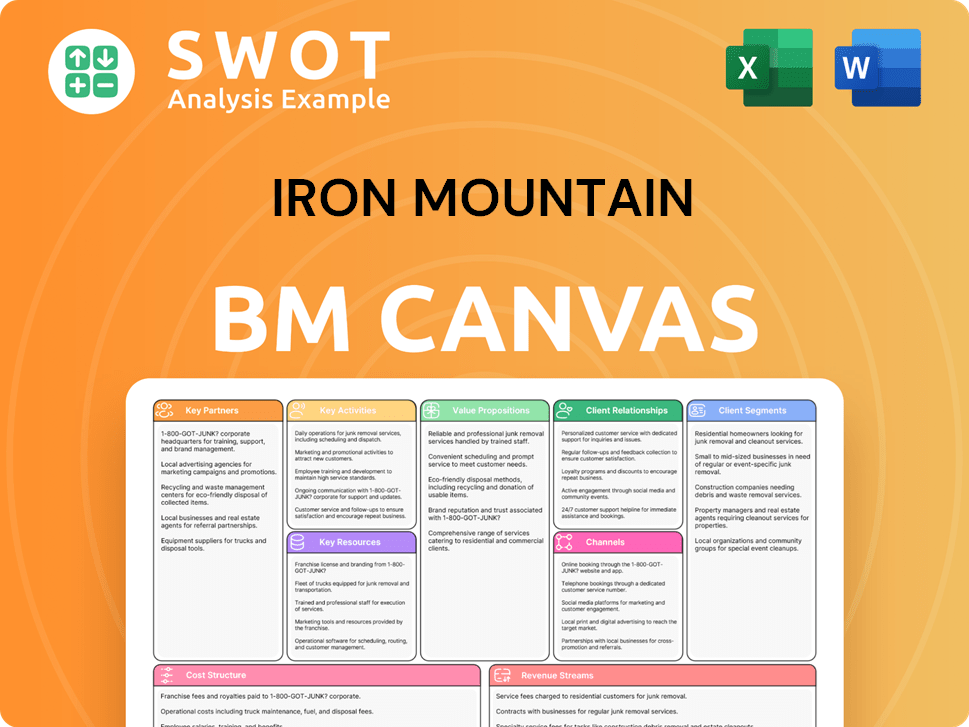
Iron Mountain Business Model Canvas
- Complete 9-Block Business Model Canvas
- Effortlessly Communicate Your Business Strategy
- Investor-Ready BMC Format
- 100% Editable and Customizable
- Clear and Structured Layout
What Recent Changes Have Shaped Iron Mountain’s Ownership Landscape?
Over the past few years, Iron Mountain has strategically expanded its Asset Lifecycle Management (ALM) and data center businesses. A key move in April 2025 was the full acquisition of Web Werks, an Indian data center company, solidifying its presence in the data center market. This acquisition followed a four-year joint venture and resulted in a shift in leadership, with Rajesh Tapadia taking over the day-to-day operations of the India data center business. In September 2024, the acquisition of Wisetek Solutions Limited further boosted its ALM capabilities globally.
These strategic moves align with industry trends of consolidation and increased institutional ownership. In January 2024, the acquisition of Regency Technologies for approximately $200 million, with $75 million due in 2025, was a significant step to enhance its IT asset remarketing and recycling services. The company's financial reports for Q1 2025 show continued growth in its ITAD and data center segments, with total asset lifecycle management revenue up 44% year-over-year to $121 million. The company's strategic focus on data centers and ALM is reflected in its increased full-year 2025 guidance and a declared quarterly cash dividend of $0.785 per share for Q2 2025, payable on July 3, 2025.
| Metric | Value (May 2025) | Details |
|---|---|---|
| Institutional Ownership | 82.91% | Remained largely unchanged |
| Mutual Fund Holdings | 63.94% | Significant portion of institutional ownership |
| Insiders' Holdings | 0.66% | Stable |
The ownership structure of Iron Mountain, including its institutional and insider holdings, has remained relatively stable. The company's focus on strategic acquisitions and its financial performance, particularly in its ITAD and data center segments, indicates a continued growth trajectory. These developments suggest a strong focus on expanding core business areas and enhancing shareholder value.
 Iron Mountain Ownership Trends
Iron Mountain’s ownership structure shows a strong institutional presence, with a significant portion held by mutual funds. Insiders maintain a small but consistent stake. The company's acquisitions are aimed at strengthening its ALM and data center businesses.
Key Acquisitions
Key acquisitions include the full acquisition of Web Werks in India and Wisetek Solutions Limited. The Regency Technologies acquisition further enhanced IT asset remarketing and recycling services. These moves reflect the company's growth strategy.
Financial Performance
Q1 2025 results show strong growth in ITAD and data center segments, with ALM revenue up 44% year-over-year. The company has also increased its full-year 2025 guidance. Iron Mountain declared a quarterly cash dividend.
Leadership and Strategy
Rajesh Tapadia now leads the India data center business. The company's strategy focuses on expanding its core businesses through strategic acquisitions and improved financial performance. There have been no significant public statements about major leadership changes.
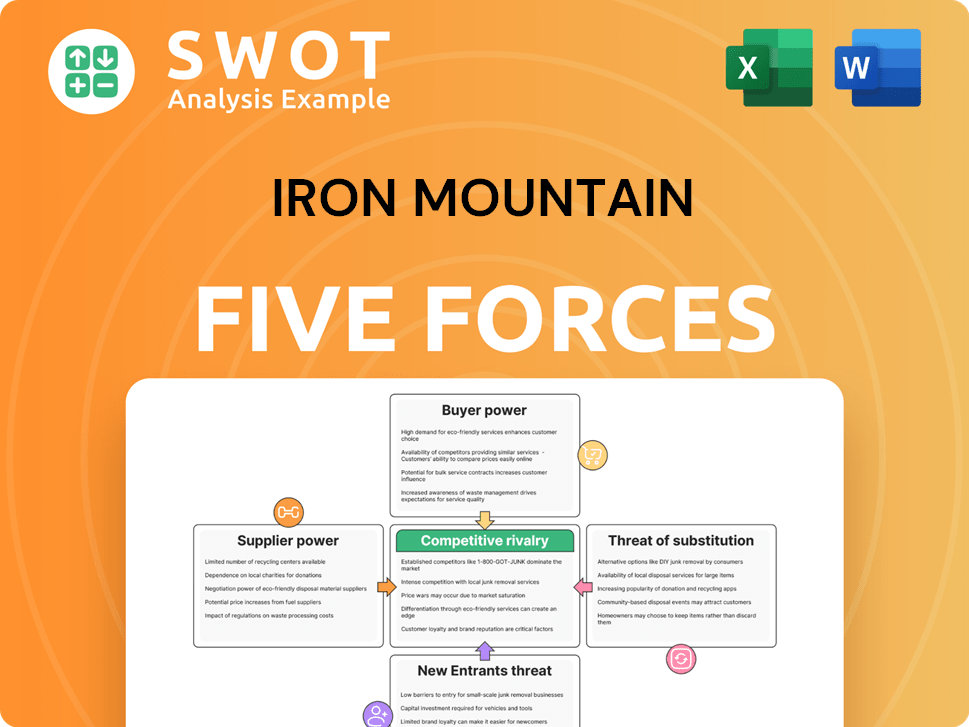
Iron Mountain Porter's Five Forces Analysis
- Covers All 5 Competitive Forces in Detail
- Structured for Consultants, Students, and Founders
- 100% Editable in Microsoft Word & Excel
- Instant Digital Download – Use Immediately
- Compatible with Mac & PC – Fully Unlocked
Related Blogs

- What are Mission Vision & Core Values of Iron Mountain Company?
- What is Competitive Landscape of Iron Mountain Company?
- What is Growth Strategy and Future Prospects of Iron Mountain Company?
- How Does Iron Mountain Company Work?
- What is Sales and Marketing Strategy of Iron Mountain Company?
- What is Brief History of Iron Mountain Company?
- What is Customer Demographics and Target Market of Iron Mountain Company?
Disclaimer
All information, articles, and product details provided on this website are for general informational and educational purposes only. We do not claim any ownership over, nor do we intend to infringe upon, any trademarks, copyrights, logos, brand names, or other intellectual property mentioned or depicted on this site. Such intellectual property remains the property of its respective owners, and any references here are made solely for identification or informational purposes, without implying any affiliation, endorsement, or partnership.
We make no representations or warranties, express or implied, regarding the accuracy, completeness, or suitability of any content or products presented. Nothing on this website should be construed as legal, tax, investment, financial, medical, or other professional advice. In addition, no part of this site—including articles or product references—constitutes a solicitation, recommendation, endorsement, advertisement, or offer to buy or sell any securities, franchises, or other financial instruments, particularly in jurisdictions where such activity would be unlawful.
All content is of a general nature and may not address the specific circumstances of any individual or entity. It is not a substitute for professional advice or services. Any actions you take based on the information provided here are strictly at your own risk. You accept full responsibility for any decisions or outcomes arising from your use of this website and agree to release us from any liability in connection with your use of, or reliance upon, the content or products found herein.