

Columbia Bank Online Porter's Five Forces Analysis
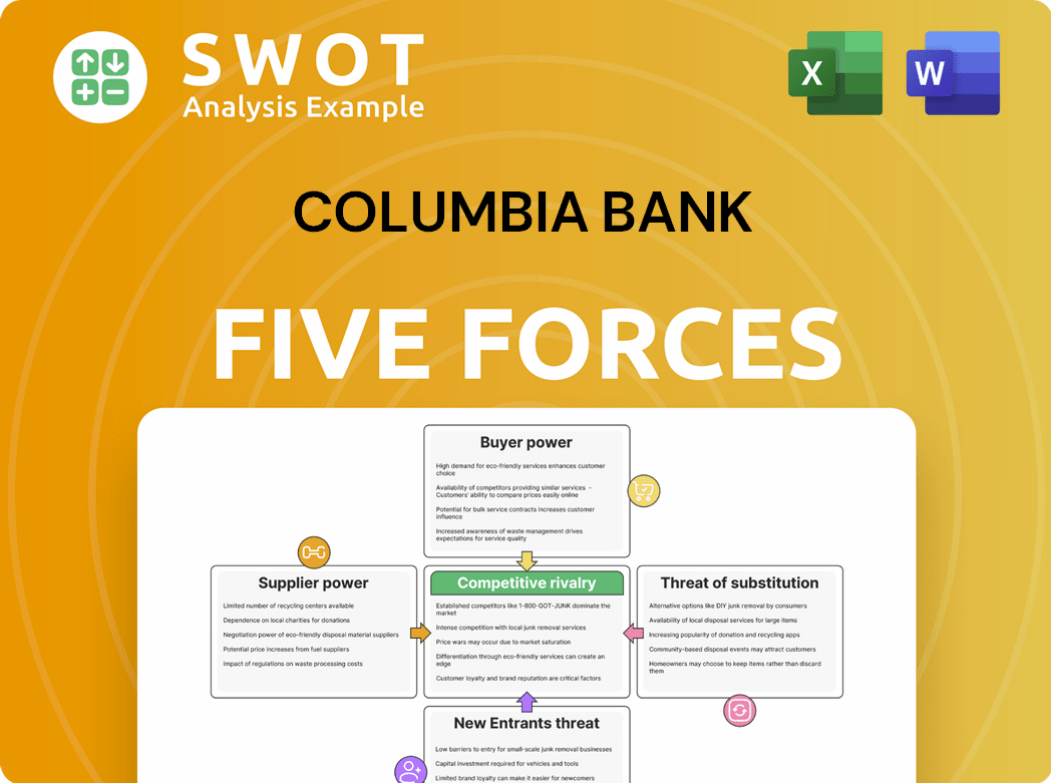
Fully Editable
Tailor To Your Needs In Excel Or Sheets
Professional Design
Trusted, Industry-Standard Templates
Pre-Built
For Quick And Efficient Use
No Expertise Is Needed
Easy To Follow
Columbia Bank Online Bundle

What is included in the product
 Detailed Word Document
Tailored exclusively for Columbia Bank, analyzing its position within its competitive landscape.

 Customizable Excel Spreadsheet
Swap in your own data, labels, and notes to reflect current business conditions.
Preview Before You Purchase
Columbia Bank Porter's Five Forces Analysis
This preview is the full Columbia Bank Porter's Five Forces Analysis. You will receive this comprehensive, professionally written document immediately after purchase.

Porter's Five Forces Analysis Template

Don't Miss the Bigger Picture
Columbia Bank navigates a complex banking landscape. Analyzing its Porter's Five Forces reveals key competitive dynamics. Buyer power, supplier influence, and competitive rivalry shape its strategic choices. The threat of new entrants and substitutes adds further pressure. Understand the forces impacting Columbia Bank's profitability and sustainability.
Ready to move beyond the basics? Get a full strategic breakdown of Columbia Bank’s market position, competitive intensity, and external threats—all in one powerful analysis.
Suppliers Bargaining Power

Limited Core Banking Tech
The banking industry's reliance on a few core tech providers boosts supplier power. High switching costs solidify suppliers' influence; changing core systems is complex. In 2024, cloud migration is a growing trend; banks are investing in digital transformation. Consider that in 2023, core banking system spending was at $24.5 billion globally.
Dependence on Key Infrastructure
Columbia Bank's reliance on key financial infrastructure and regulatory compliance systems gives suppliers leverage. These systems are critical for daily operations and adherence to regulations. Banks must invest in cybersecurity, including AI and machine learning. In 2024, cybersecurity spending in the banking sector reached approximately $20 billion globally.
Potential High Switching Costs
Specialized banking tech, with high switching costs, boosts supplier power. Banks find it tough to swap suppliers due to this. Financial firms invest heavily in AI, seeing returns. In 2024, AI spending in finance reached $100 billion. This trend further cements supplier influence.

Regulatory Compliance Systems
Suppliers of regulatory compliance systems wield substantial power in the banking sector due to the industry's strict regulatory demands. Banks heavily rely on these systems to meet operational standards. RegTech solutions offer automation and efficiency, aiding banks in navigating regulatory shifts. The RegTech market is projected to reach $213.3 billion by 2026, showing significant growth. This highlights the increasing dependence on these suppliers.
- Regulatory compliance is crucial for banks to operate legally.
- RegTech solutions enhance efficiency and adapt to changing regulations.
- The RegTech market's growth underscores its importance.
- Banks' reliance gives suppliers considerable influence.
Influence of IT Outsourcing
The rise of IT outsourcing in banking affects supplier power significantly. As Columbia Bank outsources more IT functions, its reliance on external providers increases their leverage. The Digital Operational Resilience Act (DORA) standardizes rules for financial entities and their IT service providers, like Columbia Bank. This includes the suppliers. DORA aims to ensure that suppliers meet stringent resilience standards.
- DORA's implementation is expected by January 17, 2025.
- IT outsourcing spending by banks is projected to grow.
- The global IT outsourcing market was valued at USD 446.1 billion in 2023.
Tech & Outsourcing: Supplier Power Surge!
Suppliers hold significant power due to the need for core tech, compliance systems, and outsourcing. Switching costs and regulatory demands solidify their influence. The RegTech market is set to reach $213.3 billion by 2026. IT outsourcing also boosts supplier leverage, with the global market valued at $446.1 billion in 2023.
| Area | Data | Year |
|---|---|---|
| Core Banking System Spending | $24.5 billion | 2023 |
| Cybersecurity Spending (Banking) | $20 billion | 2024 |
| AI Spending in Finance | $100 billion | 2024 |
Customers Bargaining Power

Interest Rate Sensitivity
Customers of Columbia Bank are notably sensitive to interest rate fluctuations, particularly in response to the Federal Reserve's monetary policy decisions. This heightened sensitivity directly amplifies their ability to negotiate favorable terms on loans and deposit rates. For instance, if the Fed cuts rates, as it did in 2024, customers gain leverage. This shift towards a more accommodative rate environment is vital.
Increased Banking Options
The rise of digital banking and tech giants has expanded customer choices, intensifying competition for Columbia Bank. This shift compels traditional banks to enhance customer loyalty through competitive offerings. Data indicates that in 2024, neobanks saw a 20% increase in customer acquisition. Modernizing platforms requires a laser focus on user experience to stay competitive.

Demand for Personalization
Customers today want personalized financial solutions, which is changing the banking landscape. Banks focusing on customization gain an edge. In 2024, personalized banking boosted customer satisfaction by 20% on average. This approach boosts loyalty, reducing customer churn and encouraging new product adoption.

Mortgage and Loan Demand
Customer demand significantly impacts bargaining power in the mortgage and loan market, especially when interest rates fall. As of late 2024, fluctuating rates have led to increased customer negotiation. Banks must adapt their interest income strategies to remain competitive. Non-interest revenue streams, like wealth management, are crucial for navigating this landscape.
- Demand for mortgages and loans directly influences customer bargaining power.
- Banks with diversified revenue streams are better positioned.
- Interest rate fluctuations impact customer negotiations.
- Wealth management services can offset interest rate impacts.
Digital Service Expectations
Customers' demand for digital banking experiences significantly shapes their service choices. Banks must continuously invest in digital transformation to stay competitive, especially as generative AI reshapes operations. A 2024 study showed that 70% of customers prefer digital banking. This customer-centric shift is crucial for Columbia Bank.
- Digital banking adoption continues to rise, with mobile banking users growing by 15% in 2024.
- Investment in AI-driven customer service is increasing, with banks allocating up to 20% of their IT budget to AI.
- Customer expectations include personalized services, influencing banks to adopt data analytics.
Banking Dynamics: Customer Power & Market Shifts
Columbia Bank customers wield strong bargaining power, particularly sensitive to interest rate shifts, as seen in 2024, with the Federal Reserve's policy influencing loan and deposit terms.
Digital banking and tech advancements expand customer choices, intensifying competition. Neobanks increased customer acquisition by 20% in 2024. This compels Columbia Bank to boost loyalty with competitive offerings and enhanced digital platforms.
Customer demand for personalized solutions is crucial; banks focusing on customization gain an advantage. In 2024, personalized banking improved customer satisfaction by approximately 20%.
| Factor | Impact | 2024 Data |
|---|---|---|
| Interest Rate Sensitivity | High | Fed rate changes influence loan terms |
| Digital Banking Adoption | Increasing | Mobile banking users grew by 15% |
| Personalized Banking | Positive Impact | 20% satisfaction boost |
Rivalry Among Competitors

Competition from Big Banks
Columbia Bank competes with large national and regional banks, facing strong rivalry due to their extensive resources. These competitors provide broader services and have significantly larger marketing budgets. In 2024, JPMorgan Chase's marketing expenses were about $12 billion, highlighting the financial disparity. Banks need clear strategies to stand out, as technological innovation alone, especially with AI, is insufficient for differentiation.
Rise of Neobanks
Digital-first neobanks intensify rivalry, offering innovative services and higher interest rates, challenging traditional banks to adapt. These neobanks are capturing a growing segment of the financial services market. User penetration of neobanks was at 3.89%, with a projection to reach 4.82% by 2028. This rise forces traditional institutions like Columbia Bank to innovate to stay competitive.

Increased M&A Activity
The banking sector is experiencing a surge in mergers and acquisitions (M&A), intensifying competition. This trend, with an expected 15% increase in M&A deals in 2024, concentrates market power. Smaller banks, such as Columbia Bank, face heightened pressure from these larger entities. Upcoming regulatory shifts and economic policies are set to fuel further M&A activity across various bank sizes.

Focus on Technology
Competition in the banking sector, like at Columbia Bank, fuels significant investment in technology, particularly in AI, to boost efficiency and customer service. AI has become crucial for banks to maintain a competitive edge. It is not just an add-on; banks need an AI-first approach to enhance customer engagement, forecasting, and loan underwriting by leveraging a solid data foundation.
- Banks are projected to spend $270 billion on IT in 2024.
- AI adoption in banking is expected to grow by 30% in 2024.
- AI-powered chatbots handle up to 70% of customer service inquiries.
- Data-driven personalization can increase customer engagement by 40%.
Local Market Rivalry
Columbia Bank faces intense competition in New Jersey's local market. To stay ahead, understanding local dynamics is key. New Jersey businesses showed resilience and caution in 2024. With the election and Fed actions, investment and lending are expected to increase. This environment demands strategic agility.
- Competition includes other regional banks and credit unions.
- 2024 saw a 3% increase in business lending in New Jersey.
- Interest rate sensitivity is high among local businesses.
- Focus on customer service and local expertise is crucial.
Banking Battle: Market Pressures Mount
Columbia Bank experiences strong rivalry from large national and regional banks, which possess extensive resources and larger marketing budgets. Neobanks intensify competition by offering innovative services, impacting traditional banks. Furthermore, mergers and acquisitions (M&A) in the banking sector concentrate market power, increasing pressure on smaller institutions.
| Aspect | Data | Impact on Columbia Bank |
|---|---|---|
| Marketing Spending | JPMorgan Chase spent $12B in 2024. | Highlights competitive disadvantage. |
| Neobank Penetration | 3.89% user penetration. | Requires innovation to stay competitive. |
| M&A Increase | 15% increase expected in 2024. | Increases pressure from larger entities. |
SSubstitutes Threaten

Fintech Payment Solutions
Fintech payment solutions pose a threat. Mobile payment apps and online platforms offer alternatives to traditional banking services. The substitution threat has grown. In 2024, the mobile payment market was valued at approximately $1.5 trillion. This shows the increasing appeal of fintech.
Peer-to-Peer Lending
Peer-to-peer (P2P) lending platforms pose a threat to Columbia Bank, acting as substitutes for traditional loans. These platforms lure customers with possibly lower interest rates and simpler application processes. P2P options have grown significantly; in 2024, the P2P lending market was valued at approximately $120 billion globally. This shift impacts banks, as P2P lenders like LendingClub and Prosper compete directly, costing institutions like JPMorgan revenue.

Non-Bank Financial Services
Non-bank financial services pose a threat to Columbia Bank. These services, including wealth management and insurance, directly compete with traditional banking products. Regulatory changes are influencing borrowers to seek mortgages and commercial credit from non-bank entities. As of late 2024, non-bank lenders held approximately 60% of the U.S. mortgage market, highlighting the shift. This competition could erode Columbia Bank's market share and profitability.

Digital Wallets
Digital wallets pose a threat to Columbia Bank by offering convenient alternatives for financial transactions. These wallets, like PayPal and Apple Pay, have revolutionized payment methods, impacting traditional banking. The increasing adoption of digital wallets signifies a shift in consumer behavior, potentially reducing reliance on conventional bank accounts. In 2024, the global digital wallet market was valued at $2.8 trillion, reflecting its substantial impact.
- Convenience: Digital wallets offer easier payment options than traditional banking.
- Adoption: The rise in digital wallet usage challenges conventional banking methods.
- Market Value: The digital wallet market's worth is significant, at $2.8 trillion in 2024.
Prepaid Debit Cards
Prepaid debit cards present a viable alternative to traditional checking accounts, appealing particularly to those without bank accounts or with limited banking access. These cards offer services that directly compete with core offerings of financial institutions. The prepaid debit card market has seen significant growth, impacting revenue streams for major banks like JPMorgan. JPMorgan’s revenue from checking accounts is threatened by this substitution.
- The U.S. prepaid card market was valued at $320 billion in 2023.
- Approximately 5.5% of U.S. households are unbanked.
- Prepaid cards offer features like direct deposit and bill payment.
- Banks are responding by lowering fees and improving digital services.
Columbia Bank's Rivals: A $4.3T Threat
The threat of substitutes significantly impacts Columbia Bank due to the availability of alternative financial products and services.
Fintech solutions, P2P lending, non-bank services, digital wallets, and prepaid cards provide attractive alternatives.
These options challenge Columbia Bank's market share and profitability; the combined value of digital wallets and mobile payments reached roughly $4.3 trillion in 2024.
| Substitute | Market Value (2024) | Impact on Columbia Bank |
|---|---|---|
| Digital Wallets | $2.8 trillion | Reduced transaction volume |
| Mobile Payments | $1.5 trillion | Erosion of customer base |
| P2P Lending | $120 billion | Competition for loans |
Entrants Threaten

High Regulatory Barriers
The banking sector faces high regulatory barriers, hindering new entrants. Compliance costs and complexity are significant challenges. For example, new banks must meet stringent capital requirements, such as those set by the Basel III accord, which includes minimum capital ratios, with Common Equity Tier 1 capital at 4.5% of risk-weighted assets. These barriers make it tough to compete with established banks like Columbia Bank.
Capital Requirements
New banks face substantial capital demands for infrastructure and regulatory compliance, which restricts market entry. The banking sector is at a critical point, navigating challenges and opportunities that shape its future. Recent data shows that establishing a new bank can require tens of millions of dollars, deterring many. This high barrier to entry protects existing players like Columbia Bank.

Brand Building Challenges
Building a brand and earning customer trust are time-consuming hurdles for new banks. Banks' financial results vary, with some succeeding in the coming years. For example, brand recognition significantly impacts customer loyalty, with established banks often having an advantage. In 2024, the average cost to launch a new bank branch was approximately $1 million, a significant barrier.

Technological Expertise
New entrants face a substantial barrier due to the technological prowess required in the banking sector. They must possess advanced expertise to offer digital services and ensure robust cybersecurity, critical for customer trust. Addressing existing technical debt is crucial for effectively integrating AI, as seen in the 2024 trend of banks investing heavily in tech upgrades. The rise of fintech firms highlights this, with their agility often challenging traditional institutions.
- Cybersecurity spending by financial institutions is projected to reach $34.5 billion in 2024.
- The global fintech market size was valued at USD 112.58 billion in 2021 and is projected to reach USD 332.5 billion by 2028.
- Legacy systems still burden the majority of banks, with an average of 70% of IT budgets allocated to maintaining these systems.
Incumbent Advantages
Existing banks, like Columbia Bank, benefit from established customer relationships and economies of scale, which pose significant barriers to new entrants. These advantages make it challenging for new competitors to gain market share quickly. In 2024, the banking sector saw increased consolidation, further strengthening incumbent positions. Diversified banks are expected to perform better in 2025.
- Customer loyalty built over time provides a crucial defense against new competitors.
- Economies of scale in areas like technology and marketing give incumbents a cost advantage.
- Regulatory hurdles and compliance costs can deter new entrants.
- In 2024, several regional banks merged, reflecting efforts to maintain competitiveness.
Banking's High Hurdles: A Tough Climb for Newcomers
New entrants in the banking sector face high barriers. These include regulatory hurdles and substantial capital requirements, such as Basel III. Launching a new bank branch cost around $1 million in 2024. Fintech firms also pose a threat.
| Barrier | Details | Impact |
|---|---|---|
| Regulations | Compliance, capital needs. | Increases costs, delays entry. |
| Capital | Infrastructure, tech, launch. | Restricts new bank formation. |
| Competition | Brand, scale, tech. | Challenges market share gains. |
Porter's Five Forces Analysis Data Sources
The Columbia Bank analysis uses SEC filings, industry reports, and financial databases. Market research and competitive intelligence also provide data.
