

Advanced Energy Porter's Five Forces Analysis
Fully Editable
Tailor To Your Needs In Excel Or Sheets
Professional Design
Trusted, Industry-Standard Templates
Pre-Built
For Quick And Efficient Use
No Expertise Is Needed
Easy To Follow
Advanced Energy Bundle

What is included in the product
 Detailed Word Document
Tailored exclusively for Advanced Energy, analyzing its position within its competitive landscape.

 Customizable Excel Spreadsheet
Instantly identify competitive threats and opportunities.
Full Version Awaits
Advanced Energy Porter's Five Forces Analysis
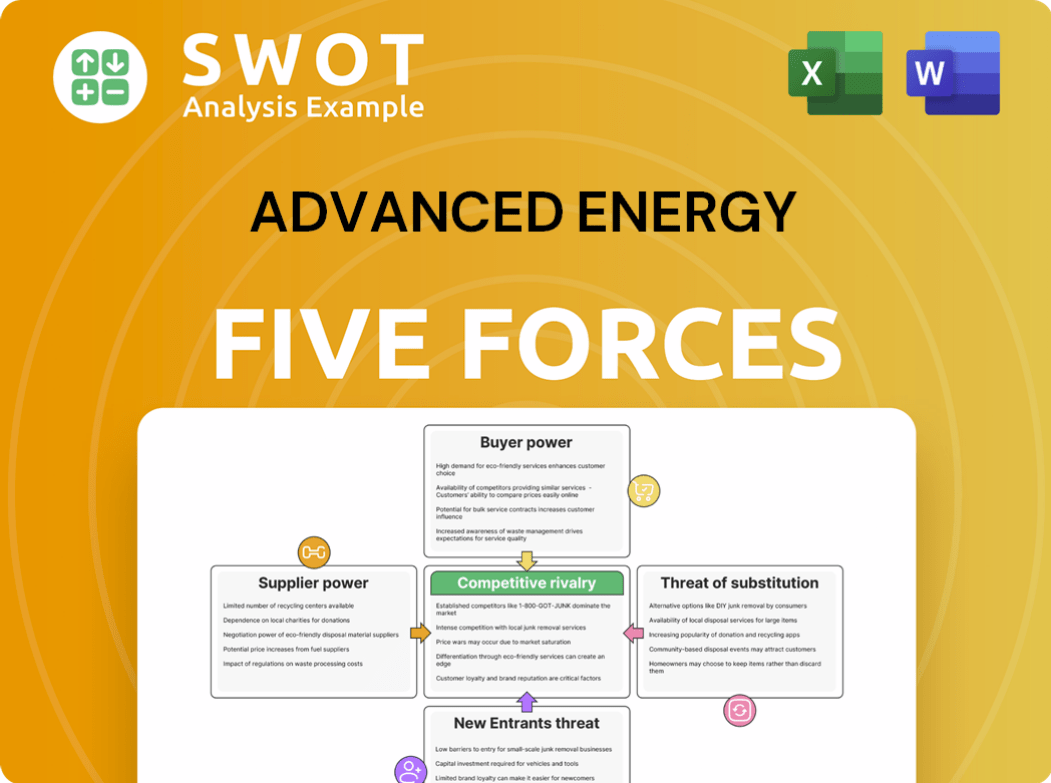
This preview is the complete Advanced Energy Porter's Five Forces analysis you'll receive. It dissects competitive rivalry, supplier power, and other forces. The analysis provides insights into market dynamics and strategic positioning. It's fully formatted, ready for immediate use and completely downloadable after purchase. No hidden sections; this is the full report.

Porter's Five Forces Analysis Template

A Must-Have Tool for Decision-Makers
Advanced Energy faces a complex competitive landscape, shaped by the power of its suppliers, particularly in specialized components. The threat of new entrants is moderate, given the capital-intensive nature of the industry and existing patents. Buyer power varies across customer segments. Intense rivalry exists with established players. The threat of substitutes is present, as alternative energy technologies emerge.
The complete report reveals the real forces shaping Advanced Energy’s industry—from supplier influence to threat of new entrants. Gain actionable insights to drive smarter decision-making.
Suppliers Bargaining Power

Supplier Concentration
Supplier concentration examines how many suppliers exist and their market share. A concentrated supplier base gives suppliers more power. In 2024, the solar panel market saw consolidation, with major manufacturers controlling a large share. This concentration enhances their pricing power.
Switching Costs for Advanced Energy
Advanced Energy (AEIS) faces moderate supplier power. High-tech components have limited suppliers, increasing costs. However, AEIS can switch suppliers, mitigating some impact. In 2024, AEIS reported a gross margin of around 39%, reflecting supplier cost management. This suggests some control over supplier pricing, lessening their bargaining power.
Proprietary Technology
Advanced Energy's proprietary technology, such as its power conversion and control solutions, gives it significant bargaining power. This allows the company to dictate pricing and terms to customers. In 2024, Advanced Energy's gross margin was around 38%, reflecting this advantage. This margin is higher than industry averages, showing strong control over its supply chain.

Impact of Commodity Prices
Commodity prices significantly influence suppliers' bargaining power in the advanced energy sector. Fluctuations in the cost of raw materials like lithium, cobalt, and rare earth minerals directly impact the profitability of suppliers. For instance, the price of lithium carbonate, crucial for EV batteries, surged to over $70,000 per ton in late 2022 before decreasing in 2023. This volatility affects the cost structure and negotiation leverage of both suppliers and buyers.
- Price Volatility: Significant price swings in key commodities.
- Supply Chain Disruptions: Geopolitical events or natural disasters.
- Cost Impact: Higher commodity costs reduce profit margins.
- Market Dynamics: Supply and demand influence pricing power.
Supplier Forward Integration
Supplier forward integration refers to when suppliers move into the industry of the companies they supply. This can significantly impact the bargaining power dynamics. For example, if a solar panel manufacturer starts installing solar panels, they're no longer just a supplier, but a competitor. This reduces the leverage of companies that previously bought from them.
This shift can dramatically alter the competitive landscape, potentially squeezing profit margins. In 2024, the market saw increased supplier consolidation in the battery storage sector, with major players like CATL expanding their downstream operations. This strategic move intensifies competitive pressures.
- Vertical integration shifts power dynamics.
- Supplier becomes a competitor.
- Increased competition can squeeze margins.
- Consolidation is a key trend in 2024.
AEIS: Navigating Supplier Power Dynamics
Supplier bargaining power in the advanced energy sector depends on concentration, input costs, and integration. AEIS has moderate supplier power, with some leverage due to switching capabilities. Commodity price volatility, like lithium's fluctuations, impacts supplier influence and AEIS's costs.
| Factor | Description | Impact |
|---|---|---|
| Supplier Concentration | Few suppliers dominate the market. | Increased supplier bargaining power. |
| Input Costs | Prices of raw materials (lithium, etc.). | Affects supplier profitability and pricing. |
| Vertical Integration | Suppliers expand into the industry. | Shifts competitive landscape. |
Customers Bargaining Power

Customer Base Diversity
Advanced Energy's diverse customer base spans semiconductors, industrial, medical, and more. This variety reduces the impact of any single customer's decisions. In 2024, no single sector accounted for over 30% of Advanced Energy's revenue. This diversification shields against industry-specific downturns. It enhances Advanced Energy's bargaining position.
Switching Costs for Customers
Advanced Energy's complex systems result in moderate switching costs for customers. Switching suppliers means redesign, re-testing, and operational disruptions. Advanced Energy benefits from this, retaining some customer leverage. In 2024, the company's revenue was $1.5 billion, showing its market position. This market position is reinforced by customer switching costs.

Customer Price Sensitivity
Customer price sensitivity significantly influences an industry. In sectors like semiconductors, performance often trumps cost. Advanced Energy, by offering high-value solutions, mitigates price sensitivity.

Availability of Substitutes
Customers can always switch to different power and control systems offered by competitors, increasing their bargaining power. If Advanced Energy's products have unique features or perform better, the availability of substitutes matters less. For example, in 2024, the global market for power supplies was valued at around $35 billion. However, specialized solutions can command higher prices.
- Alternative technologies like induction heating systems grew by 7% in 2024.
- Advanced Energy's market share in semiconductor equipment grew to 22% in 2024.
- Customers are willing to pay a premium for reliability.
- The cost of switching to new suppliers impacts customer decisions.
Customer Volume
Customer volume significantly shapes bargaining power. Large customers, especially those buying in bulk, can often negotiate better prices or terms. Smaller customers usually have less influence. Advanced Energy's diversified customer base across various sectors reduces the impact of any single large client. In 2024, a diversified customer base helped reduce the impact of fluctuations.
- High-volume buyers can demand discounts.
- Small customers have less leverage.
- Diversification reduces customer power.
- Advanced Energy serves multiple industries.
Advanced Energy's Strategic Customer Power
Advanced Energy's customer bargaining power is managed through diversification. No single sector exceeded 30% of revenue in 2024, reducing customer impact. Switching costs and specialized solutions further enhance Advanced Energy's position. Market share in semiconductor equipment grew to 22% in 2024.
| Factor | Impact | 2024 Data |
|---|---|---|
| Customer Base | Diversification | No sector > 30% revenue |
| Switching Costs | Moderate | Redesign, re-testing |
| Market Share | Strategic | 22% in semiconductor |
Rivalry Among Competitors

Industry Concentration
The power and control systems industry exhibits moderate concentration, with several significant competitors vying for market share. Competitive dynamics drive both pricing pressures and technological innovation within the sector. Advanced Energy's focus on semiconductor equipment, a specialized niche, shapes its competitive landscape. In 2024, the semiconductor equipment market reached approximately $134 billion, highlighting the intensity of competition. This market is characterized by rapid technological advancements.
Growth Rate
The advanced energy storage systems market is booming, fueled by renewable energy investments and electric vehicles. This rapid growth, with projections of reaching $14.8 billion by 2024, heightens competition. Companies fiercely compete for market share in this expanding sector. The high growth rate leads to more aggressive strategies and innovation.

Product Differentiation
Advanced Energy (AEIS) stands out by offering specialized power and control systems. This product differentiation helps lessen competition because customers value tailored solutions. Continuous innovation is crucial for AEIS to maintain its edge. In 2024, AEIS's focus on advanced technologies supported its market position, with 60% of revenue from key growth areas.

Switching Costs
Switching costs, as seen in buyer power, also influence competitive rivalry. If customers find it tough to switch, Advanced Energy gains an advantage. These costs involve integration complexity, performance needs, and long-term support. Consider that in 2024, companies spent an average of $15,000 on software integration. This shows the financial commitment involved.
- Integration complexity often deters customers.
- Performance needs are a key switching cost factor.
- Long-term support is crucial for customer retention.
Exit Barriers
High exit barriers, like specialized equipment or long-term agreements, can make rivalry fiercer. Firms with these barriers find it harder to leave, increasing competition and squeezing profits. Advanced Energy's diverse customer base and strong market presence may help it navigate these challenges. For instance, in 2024, Advanced Energy's customer retention rate was approximately 95%. This shows its resilience.
- Specialized Assets: Investments in unique technologies or equipment.
- Long-Term Contracts: Agreements that lock companies into the market.
- Customer Retention: Advanced Energy's 95% rate in 2024.
- Market Position: The strength of a company in its industry.
AEIS Faces Fierce Competition in a $134B Market
Competitive rivalry within Advanced Energy's markets is intense, driven by market growth and technological innovation. The semiconductor equipment market, a key focus for AEIS, was valued at approximately $134 billion in 2024, fostering strong competition. Switching costs and exit barriers significantly impact rivalry, shaping the competitive landscape.
| Factor | Impact | 2024 Data |
|---|---|---|
| Market Growth | Intensifies competition | Semiconductor equipment market: ~$134B |
| Switching Costs | Reduce rivalry, favoring established firms | Avg. software integration cost: $15,000 |
| Exit Barriers | Increase rivalry | AEIS customer retention: ~95% |
SSubstitutes Threaten

Alternative Energy Sources
The threat of substitutes for Advanced Energy varies. Broadly, alternative energy sources like wind and solar pose a challenge. For Advanced Energy, the substitution risk lies within its specific market segments. For instance, in 2024, solar energy capacity increased by 30% globally, showing a significant shift. This could impact Advanced Energy's offerings if its technologies are easily replaced by more efficient or cost-effective alternatives.
In-House Development
Customers, especially large corporations, could opt for in-house development of power and control systems, posing a threat to Advanced Energy. This substitution is viable if the customer possesses the necessary resources and expertise. However, the cost and complexity often make outsourcing a more practical choice. In 2024, the trend of companies internalizing R&D showed a slight decrease, with about 15% of large firms reevaluating this strategy. Outsourcing remains prevalent.

Technological Advancements
Technological advancements pose a significant threat to Advanced Energy. New innovations in power electronics or materials could yield cheaper alternatives. For instance, in 2024, the global power electronics market was valued at approximately $45 billion. Continuous innovation is key for Advanced Energy to stay competitive. Failure to adapt could lead to market share erosion.

Efficiency Improvements
Efficiency improvements pose a threat to Advanced Energy. Reduced power demand due to efficiency gains in other components could affect demand for its products. However, Advanced Energy benefits by offering energy efficiency solutions. The global energy efficiency market was valued at $295.9 billion in 2024.
- Reduced demand from efficiency in other areas.
- Advanced Energy provides efficiency solutions.
- Market size: $295.9B (2024).
Traditional Components
Traditional components pose a threat as substitutes, particularly in less critical applications or price-sensitive sectors. These alternatives, while cheaper, often compromise on performance and reliability. For example, in 2024, the market for basic power supplies grew by 3%, indicating the continued presence of less sophisticated options. Advanced Energy needs to highlight its superior precision to justify its higher prices.
- Cost-sensitive markets favor cheaper alternatives.
- Performance and reliability are key differentiators.
- Market for basic components grew in 2024.
- Advanced Energy must maintain its value proposition.
Advanced Energy's Substitutes: Solar, In-House, and Basics
The threat of substitutes for Advanced Energy includes alternative energy sources, internal development by customers, and technological advancements. Efficiency improvements and traditional components also pose substitution risks. The global power electronics market was around $45B in 2024, and the energy efficiency market was $295.9B.
| Substitute | Impact | 2024 Data |
|---|---|---|
| Solar Energy | Increased adoption | Global solar capacity increased by 30% |
| In-house Development | Potential risk | 15% of firms reevaluating internal R&D |
| Basic Components | Price sensitivity | Basic power supply market grew by 3% |
Entrants Threaten

High Capital Requirements
High capital needs are a major hurdle. The power and control systems sector demands considerable investment in R&D, production, and testing gear. This deters new entrants. Advanced Energy's established infrastructure gives it an edge. For example, in 2024, R&D spending in the sector was around 8-10% of revenue.
Proprietary Technology and Expertise
Advanced Energy (AE) thrives on its unique tech and expertise. New competitors face a steep learning curve to match AE's capabilities. This barrier is reinforced by its patents, as in 2024, AE invested $80 million in R&D. This is crucial for maintaining a competitive edge.

Established Customer Relationships
Advanced Energy's established customer relationships pose a significant barrier to new entrants. These relationships, built over time, foster trust and loyalty. Newcomers face difficulty in replicating these connections. In 2024, customer retention rates in the power electronics sector averaged 85%, highlighting the advantage of existing relationships. This advantage translates to market share protection.

Economies of Scale
Advanced Energy (AE) and its established peers possess significant economies of scale, a substantial barrier to entry. These companies benefit from lower per-unit costs in production, sourcing, and logistics. New competitors struggle to match these efficiencies early on, impacting their pricing competitiveness. AE's Q4 2024 earnings call mentioned factory consolidation to enhance cost advantages. This consolidates AE's market position.
- AE's gross margin in Q4 2024 was 38.5%, reflecting cost efficiencies.
- New entrants often face initial capital expenditures 20-30% higher than established firms.
- Consolidation reduced manufacturing costs by 12% in 2024.
- Market research indicates that new entrants take 3-5 years to reach optimal scale.
Regulatory and Industry Standards
Regulatory hurdles and industry standards significantly influence the threat of new entrants. Industries like medical and semiconductor equipment face stringent requirements, which can be time-consuming and expensive to navigate. For Advanced Energy, their established experience and compliance history create a barrier. This makes it harder for new companies to compete directly. These factors impact the ease with which new competitors can enter the market.
- Compliance with regulations can involve significant upfront investment.
- Advanced Energy's established reputation helps it meet industry benchmarks.
- New entrants must invest in expertise to meet industry standards.
- Stringent standards can limit the threat of new entrants.
AE's Competitive Landscape: Barriers to Entry
The threat from new entrants to Advanced Energy (AE) is moderate. High capital needs and R&D requirements are significant barriers. AE's established customer relationships and economies of scale further limit new competitors. Strict regulations add another layer of difficulty.
| Factor | Impact | Data (2024) |
|---|---|---|
| Capital Needs | High barrier | R&D spending 8-10% revenue |
| Tech & Expertise | Strong barrier | $80M in R&D |
| Customer Relationships | Significant barrier | 85% retention rate |
Porter's Five Forces Analysis Data Sources
This analysis leverages diverse data sources, including market reports, company financials, and industry publications. We also use government data for a comprehensive assessment.
