

Boston Scientific Porter's Five Forces Analysis
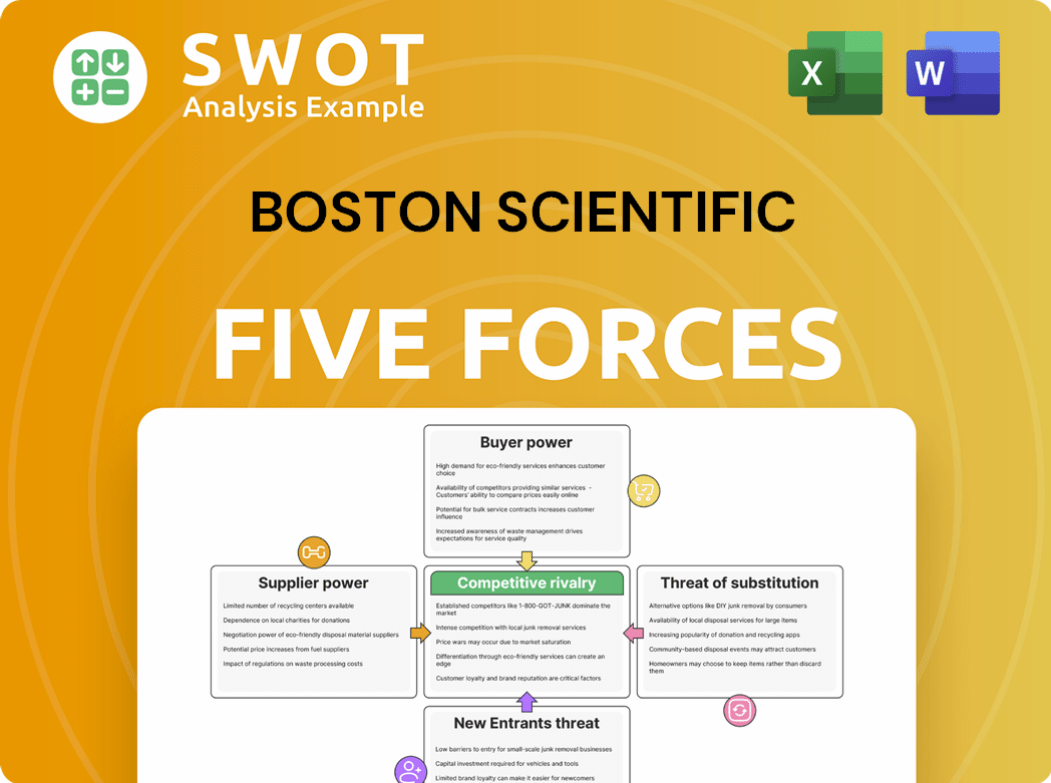
Fully Editable
Tailor To Your Needs In Excel Or Sheets
Professional Design
Trusted, Industry-Standard Templates
Pre-Built
For Quick And Efficient Use
No Expertise Is Needed
Easy To Follow
Boston Scientific Bundle

What is included in the product
 Detailed Word Document
Evaluates control held by suppliers and buyers, and their influence on pricing and profitability.

 Customizable Excel Spreadsheet
A clear summary of Boston Scientific's five forces is presented, enabling rapid strategic assessments.
Preview the Actual Deliverable
Boston Scientific Porter's Five Forces Analysis
This is the complete Boston Scientific Porter's Five Forces analysis. The document provides a thorough examination of the industry's competitive landscape. It assesses threats of new entrants, bargaining power of suppliers and buyers, and competitive rivalry. You get this analysis immediately.

Porter's Five Forces Analysis Template

From Overview to Strategy Blueprint
Boston Scientific operates in a dynamic medical device market, facing intense competition. Supplier power is moderate due to specialized components. Buyer power is also significant given healthcare provider influence. Threat of new entrants is moderate owing to high barriers. Substitutes pose a threat with evolving treatment options. Competitive rivalry is fierce amongst industry leaders.
Ready to move beyond the basics? Get a full strategic breakdown of Boston Scientific’s market position, competitive intensity, and external threats—all in one powerful analysis.
Suppliers Bargaining Power

Supplier Concentration
The bargaining power of suppliers for Boston Scientific is moderately high due to supplier concentration. A limited number of specialized medical device component manufacturers exist, especially those meeting stringent quality standards. Boston Scientific depends on a relatively small number of critical suppliers. In 2024, supply chain disruptions increased costs by 2-3% for medical device companies.
Switching Costs
Switching suppliers for critical medical device components is a costly endeavor, creating a significant barrier. The expenses can range from $1.2 million to $3.7 million per component type. Recertification processes alone can take 12-18 months, adding to the complexity. This high investment increases supplier power.
Dependence on Quality Certifications
Boston Scientific relies on suppliers adhering to strict FDA and ISO standards, which limits the available pool of vendors. This scarcity enhances the bargaining power of certified suppliers. For instance, in 2024, approximately 70% of Boston Scientific's suppliers must meet these high-quality standards, impacting sourcing costs. Maintaining these certifications involves continuous audits and compliance, adding to the complexity and expense of changing suppliers. This dependence influences Boston Scientific's operational costs and supply chain resilience.

Unique Technological Capabilities
Some suppliers, especially those with unique technological capabilities, hold significant bargaining power over Boston Scientific. These suppliers often provide specialized components essential for Boston Scientific's advanced medical devices, creating a dependence. This reliance reduces Boston Scientific's ability to negotiate favorable prices, particularly for cutting-edge technologies. In 2024, Boston Scientific's R&D spending was approximately $1.5 billion, highlighting its reliance on external innovation.
- Exclusive Technology: Suppliers with proprietary technologies have strong negotiation power.
- Innovation Dependence: Boston Scientific relies on these suppliers for crucial components.
- Price Sensitivity: Limited ability to reduce costs due to reliance on unique suppliers.
- R&D Investment: Boston Scientific's high R&D spending underscores this dependency.
Contract Manufacturing
The bargaining power of suppliers, specifically contract manufacturing organizations (CDMOs), has shifted somewhat. This is especially true for CDMOs with expertise in biologics. Companies less reliant on CDMOs often have an advantage due to in-house production control, but this requires significant fixed asset investments. For example, in 2024, the global CDMO market was valued at approximately $180 billion.
- CDMO market growth is projected to reach $275 billion by 2028.
- Biologic drug manufacturing is a high-demand area.
- Companies with in-house production can control costs more effectively.
- Fixed asset investments include manufacturing facilities and equipment.
Supplier Dynamics: Costs & Risks
Boston Scientific's suppliers wield moderate power, especially those with specialized components. Switching suppliers is costly, with expenses up to $3.7M per component. Reliance on FDA/ISO-certified suppliers and proprietary tech strengthens their position.
| Aspect | Details | Impact |
|---|---|---|
| Supplier Concentration | Few specialized manufacturers, high standards. | Increased costs and supply chain risks. |
| Switching Costs | $1.2M-$3.7M, 12-18 months for recert. | High barrier to changing suppliers. |
| R&D Dependence | $1.5B R&D in 2024. | Limits negotiation power. |
Customers Bargaining Power

Concentrated Buyers
Large healthcare providers and Group Purchasing Organizations (GPOs) wield significant bargaining power. They aggregate their purchasing needs, leading to substantial buying volume. This concentration allows them to negotiate favorable pricing terms with Boston Scientific. For instance, GPOs manage approximately 60% of U.S. hospital purchases. Boston Scientific must carefully manage pricing to satisfy these key customers.
Price Sensitivity
Healthcare procurement teams, focused on cost savings, negotiate with vendors, increasing price sensitivity. This pressures Boston Scientific to offer competitive pricing. Rising healthcare costs amplify buyers' efforts to cut expenses, strengthening their bargaining power. In 2024, the US healthcare expenditure is projected to be $4.8 trillion. This creates pressure for cost reductions.

Product Differentiation
Boston Scientific's strong product differentiation, through innovative medical devices, reduces customer bargaining power. Unique technologies and clinical advantages make customers less price-sensitive. For instance, in 2024, their focus on advanced technologies like the FARAPULSE™ PFA System highlights this. Continuous innovation is key to sustaining this edge, as seen in their R&D investments, which were $1.6 billion in 2024.

Demand for Value-Based Pricing
Healthcare providers are increasingly pushing for value-based pricing, requiring Boston Scientific to prove their products' worth. This focus intensifies negotiations, potentially squeezing prices, but also highlights product advantages. Demonstrating clinical and economic value is key in this environment, influencing Boston Scientific's revenue strategies. For example, in 2024, value-based contracts accounted for roughly 40% of healthcare payments.
- Value-based pricing models are gaining traction, with an estimated 45% of US healthcare spending linked to such models by the end of 2024.
- Boston Scientific needs to showcase how its products improve patient outcomes and reduce overall healthcare costs to justify pricing.
- Negotiations with hospitals and insurance companies are becoming more complex, focusing on product efficacy and cost-effectiveness.
- This shift offers an opportunity for Boston Scientific to emphasize its innovation and superior product benefits.
Influence of Telehealth
Telehealth and remote patient monitoring are changing how healthcare is delivered, potentially influencing customer purchasing decisions. As these models evolve, customer needs and priorities shift, impacting their bargaining power. Boston Scientific must adapt its offerings to stay relevant in this changing landscape. In 2024, the telehealth market is projected to reach $62.5 billion, highlighting its growing influence.
- Telehealth's expansion alters customer expectations and choices.
- Changing delivery models may increase customer power.
- Boston Scientific must adjust to new healthcare dynamics.
- The telehealth market reflects the shift in influence.
Buyer Power Dynamics at a Medical Device Giant
Customer bargaining power at Boston Scientific is shaped by the size of buyers and focus on cost reduction. Healthcare providers and GPOs negotiate favorable pricing. The shift towards value-based pricing impacts negotiations.
| Aspect | Details |
|---|---|
| GPO Influence | GPOs manage ~60% of US hospital purchases, impacting pricing. |
| Value-Based Pricing | 40% of healthcare payments were value-based in 2024. |
| R&D Investment | Boston Scientific spent $1.6 billion on R&D in 2024. |
Rivalry Among Competitors

Intense Competition
The medical device industry is fiercely competitive, hosting many companies. This rivalry drives down prices and pushes for more innovation, affecting Boston Scientific's market share. Boston Scientific competes with giants like Medtronic and Abbott. In 2024, Medtronic's revenue was about $32 billion, highlighting the scale of the competition.
Focus on Innovation
Competitive rivalry in the medical device industry compels companies like Boston Scientific to prioritize innovation. This includes developing novel materials and targeting specific medical indications to gain a competitive edge. Stricter regulations in established markets push manufacturers to innovate and provide detailed data. Innovation is a key differentiator; in 2024, Boston Scientific invested $1.4 billion in R&D.

Mergers and Acquisitions
Strategic mergers and acquisitions are significantly altering the competitive environment in the medical device industry. These transactions enable companies to broaden their product lines and gain a foothold in rapidly expanding market areas. Boston Scientific, for example, has been involved in acquisitions such as the purchase of Silk Road Medical for $1.16 billion in 2024, enhancing its competitiveness. These strategic moves are vital for staying ahead.

Geographic Expansion
Geographic expansion fuels competitive rivalry, particularly in high-growth emerging markets like China and India. These regions present substantial opportunities, yet they also intensify competition as companies vie for market share. Boston Scientific's strategies for these markets are critical for sustained growth, given the dynamic nature of these economies. In 2024, Boston Scientific increased its presence in Asia-Pacific, with sales growing by 10% year-over-year in that region.
- Emerging markets offer growth potential.
- Competition intensifies in these regions.
- Boston Scientific's strategies are key.
- Asia-Pacific sales grew by 10% in 2024.
Procedure Demand
The medical device market sees stable demand due to normalized patient and procedure volumes. Companies excelling with diverse portfolios and strategic approaches often outperform competitors. Boston Scientific's commitment to sustainable profitability is key. The company's revenue in Q1 2024 was approximately $3.87 billion, a 10.3% increase. This growth reflects strong market positioning.
- Stable demand supports consistent revenue streams.
- Portfolio strength is crucial in a competitive landscape.
- Boston Scientific's focus on efficiency drives success.
- Q1 2024 revenue increase highlights positive performance.
Medical Device Market Dynamics: Competition and Growth
Intense competition characterizes the medical device sector, affecting profitability. Boston Scientific faces rivals like Medtronic and Abbott, with Medtronic's 2024 revenue at $32B. Strategic moves, including mergers and geographic expansion, shape the market. For instance, Boston Scientific's sales in the Asia-Pacific region grew by 10% in 2024.
| Aspect | Details | Impact |
|---|---|---|
| Key Competitors | Medtronic, Abbott | Market Share Pressure |
| Innovation Spending | Boston Scientific R&D: $1.4B (2024) | Competitive Edge |
| Strategic Actions | Acquisition of Silk Road Medical ($1.16B, 2024) | Portfolio Expansion |
| Regional Growth | Asia-Pacific Sales: +10% (2024) | Increased Market Presence |
SSubstitutes Threaten

Alternative Treatments
The availability of alternative treatments presents a considerable threat to Boston Scientific. Traditional approaches, including pharmaceuticals and lifestyle adjustments, serve as viable substitutes for medical devices. To mitigate this, Boston Scientific must consistently highlight the unique advantages and superior outcomes of its products. In 2024, the global medical device market faced competition from alternative therapies, with some patients opting for less invasive options. Boston Scientific's ability to innovate and differentiate its offerings is crucial to maintain market share against these substitutes.
Non-Invasive Technologies
Non-invasive technologies pose a threat to Boston Scientific. These emerging technologies, like non-invasive glucose monitors from companies such as Know Labs and Afon Technology, can substitute for invasive medical devices. The global non-invasive glucose monitoring market was valued at $18.7 million in 2023. To stay competitive, Boston Scientific must prioritize innovation in response to these developments.

Wearable Devices
Wearable devices and biometric technology are rapidly advancing, posing a threat to Boston Scientific. These devices, capable of diagnosing and managing health, empower consumers. The growing accessibility of Continuous Glucose Monitors (CGMs) creates market opportunities for new entrants, increasing competition. In 2024, the global wearable medical devices market was valued at $27.3 billion.

Telemedicine and Remote Care
Telemedicine and remote care pose a threat to Boston Scientific. These services leverage Internet of Medical Things (IoMT) devices. Such devices enable real-time monitoring and data analysis. Remote patient monitoring (RPM) uses smartwatches and glucose monitors. The global RPM market was valued at $61.9 billion in 2023.
- IoMT devices support home-based treatment.
- RPM offers alternatives to traditional procedures.
- Market growth is driven by technological advancements.
- The shift impacts device sales and procedural volumes.
AI-Driven Diagnostics
AI-driven diagnostics pose a threat to Boston Scientific's traditional methods. These advanced technologies offer improved healthcare through innovative research. Boston Scientific must incorporate AI to stay competitive. The global AI in healthcare market was valued at $12.8 billion in 2023. It's projected to reach $194.4 billion by 2032, showcasing significant growth.
- AI diagnostics can provide faster and more accurate results.
- They can reduce the need for invasive procedures.
- Integration of AI can lead to cost savings.
- Boston Scientific faces competition from AI-focused startups.
Alternatives Reshape the Medical Device Landscape
Substitutes, including pharmaceuticals, lifestyle changes, and non-invasive tech, challenge Boston Scientific. Wearable devices and telemedicine also offer alternatives. To combat this, Boston Scientific must innovate and highlight its products' advantages.
| Type of Substitute | 2023 Market Value (USD) | Impact on Boston Scientific |
|---|---|---|
| Non-invasive Glucose Monitoring | $18.7M | Threatens invasive device sales |
| Wearable Medical Devices | $27.3B (2024 est.) | Creates competition |
| Remote Patient Monitoring | $61.9B | Shifts treatment approaches |
Entrants Threaten

High Capital Requirements
The medical device industry has high capital requirements, a significant barrier for new entrants. Innovation, manufacturing, and clinical trials are costly. Boston Scientific, for example, invested $1.05 billion in R&D in 2023. New firms need substantial funding to compete.
Regulatory Hurdles
Stringent regulatory requirements, like FDA approval, are a major obstacle for new entrants. Compliance is expensive and takes a long time. Boston Scientific has an advantage due to its existing regulatory knowledge and systems. In 2024, FDA approvals can cost companies millions and take years, per industry reports. This advantage helps Boston Scientific.

Technological Expertise
Developing medical devices demands specialized tech expertise, a high barrier for new entrants. Boston Scientific's robust R&D, with $1.3B spent in 2023, offers a key advantage. New firms face the costly and time-consuming task of building such capabilities. This technological edge helps protect Boston Scientific's market position.

Brand Recognition
Boston Scientific benefits from robust brand recognition and customer loyalty, a significant barrier for new entrants. Establishing a reputable brand and cultivating customer trust demands considerable time and financial resources. New competitors face the challenge of substantial investments in marketing and branding efforts to gain market share. This advantage is reflected in their 2024 revenue of approximately $15.2 billion, showcasing their strong market presence.
- Boston Scientific's brand strength deters new competitors.
- Building a strong brand requires time and money.
- Marketing and branding are essential for new entrants.
- 2024 revenue indicates market dominance.
Evolving Technologies
Evolving technologies pose a threat. Digital health advancements lower entry barriers. Chinese companies offer innovative, competitively priced products. Boston Scientific needs to adapt. This is crucial to maintain its market position.
- Digital health market projected to reach $604 billion by 2025.
- Chinese medical device market grew by 16% in 2023.
- Boston Scientific's R&D spending was $1.5 billion in 2024.
Boston Scientific: Navigating Entry Threats
The threat of new entrants is moderate for Boston Scientific. High capital needs and regulations create barriers. Yet, digital health and Chinese competitors pose risks. Boston Scientific must innovate.
| Factor | Impact | Data |
|---|---|---|
| Capital Requirements | High | $1.5B R&D in 2024 |
| Regulatory Hurdles | Significant | FDA approvals cost millions |
| Tech Advancements | Increasing | Digital health market at $604B by 2025 |
Porter's Five Forces Analysis Data Sources
Boston Scientific's analysis uses annual reports, financial data, and industry reports. It also uses market research data to gauge competition accurately.
