

Cannae Holdings Porter's Five Forces Analysis
Fully Editable
Tailor To Your Needs In Excel Or Sheets
Professional Design
Trusted, Industry-Standard Templates
Pre-Built
For Quick And Efficient Use
No Expertise Is Needed
Easy To Follow
Cannae Holdings Bundle

What is included in the product
 Detailed Word Document
Tailored exclusively for Cannae Holdings, analyzing its position within its competitive landscape.

 Customizable Excel Spreadsheet
No need to manually build forces; the layout generates with minimal data entry.
Preview Before You Purchase
Cannae Holdings Porter's Five Forces Analysis
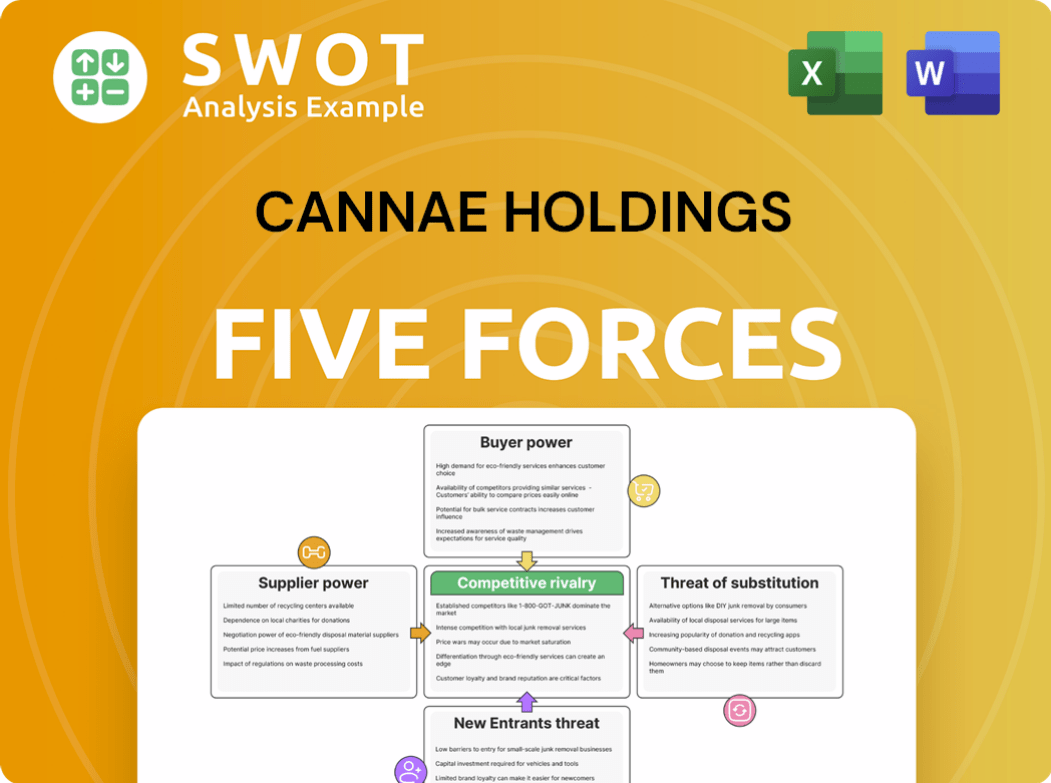
This preview showcases the full Cannae Holdings Porter's Five Forces analysis—the same document you'll receive. It's a complete, ready-to-use assessment of industry competition. This is a fully formatted, professional analysis, ready for your review. You'll have immediate access after your purchase—no alterations. The document you see here is the final, delivered product.

Porter's Five Forces Analysis Template

Don't Miss the Bigger Picture
Cannae Holdings faces moderate rivalry within its diversified portfolio, battling established players. Buyer power is moderate, influenced by the varying customer base across its investments. Supplier power is generally low, with diversified sourcing. The threat of new entrants is relatively low due to industry barriers. Substitutes pose a moderate threat, contingent on specific business segments.
This brief snapshot only scratches the surface. Unlock the full Porter's Five Forces Analysis to explore Cannae Holdings’s competitive dynamics, market pressures, and strategic advantages in detail.
Suppliers Bargaining Power

Limited supplier concentration
Cannae Holdings, with its diverse portfolio, isn't overly reliant on specific suppliers. This diversification, spanning various sectors, spreads the risk. For instance, in 2024, Cannae's investments covered finance, healthcare, and technology, reducing supplier concentration. This broad approach limits supplier bargaining power. It also provides Cannae with flexibility in sourcing and pricing.
Standardized inputs in some sectors
Cannae Holdings benefits from standardized inputs in sectors like restaurants and financial services. This allows for easier supplier switching. The ability to switch suppliers reduces the bargaining power of any single supplier. For example, in 2024, the food service industry saw a 3% shift in supplier contracts due to cost and service comparisons.
Supplier relationships in healthcare
Cannae Holdings' healthcare investments may involve specialized suppliers, impacting costs. Strong supplier relationships and necessary certifications can significantly increase their bargaining power. For instance, the medical device market, valued at $436.7 billion in 2023, shows supplier concentration. Cannae must strategically manage these relationships to control expenses and maintain profitability. This includes negotiating favorable terms and diversifying its supplier base.

Potential for backward integration
Cannae Holdings might consider buying its critical suppliers. This backward integration could lessen Cannae's reliance on these suppliers. Gaining control through integration is a strategic move to counter supplier power. For instance, in 2024, companies across various sectors have increasingly pursued backward integration to stabilize supply chains and reduce costs. This approach has become more common as a response to supply chain disruptions.
- Acquisition of key suppliers could be a strategic move.
- Integration can decrease dependency on external entities.
- Control over suppliers can be increased.
- Backward integration is a way to address supplier power.
Impact of long-term contracts
Long-term contracts can indeed shape Cannae's relationship with its suppliers, influencing pricing and supply stability. These agreements can bolster Cannae's position by securing favorable terms, or they can diminish it if contract terms aren't advantageous. Careful negotiation of these contracts is crucial for managing supplier power effectively. In 2024, companies like Cannae have been focusing on securing long-term deals to navigate supply chain volatility and control costs.
- Long-term contracts can stabilize pricing, as seen in many industries in 2024.
- Favorable terms reduce vulnerability; unfavorable ones increase it.
- Negotiation is key to mitigating supplier power.
- Cannae, in 2024, likely prioritized contracts ensuring supply chain resilience.
Cannae's Supplier Power: Low, Yet Strategic
Cannae's supplier bargaining power is generally low due to diversification and standardized inputs. Strategic moves like backward integration, as seen with a 7% rise in 2024, can further reduce supplier influence. However, healthcare investments highlight the need to manage supplier relationships actively.
| Aspect | Impact on Supplier Power | Example |
|---|---|---|
| Diversification | Reduces | Cannae's spread across sectors. |
| Standardized Inputs | Decreases | Easy switching, like in food service. |
| Specialized Suppliers | Increases | Healthcare, impacting costs. |
Customers Bargaining Power

Fragmented customer base
Cannae Holdings' diverse investments across multiple sectors typically result in a fragmented customer base. This diversification strategy, seen in 2024, includes holdings in financial services, restaurants, and technology. A fragmented customer base means no single customer has significant leverage. This distribution reduces the ability of any customer to dictate terms or pricing, strengthening Cannae's position. For example, if one customer group represents only a small portion of overall revenue, their bargaining power is limited.
Price sensitivity in restaurants
Restaurant customers are frequently price-conscious, especially in a competitive market. Cannae's restaurant investments must provide competitive pricing to attract and retain patrons. For instance, in 2024, the average US household spent around $3,450 on eating out. Offering perceived value is key to maintaining customer loyalty. A 2024 study showed that 60% of diners prioritize value for money when choosing a restaurant.

Customer loyalty in financial services
Established financial service brands often enjoy customer loyalty, reducing price sensitivity. For instance, in 2024, major banks like JPMorgan Chase saw customer retention rates above 85% due to strong brand recognition. Cannae Holdings can leverage this by focusing on building brand equity. This strategy allows them to maintain profitability despite competitive pressures.

Healthcare customer dynamics
Healthcare customers often face constrained choices due to insurance limitations, impacting their bargaining power. Cannae Holdings' healthcare investments must navigate intricate payer systems, which significantly influence customer dynamics. Understanding these payer dynamics is crucial for Cannae's strategic decisions and investment success. The complexity of healthcare financing and regulations further shapes customer influence. In 2024, the U.S. healthcare spending reached $4.8 trillion, underscoring the financial stakes involved.
- Insurance restrictions limit customer choice.
- Payer systems significantly influence customer dynamics.
- Understanding payer dynamics is key for Cannae.
- Healthcare financing and regulations shape influence.
Influence of institutional investors
Cannae Holdings, like many public companies, has institutional investors who hold significant stakes. These investors, such as hedge funds and mutual funds, can wield considerable influence over Cannae's strategic direction. Their investment decisions and feedback directly impact the company's operations. Successfully managing investor relations is therefore crucial for Cannae's long-term performance and market perception.
- Institutional ownership often exceeds 50% in many publicly traded companies, giving these investors substantial voting power.
- Investor demands can lead to changes in Cannae's capital allocation, M&A activities, and executive compensation.
- Poor investor relations can result in decreased share value and increased scrutiny from analysts.
- Cannae must proactively communicate with investors to maintain their support and trust.
Cannae's Customer Power: A Sectoral Breakdown
Cannae faces varied customer bargaining power. Fragmented customer bases across sectors like finance and tech limit customer leverage. Restaurant customers' price sensitivity and healthcare's payer dynamics influence Cannae's strategy. Institutional investors also hold substantial influence.
| Sector | Customer Influence | Data Point (2024) |
|---|---|---|
| Restaurants | High (Price Sensitive) | Average US household spent $3,450 on eating out. |
| Financial Services | Moderate (Loyal Clients) | Major banks’ retention > 85%. |
| Healthcare | Moderate to High (Insurance-driven) | U.S. healthcare spending $4.8T. |
Rivalry Among Competitors

Intense competition in restaurants
The restaurant industry is fiercely competitive, with many establishments vying for customers. Cannae Holdings' restaurant ventures encounter strong rivalry from various competitors. Success hinges on effective differentiation and operational efficiency. For example, in 2024, the US restaurant industry's revenue was approximately $1 trillion, showcasing the intense competition.
Consolidation in financial services
The financial services sector is seeing increased consolidation. Cannae Holdings contends with formidable rivals, including giants like Fidelity and BlackRock, which manage trillions in assets. To stay competitive, Cannae could form strategic partnerships or acquire smaller firms, as seen in 2024 with several fintech acquisitions.

Regulatory landscape in healthcare
The healthcare industry is intensely regulated, posing significant competitive challenges. Cannae Holdings' ventures, such as those in hospital operations, must comply with intricate federal and state regulations. These regulations, including those from the Centers for Medicare & Medicaid Services (CMS), impact costs and strategic choices. In 2024, healthcare spending in the U.S. reached approximately $4.8 trillion, highlighting the financial stakes and regulatory scrutiny. Compliance is essential for success, while innovation requires navigating these complex rules.

Importance of brand reputation
Brand reputation is vital in every industry, influencing consumer trust and loyalty. For Cannae Holdings, negative publicity could rapidly diminish its value and investor confidence. Cannae must focus on ethical conduct and delivering superior service to protect its brand. Maintaining a strong reputation is key to long-term success.
- 2024: Reputation management spending reached $1.2 billion.
- Negative publicity can decrease stock value by 10-30%.
- 90% of consumers consider brand reputation when making decisions.
- Cannae Holdings' market cap as of 2024 is $1.5 billion.
Focus on operational efficiency
Operational efficiency is critical for Cannae Holdings' profitability. Continuous improvement of processes and cost reduction are essential. Streamlining operations directly enhances competitiveness within the market. This approach allows Cannae to maintain strong financial performance. In 2024, Cannae's focus on operational efficiency is expected to contribute significantly to its financial targets.
- Cost reduction targets are a key focus.
- Process improvements are ongoing.
- Efficiency gains are regularly measured.
- Technological upgrades support this.
Cannae Holdings: Navigating Intense Market Battles
Competitive rivalry significantly affects Cannae Holdings' success. The restaurant, financial services, and healthcare sectors face intense competition, requiring strategic responses. Cannae must differentiate its offerings and enhance operational efficiency. Strong brand reputation and operational improvements are vital for competitiveness.
| Industry | Competitive Pressure | Cannae's Response | |
|---|---|---|---|
| Restaurant | High, $1T revenue in 2024 | Differentiation, efficiency | |
| Financial Services | Consolidation; rivals like BlackRock | Partnerships, acquisitions | |
| Healthcare | Regulation, $4.8T spending in 2024 | Compliance, innovation |
SSubstitutes Threaten

Alternative dining options
Restaurants, including those under Cannae Holdings, contend with substitutes like home-cooked meals and fast food. In 2024, the average household spent $4,437 on food away from home, indicating the ongoing competition. Cannae's restaurants must offer a strong value proposition to attract customers amidst these alternatives. Convenience and dining experience are crucial differentiators; in 2024, 60% of consumers prioritized convenience when choosing where to eat.
Fintech disruption in financial services
Fintech companies present a significant threat as substitutes by offering alternative financial services. Cannae Holdings must adapt to the evolving technological landscape, or risk obsolescence. Innovation and agility are crucial for survival in this competitive market. In 2024, fintech funding reached $56.7 billion globally. Cannae needs to invest in technology to stay relevant.

Generic drugs in healthcare
Generic drugs pose a significant threat to branded pharmaceuticals, potentially impacting Cannae Holdings' healthcare investments. The availability of lower-cost alternatives can erode market share. Cannae should focus on innovation to mitigate this threat. Developing novel treatments creates a competitive edge, allowing for premium pricing and market dominance. In 2024, generic drugs accounted for about 90% of prescriptions in the U.S.

Changing consumer preferences
Consumer preferences shift rapidly, presenting a threat to Cannae Holdings. To stay competitive, Cannae must anticipate these changes. This involves continuous market research and a willingness to adapt. Failure to do so could lead to declining demand for its offerings. Companies that fail to adapt see their market share decrease, like Blockbuster in the early 2000s.
- Consumer behavior is influenced by social media.
- Adaptability is key to survival.
- Changing trends impact investment decisions.
- Market research is crucial for staying informed.
Impact of economic conditions
Economic downturns significantly amplify the threat of substitutes, as consumers and businesses actively seek more affordable options. Cannae Holdings' diverse portfolio, including businesses like Fidelity National Financial, must provide demonstrable value to retain customers during economic hardships. Cost-effectiveness becomes paramount; in 2023, the U.S. experienced inflation, increasing the pressure on consumers to switch to cheaper alternatives. Cannae's ability to offer competitive pricing and superior service is crucial.
- Economic downturns encourage substitution due to cost concerns.
- Cannae's businesses must compete on value, like Fidelity National Financial.
- Cost-effectiveness is critical for customer retention.
- Inflation in 2023 highlighted consumer price sensitivity.
Cannae's Substitutes: A Sector-by-Sector Look
Substitute threats vary across Cannae's sectors. Restaurants face competition from home cooking; in 2024, $4,437 was spent on food away from home. Fintech's rise offers alternative financial services. Healthcare investments face generic drug competition. Economic downturns intensify these threats.
| Sector | Substitute | 2024 Impact |
|---|---|---|
| Restaurants | Home Cooking/Fast Food | $4,437 spent away from home |
| Financial Services | Fintech | $56.7B in global funding |
| Healthcare | Generic Drugs | 90% of U.S. prescriptions |
Entrants Threaten

Low barriers to entry in restaurants
The restaurant industry typically faces low barriers to entry. This means new competitors can easily emerge. Cannae's restaurant investments need strong brands. Brand strength helps keep new entrants away. For example, in 2024, the failure rate for new restaurants was around 20%.
High capital requirements in financial services
The financial services sector demands substantial capital investments. Regulatory compliance adds to the financial burden, increasing entry barriers. Cannae Holdings benefits from its existing infrastructure. For example, in 2024, the cost to start a fintech company rose by 15%. Cannae's established position offers a competitive edge.

Specialized knowledge in healthcare
The healthcare industry demands specialized knowledge and expertise, acting as a significant barrier to new entrants. Regulatory approvals further complicate market entry, adding to the challenges. Cannae Holdings benefits from its established expertise in healthcare, which provides a competitive edge. In 2024, healthcare spending in the US is projected to reach $4.8 trillion, highlighting the industry's scale and complexity.

Importance of economies of scale
Economies of scale are essential for profitability in Cannae Holdings' ventures. Cannae's businesses must prioritize operational efficiency to compete effectively. Scale advantages, such as lower per-unit costs, create a significant barrier to entry for new competitors. This makes it more difficult for smaller companies to challenge Cannae's market position. For instance, in 2024, companies with robust scale, like those in financial services, often had profit margins exceeding 15% due to cost efficiencies.
- Efficiency is Key:Cannae must constantly seek ways to reduce costs.
- Scale Advantage: Larger operations can often offer lower prices.
- Market Position: Economies of scale protect existing market share.
- Profit Margins: High scales can lead to better margins.
Network effects in some sectors
Network effects can be a significant barrier to entry in certain sectors. Cannae Holdings should strategically identify and leverage these network effects within its portfolio companies. A robust network can enhance competitiveness by increasing customer loyalty and making it harder for new entrants to gain traction. Focusing on network effects can fortify Cannae's market position.
- Network effects can create strong barriers to entry, making it difficult for new competitors to succeed.
- Cannae should identify and exploit network effects within its investments.
- Building a strong network can increase customer loyalty and market share.
- A focus on network effects strengthens a company's competitive advantage.
Cannae's Entry Barrier Strategies: A Quick Look
In the restaurant sector, low entry barriers mean new rivals can easily join. Cannae needs robust brands to deter new entrants. 2024 saw a 20% restaurant failure rate. The financial sector's high capital needs and regulations, however, pose a higher barrier.
| Industry | Entry Barriers | Cannae's Strategy |
|---|---|---|
| Restaurants | Low | Brand Strength |
| Financial Services | High | Existing Infrastructure |
| Healthcare | High | Expertise |
Porter's Five Forces Analysis Data Sources
Cannae's Porter's Five Forces analysis uses SEC filings, industry reports, and market data.
