

Carlisle Companies Porter's Five Forces Analysis
Fully Editable
Tailor To Your Needs In Excel Or Sheets
Professional Design
Trusted, Industry-Standard Templates
Pre-Built
For Quick And Efficient Use
No Expertise Is Needed
Easy To Follow
Carlisle Companies Bundle

What is included in the product
 Detailed Word Document
Evaluates control held by suppliers and buyers, and their influence on pricing and profitability.

 Customizable Excel Spreadsheet
Customize pressure levels based on new data or evolving market trends.
Same Document Delivered
Carlisle Companies Porter's Five Forces Analysis
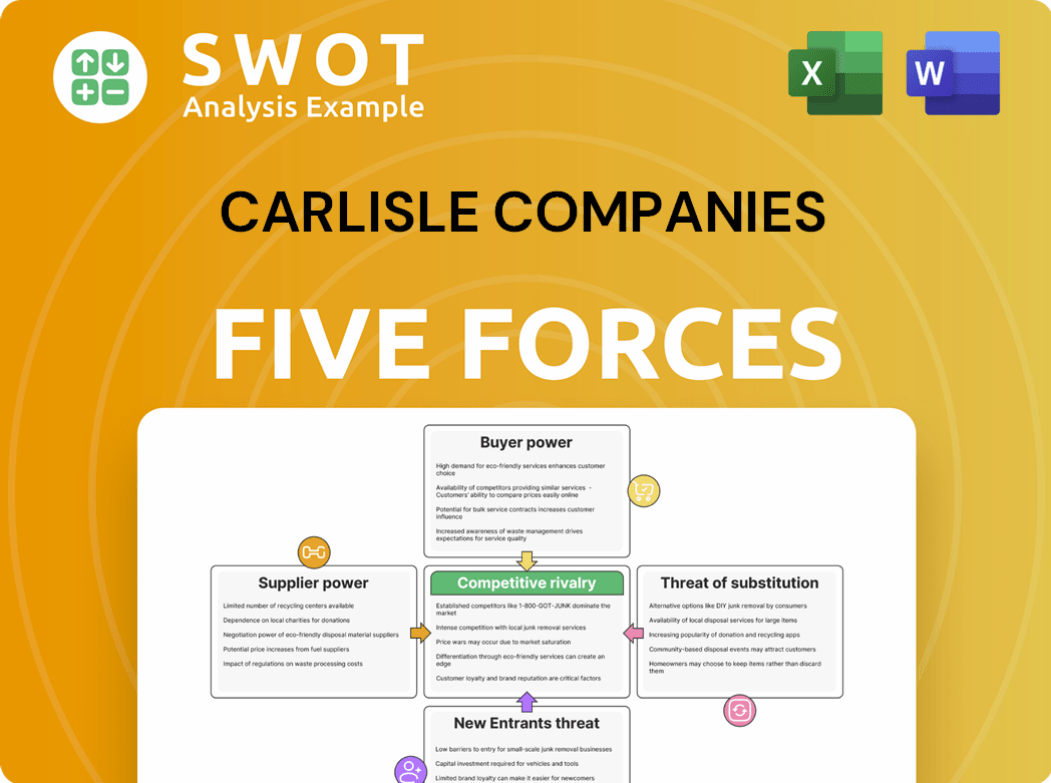
This preview provides a full Porter's Five Forces analysis of Carlisle Companies, identical to the one you'll receive. It examines industry competition, supplier power, and buyer power. Also, the threat of substitutes and new entrants will be evaluated. Upon purchase, you get this complete, ready-to-use document.

Porter's Five Forces Analysis Template

Go Beyond the Preview—Access the Full Strategic Report
Analyzing Carlisle Companies through Porter's Five Forces reveals a dynamic competitive landscape. The industry's rivalry, influenced by key players, shapes pricing and innovation. Supplier power impacts costs, while buyer power influences margins. Threats from new entrants and substitutes constantly challenge Carlisle's market position.
This brief snapshot only scratches the surface. Unlock the full Porter's Five Forces Analysis to explore Carlisle Companies’s competitive dynamics, market pressures, and strategic advantages in detail.
Suppliers Bargaining Power

Supplier Concentration
Supplier concentration significantly impacts Carlisle's operations. If crucial components come from a few suppliers, their power increases. For instance, a concentrated market for specialized adhesives could give suppliers leverage. In 2024, Carlisle's ability to negotiate prices depends on supplier options. The cost of switching suppliers is a critical factor.
Input Material Uniqueness
Carlisle faces higher supplier power when input materials are unique. Specialized or proprietary components, like those used in their building products, give suppliers leverage. For example, in 2024, Carlisle's Construction Materials segment relied on specific chemical suppliers. The difficulty in finding substitutes allows these suppliers to negotiate favorable terms.
Switching Costs for Carlisle
Switching costs are critical for Carlisle Companies when evaluating supplier power. If Carlisle switched suppliers, it would incur expenses like new equipment, retraining, and integration challenges. High switching costs amplify supplier power, as Carlisle's dependence on existing suppliers grows. For example, in 2024, Carlisle's capital expenditures were approximately $250 million, indicating significant investment in specialized equipment tied to specific suppliers.

Supplier Forward Integration
Suppliers could move into Carlisle's business, becoming competitors. This could limit Carlisle's access to essential supplies. This forward integration could ramp up competition. It is crucial to evaluate how likely this is and what effect it might have. For example, in 2024, the construction materials market, a key area for Carlisle, saw shifts in supplier dynamics due to consolidation.
- Supplier forward integration threatens Carlisle's supply chain.
- Increased competition could lower Carlisle's profitability.
- The risk level depends on supplier market power.
- Monitor supplier strategies and market trends.
Impact of Inputs on Quality
Carlisle Companies' product quality hinges on its inputs, making supplier quality crucial. Suppliers of high-grade materials, vital for product performance, wield significant power, particularly in industries with strict quality benchmarks. Consider Carlisle's Construction Materials segment, where the consistency of roofing materials is paramount. In 2024, Carlisle reported that raw material costs significantly impacted its gross profit margins.
- High-quality inputs are essential for maintaining Carlisle's product standards.
- Suppliers of critical, high-grade materials have greater bargaining power.
- Industries with stringent quality requirements increase supplier influence.
- In 2024, raw material costs affected Carlisle's gross profit margins.
Supplier Dynamics Impacting Pricing
Supplier concentration affects Carlisle's pricing power. Unique input materials, like specialized chemicals, give suppliers leverage. High switching costs, such as investment in specific equipment, also bolster supplier power. In 2024, raw material costs affected gross profit margins.
| Factor | Impact | 2024 Example |
|---|---|---|
| Supplier Concentration | Increases Supplier Power | Specialized adhesives market |
| Unique Inputs | Enhances Supplier Leverage | Chemicals for Construction Materials |
| Switching Costs | Amplifies Supplier Power | $250M CapEx in equipment |
Customers Bargaining Power

Customer Concentration and Volume
The bargaining power of Carlisle's customers is amplified if sales depend heavily on a few large buyers. These key customers can then demand lower prices or better terms. In 2023, a significant portion of Carlisle's revenue came from a concentrated customer base, increasing their negotiating leverage. Analyzing the sales distribution and volume purchased by top clients is crucial. For example, if the top 10 customers account for over 50% of sales, customer power is high.
Product Differentiation Impact
If Carlisle's products stand out, customers find fewer choices, lowering their power. Carlisle's strong brand and unique features make customers less sensitive to price changes. For instance, Carlisle's 2024 revenue reached $6.4 billion, indicating its market strength. This differentiation helps maintain pricing power.

Customer Switching Costs
Low switching costs boost buyer power. Customers easily shifting to rivals exert leverage. Analyze factors impacting loyalty and switching costs. In 2024, industry data showed average switching costs at $50-$100 for similar products. High customer loyalty decreases buyer power.

Customer Information Availability
Customers' bargaining power rises with information access regarding pricing and product performance. Market transparency enables customers to negotiate favorable terms. Carlisle's customers, armed with data, can compare offerings. This impacts Carlisle's pricing strategies and profit margins.
- Increased competition due to readily available information can pressure Carlisle to offer competitive pricing.
- Customers' ability to easily compare Carlisle's products against competitors' can decrease brand loyalty.
- In 2024, the construction industry saw a 5% increase in online product comparison tools, potentially increasing customer bargaining power.
Price Sensitivity of Buyers
The price sensitivity of Carlisle's customers significantly impacts their bargaining power. Customers become more assertive in price negotiations when they are highly price-sensitive, potentially squeezing Carlisle's profits. Economic downturns, such as the slowdown in construction in 2023-2024, can heighten price sensitivity. This is especially true for customers in industries like construction materials.
- Economic conditions, like the 2023-2024 slowdown in construction, increase price sensitivity.
- Customers in construction materials are particularly price-sensitive.
- High price sensitivity leads to greater customer bargaining power.
- This pressure can reduce Carlisle's profit margins.
Buyer Power Dynamics: 2024 Insights
Customer bargaining power at Carlisle hinges on factors like buyer concentration and product differentiation. Concentrated customer bases amplify buyer leverage, while unique products diminish it. In 2024, market transparency and customer price sensitivity also influenced negotiations.
| Factor | Impact on Power | 2024 Data |
|---|---|---|
| Customer Concentration | High concentration boosts power | Top 10 customers: 45% of sales |
| Product Differentiation | Strong differentiation lowers power | Carlisle’s revenue reached $6.4B |
| Price Sensitivity | High sensitivity boosts power | Construction slowdown in 2024 (2%) |
Rivalry Among Competitors

Industry Concentration and Balance
High industry concentration usually lowers rivalry, whereas fragmentation boosts it. The competitive balance matters; firms of similar size might compete harder. In 2024, Carlisle Companies showed a moderate concentration in its key markets, with the top 4 players holding about 60% of the market share. This balance, along with the presence of several smaller competitors, indicates a moderate level of competitive rivalry.
Industry Growth Rate
Slow industry growth often makes competition fiercer as companies battle for market share. Rapid growth, however, can ease rivalry, providing opportunities for all. Carlisle Companies operates in diverse markets, including construction materials and aerospace, with varying growth rates. For example, the global construction market is projected to grow, but at a moderate pace. The aerospace sector shows more volatility but also growth potential.

Product Differentiation
Low product differentiation amplifies competitive rivalry. Industries with similar offerings see price wars and squeezed margins. Carlisle's segments, like building products, may face this challenge. In 2023, Carlisle reported $6.2 billion in net sales, showing its scale within potentially competitive markets.

Exit Barriers
High exit barriers intensify competitive rivalry. These barriers, like specialized assets, keep struggling firms in the market. Analyze these barriers within Carlisle's sectors for a clearer view. This directly impacts competition dynamics, influencing strategic decisions. Consider the impact on Carlisle's profitability and market position.
- Specialized Assets: Investments in specific equipment or facilities can make it costly for Carlisle to leave a market.
- Contractual Obligations: Long-term contracts with suppliers or customers might hinder Carlisle's exit strategy.
- Government Regulations: Compliance costs and exit requirements could be substantial in certain regions.
- Economic Dependence: If Carlisle's operations are crucial to a local economy, exiting might be difficult.
Fixed vs. Variable Costs
High fixed costs can intensify competition. This happens because companies aim to spread these costs across more units, potentially triggering price wars. Analyzing Carlisle and its rivals' cost structures is crucial for understanding this dynamic. For instance, in 2024, Carlisle's selling and administrative expenses were around $420 million. These costs, which are partially fixed, influence pricing strategies and competitive behavior.
- Carlisle's fixed costs include manufacturing facility expenses and some administrative costs.
- Competitors with similar cost structures might engage in aggressive pricing to maintain market share.
- Variable costs like raw materials also influence pricing, but fixed costs create more pressure.
- Understanding these costs helps assess the potential for price competition within the industry.
Carlisle's Competitive Landscape: A Balanced View
Competitive rivalry for Carlisle Companies is moderate. Market concentration and the presence of smaller firms suggest balanced competition. The company operates in markets with varying growth rates, impacting rivalry dynamics.
Product differentiation influences pricing strategies; Carlisle's $6.2B in 2023 sales reflect its scale. Exit barriers, such as specialized assets, affect competitive intensity within its sectors. High fixed costs, like $420M in 2024 selling/admin expenses, drive price competition.
| Factor | Impact on Rivalry | Carlisle's Context |
|---|---|---|
| Market Concentration | Moderate impact | Top 4 players hold ~60% market share |
| Industry Growth | Varies by market | Construction (moderate), Aerospace (volatile) |
| Product Differentiation | High rivalry with low differentiation | Building products segment |
SSubstitutes Threaten

Availability of Substitutes
The threat of substitutes for Carlisle Companies is moderate. This is because customers have options like different roofing materials or insulation types. For instance, in 2024, the global roofing market was valued at approximately $100 billion, with various materials competing. The availability of these alternatives means Carlisle must continually innovate and maintain competitive pricing.
Relative Price Performance
The threat of substitutes for Carlisle Companies is influenced by price-performance. If substitutes offer better value, the threat rises. Customers switch when substitutes provide similar benefits at a lower cost. For instance, in 2024, alternative building materials like composites showed competitive pricing. This shift impacts Carlisle's profitability.

Switching Costs for Buyers
Low switching costs amplify the threat of substitutes for Carlisle Companies' customers. If alternatives are readily available, clients may switch due to price hikes or quality concerns. Analyze costs and efforts for customers to change suppliers. In 2024, the building products sector faced increased competition.

Buyer Propensity to Substitute
Buyer propensity to substitute examines customers' willingness to switch to alternatives. Even with substitutes, factors like habit or brand loyalty can deter switching. This is crucial for Carlisle Companies, as it impacts pricing power and market share. Understanding these dynamics helps in strategy formulation.
- Brand loyalty significantly reduces substitution.
- Perceived risk of switching can also limit substitution.
- In 2024, Carlisle's strong brand helped maintain customer retention.
- Analyze competitor actions in this area.
Innovation in Other Industries
Innovation in other industries poses a threat by creating new substitutes for Carlisle Companies' products. Technological advancements and emerging trends should be closely monitored for disruptive potential. For example, the rise of alternative materials could impact Carlisle's building products division. Consider potential indirect substitutes, such as digital solutions replacing physical components. This proactive stance is crucial to mitigate risks and capitalize on opportunities.
- The global construction market, a key area for Carlisle, was valued at $11.5 trillion in 2023.
- The rise of 3D printing in construction represents a potential substitute threat.
- Digital twins and virtual design tools could indirectly substitute some of Carlisle's offerings.
- Carlisle's revenue in 2023 was approximately $6.6 billion.
Substitutes Pose Moderate Threat to Roofing Market
The threat of substitutes for Carlisle Companies is moderate, affected by price-performance and switching costs. Customers might switch to alternative materials if they offer better value or lower costs. Analyzing buyer behavior and competitor actions is crucial. In 2024, the global roofing market was around $100B.
| Factor | Impact | 2024 Data |
|---|---|---|
| Price-Performance | High if substitutes offer better value | Alternative materials like composites offer competitive pricing |
| Switching Costs | Low costs amplify the threat | Building products sector faced increased competition |
| Buyer Propensity | Influenced by brand loyalty | Carlisle's strong brand helped retain customers |
Entrants Threaten

Barriers to Entry
High barriers to entry limit new competitors, decreasing the threat. Carlisle faces barriers such as significant capital needs and proprietary tech. In 2023, Carlisle's R&D spending was $45.7 million, indicating tech focus. These barriers help protect its market position.
Economies of Scale
If established firms have economies of scale, new entrants face cost challenges. Carlisle, with its size, likely benefits from cost advantages, like bulk purchasing. In 2023, Carlisle's net sales were approximately $6.4 billion, showing its scale. Competitors with similar scale can better withstand new entry threats.

Capital Requirements
High capital needs are a barrier to new competitors. Carlisle's sectors require large investments in manufacturing plants and research. For instance, in 2024, Carlisle's capital expenditures were substantial, reflecting its asset-intensive operations. These high upfront costs make it hard for new firms to join the market.

Access to Distribution Channels
New entrants to Carlisle Companies face distribution hurdles. Established firms like Carlisle often control essential distribution networks, limiting newcomers' reach. This control makes it tough for new competitors to get their products to consumers effectively. The difficulty in securing distribution impacts the ability to compete. Consider the costs of setting up a new distribution system.
- Carlisle's revenue in 2023 was approximately $6.2 billion.
- The company operates through various distribution channels including direct sales and partnerships.
- New entrants might struggle to match Carlisle's established distribution network.
- High capital investment is needed for setting up a distribution network.
Government Policies
Government policies play a crucial role in shaping the threat of new entrants for Carlisle Companies. Regulations, subsidies, and trade barriers can either ease or hinder market entry. Favorable policies can incentivize new competitors, while restrictive ones can act as barriers. Carlisle must carefully analyze the regulatory landscape in its key markets to assess this threat.
- In 2024, regulatory changes in the construction and aerospace industries, where Carlisle operates, could impact entry barriers.
- Subsidies for sustainable building materials might attract new entrants.
- Trade barriers, like tariffs, can protect existing players.
- Carlisle's ability to navigate these policies will influence its competitive position.
New Entrants' Challenge: Moderate Threat
The threat of new entrants for Carlisle Companies is moderate. High capital investments and established distribution networks pose barriers. Government policies and regulations also impact market entry.
| Factor | Impact | Data |
|---|---|---|
| Capital Needs | High barrier | Carlisle's 2024 CapEx: substantial |
| Distribution | Significant hurdle | Carlisle uses direct sales, partnerships |
| Government Policy | Can be a barrier or incentive | Regulatory changes in 2024 affect barriers |
Porter's Five Forces Analysis Data Sources
The Carlisle Companies Porter's analysis leverages financial reports, market research, and competitor analysis. SEC filings and industry publications provide further insights.
