

CF Industries Holdings Porter's Five Forces Analysis
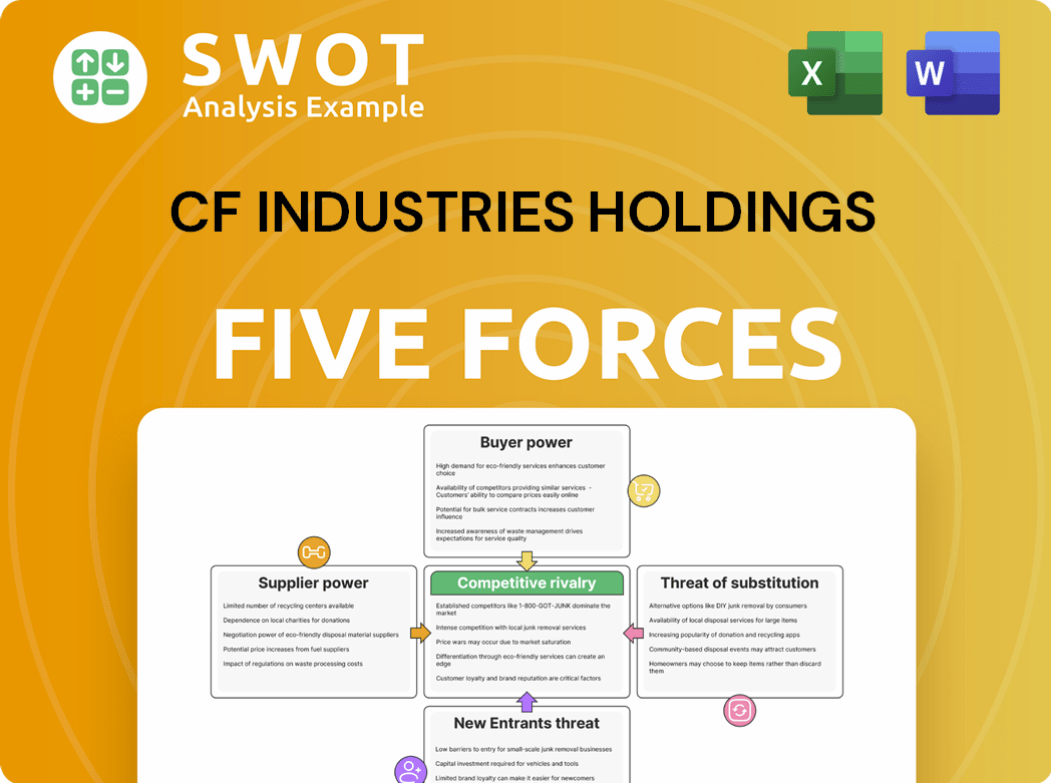
Fully Editable
Tailor To Your Needs In Excel Or Sheets
Professional Design
Trusted, Industry-Standard Templates
Pre-Built
For Quick And Efficient Use
No Expertise Is Needed
Easy To Follow
CF Industries Holdings Bundle

What is included in the product
 Detailed Word Document
Analyzes CF Industries' competitive environment, detailing supplier/buyer power, and barriers to entry.

 Customizable Excel Spreadsheet
Customize Porter's Five Forces pressure levels to reflect evolving market dynamics.
Same Document Delivered
CF Industries Holdings Porter's Five Forces Analysis
You're previewing the final version—precisely the same document that will be available to you instantly after buying. This CF Industries Holdings Porter's Five Forces analysis assesses industry rivalry, supplier power, buyer power, threat of substitutes, and threat of new entrants. Each force is thoroughly examined, providing a comprehensive overview. The analysis includes detailed insights, ensuring you receive a complete and ready-to-use document.

Porter's Five Forces Analysis Template

Don't Miss the Bigger Picture
CF Industries Holdings operates in an industry significantly impacted by the bargaining power of buyers and suppliers. The threat of new entrants is moderate due to high capital requirements and regulatory hurdles. Competitive rivalry is intense, driven by a few major players vying for market share. The availability of substitute products poses a limited threat.
This brief snapshot only scratches the surface. Unlock the full Porter's Five Forces Analysis to explore CF Industries Holdings’s competitive dynamics, market pressures, and strategic advantages in detail.
Suppliers Bargaining Power

Supplier Concentration
In the fertilizer industry, supplier concentration is a significant factor. Suppliers of essential inputs like natural gas can wield considerable power. CF Industries, while having access to North American natural gas, faces vulnerability due to reliance on key suppliers. Natural gas prices fluctuated significantly in 2024. A long-term contract with a fixed price for natural gas is critical.
Input Cost Volatility
Input cost volatility, especially for natural gas, significantly affects supplier power in CF Industries. Decarbonization efforts may lessen reliance on fossil fuels. Managing this volatility via hedging and operational strategies is key. In 2024, natural gas prices fluctuated, impacting CF's cost structure. CF's 2023 annual report highlights the impact of raw material costs on profitability.
Switching Costs
CF Industries' supplier power hinges on switching costs. If changing suppliers is tough, like with unique inputs, suppliers gain power. However, CF Industries can lessen this by using flexible production or having multiple suppliers. In 2024, the company spent approximately $3.5 billion on raw materials, highlighting the impact of supplier costs.

Supplier Forward Integration
Supplier forward integration, though not a major issue, poses a risk to CF Industries. Suppliers entering the fertilizer market directly could increase their power. This potential threat requires careful monitoring of supplier activities. Strengthening relationships with downstream customers is a key countermeasure.
- 2024 saw no major instances of supplier forward integration in the fertilizer market.
- CF Industries' strong distribution network somewhat mitigates this risk.
- Monitoring raw material suppliers' strategic moves is crucial.
Geopolitical Factors
Geopolitical factors significantly influence supplier power, potentially disrupting CF Industries' supply chains. Events like the Russia-Ukraine war have created volatility in the global fertilizer market, impacting key input prices such as natural gas. Trade restrictions or sanctions can limit the availability of essential materials, increasing costs and reducing bargaining leverage. To counter these risks, CF Industries focuses on geographical diversification and strategic reserve management, as evidenced by their global operations and supply agreements.
- Russia, a major fertilizer exporter, faced sanctions, impacting global supply chains.
- Natural gas price volatility affects fertilizer production costs.
- CF Industries operates globally to diversify supply sources.
- Strategic reserves help buffer against supply disruptions.
Navigating Supplier Power: A Strategic Overview
CF Industries faces supplier power primarily through natural gas, a key input. Natural gas price volatility, as seen in 2024, impacts costs significantly. Strategic measures such as geographical diversification are essential to manage supplier risks.
| Aspect | Impact | 2024 Data |
|---|---|---|
| Natural Gas Price Volatility | Significant cost fluctuation | Prices fluctuated, affecting production costs. |
| Supplier Concentration | High for key inputs | Raw material costs about $3.5 billion in 2024. |
| Geopolitical Risks | Supply chain disruptions | Sanctions impacted fertilizer exports. |
Customers Bargaining Power

Customer Concentration
Customer concentration affects CF Industries. A few large buyers could pressure prices, impacting profits. CF Industries must diversify its customer base. In 2024, key customers could negotiate lower prices due to their buying power. Building strong relationships with various customers is crucial for stability.
Price Sensitivity
Farmers' price sensitivity significantly influences their bargaining power in the agricultural market. Their ability to switch to cheaper fertilizers or decrease usage directly impacts CF Industries' pricing strategies. Offering value-added products, like enhanced efficiency fertilizers, can help reduce this sensitivity. In 2024, fertilizer prices saw fluctuations; for example, ammonia prices ranged from $500-$800 per ton, reflecting customer price sensitivity.

Availability of Information
Customers armed with market insights can negotiate better deals. Pricing and market trends transparency give customers power. CF Industries can counter this with superior customer service and tailored solutions. In 2024, the average ammonia price was around $550 per tonne, demonstrating price sensitivity. This highlights the importance of customer relationship management.

Switching Costs
Switching costs significantly impact customer bargaining power within the fertilizer industry. Low switching costs empower customers, enabling them to easily shift between suppliers like CF Industries. This increases price sensitivity and reduces CF Industries' ability to maintain high margins. Building strong relationships and offering value-added services can raise these costs.
- In 2024, the average cost of anhydrous ammonia, a key CF Industries product, fluctuated, reflecting the impact of customer switching.
- Farmers can switch to alternative fertilizers like urea or ammonium nitrate, especially if prices are more favorable.
- Offering agronomic advice and customized fertilizer blends can increase customer loyalty and switching costs.
- CF Industries reported revenues of $6.8 billion in 2024, showing the importance of customer relationships.
Product Differentiation
For CF Industries, the bargaining power of customers is amplified by the limited product differentiation in commodity fertilizers. Because these products are largely similar, customers can easily switch suppliers based on price. This dynamic intensifies price competition. To mitigate this, CF Industries has invested in differentiated products.
- In 2023, CF Industries reported a net sales of $7.1 billion.
- The company has focused on innovative products like low-carbon ammonia.
- This strategy aims to reduce customer price sensitivity.
- Investing in these products helps to create more value.
Buyer Power: How It Shapes Fertilizer Prices
Customer bargaining power significantly impacts CF Industries. Key buyers can pressure prices. Farmers' price sensitivity and switching options influence their power. Differentiated products and strong customer relationships help counter this.
| Factor | Impact | 2024 Data |
|---|---|---|
| Customer Concentration | High concentration increases bargaining power. | Top 10 customers accounted for a significant portion of sales. |
| Price Sensitivity | Influences fertilizer demand and pricing. | Ammonia prices ranged $500-$800/ton. |
| Switching Costs | Low costs enhance buyer power. | Urea & AN alternatives available. |
Rivalry Among Competitors

Market Concentration
The fertilizer market shows moderate concentration, fostering fierce rivalry. Nutrien, Yara, and Mosaic are key competitors. CF Industries, with a market cap around $28 billion in late 2024, battles for market share. To succeed, CF Industries focuses on cost efficiency, innovation, and superior customer service.
Industry Growth Rate
A slower industry growth rate intensifies competition. The nitrogen fertilizer market's maturity means companies fight for a larger share. CF Industries eyes growth via new applications, like low-carbon ammonia for energy. Geographic expansion is another avenue. In 2024, global fertilizer demand showed moderate growth.

Product Differentiation
Product differentiation is limited in commodity fertilizers, intensifying rivalry. Companies like CF Industries often compete on price, which can compress profit margins. In 2024, fertilizer prices saw fluctuations, impacting profitability. Investing in specialty fertilizers and sustainable products, as CF Industries is doing, can set them apart and ease price competition.

Switching Costs
Switching costs play a crucial role in the competitive landscape for CF Industries. Low switching costs for customers often amplify rivalry within the industry. When buyers can easily change between suppliers, competition escalates, pressuring companies to compete fiercely. CF Industries can counter this by focusing on building strong customer relationships and offering extra services.
- In 2024, the average cost to switch fertilizer suppliers remained relatively low, approximately $50 per ton due to readily available alternatives.
- CF Industries reported a customer retention rate of 85% in 2024, indicating moderate switching.
- Offering services like supply chain optimization helped retain customers.
Exit Barriers
High exit barriers, such as specialized assets or long-term contracts, intensify rivalry. Companies may persist in competition even when losses occur. For CF Industries, with its specialized ammonia plants, this is relevant. Careful capacity management and strategic diversification are crucial to mitigate the impact. In 2024, CF Industries' long-term debt was approximately $4.8 billion.
- Specialized Assets: Ammonia plants require significant investment.
- Long-Term Contracts: These can lock in commitments.
- Overcapacity Risk: This can lead to price wars.
- Diversification: Can reduce reliance on any single market.
Fertilizer Market: Intense Competition
Competitive rivalry is fierce in the fertilizer market, especially for CF Industries. Factors include moderate market concentration and slow growth. Product commoditization and low switching costs exacerbate competition. High exit barriers, like specialized assets, also intensify rivalry.
| Aspect | Impact on Rivalry | 2024 Data |
|---|---|---|
| Market Concentration | Moderate | Top 3 firms control 60% of the market share. |
| Growth Rate | Slows | Global fertilizer demand grew by 2.5%. |
| Switching Costs | Low | Avg. switching cost: $50/ton; retention 85%. |
| Exit Barriers | High | CF's long-term debt: $4.8B, ammonia plants. |
SSubstitutes Threaten

Alternative Fertilizers
Organic fertilizers and bio-stimulants present a growing substitution threat to CF Industries. These alternatives are becoming more popular due to environmental and sustainability concerns. For instance, the global biostimulants market was valued at $3.2 billion in 2023. CF Industries could mitigate this risk by investing in or developing its own bio-based products. This strategic move would allow CF Industries to stay competitive.
Precision Agriculture
Precision agriculture poses a threat to CF Industries. Techniques like variable-rate application reduce fertilizer demand. Technologies optimize nutrient use, decreasing the need for excess products. To adapt, CF Industries could provide precision application services. For instance, in 2024, the adoption of precision agriculture grew by 15% in North America, impacting fertilizer sales.

Crop Rotation
Crop rotation poses a threat to CF Industries. This practice reduces the need for nitrogen fertilizers. Farmers using crop rotation may decrease synthetic nitrogen demand. Promoting nitrogen fertilizers' benefits for crops and soil helps sustain demand. In 2024, global fertilizer demand is projected to be around 200 million metric tons.

Reduced Meat Consumption
The threat of substitutes for CF Industries includes the potential shift towards plant-based diets, which could decrease demand for agricultural products and, consequently, fertilizer. This trend, while gradual, poses a long-term consideration for the company. To mitigate this risk, CF Industries can diversify into industrial applications for ammonia. This strategic move helps buffer against fluctuations in agricultural demand.
- The global plant-based meat market was valued at $5.3 billion in 2023.
- Analysts predict the plant-based meat market to reach $11.8 billion by 2028.
- CF Industries' revenue in 2023 was $6.9 billion.
Technological Advancements
Technological advancements pose a threat to CF Industries. New technologies that enhance nutrient uptake efficiency could reduce fertilizer demand. Innovations in plant genetics and soil management can minimize the need for synthetic inputs. Investing in research and development to improve fertilizer efficiency is essential. These advancements could alter the market dynamics.
- In 2024, global fertilizer demand decreased by 3%.
- Precision agriculture technologies are projected to grow by 15% annually.
- R&D spending on sustainable agriculture reached $5 billion.
- Companies focusing on bio-stimulants saw a 20% revenue increase.
Alternatives Challenging Fertilizer Giants
Substitute threats for CF Industries include organic fertilizers, precision agriculture, crop rotation, plant-based diets, and tech advancements, all influencing demand. Organic alternatives are growing; the biostimulants market was $3.2B in 2023. Precision ag grew 15% in 2024, affecting fertilizer sales. CF Industries' revenue was $6.9B in 2023.
| Substitute | Market Data (2023-2024) | Impact on CF Industries |
|---|---|---|
| Organic Fertilizers | Biostimulants market: $3.2B (2023), R&D spending: $5B (2024) | Potential for reduced demand of synthetic fertilizers. |
| Precision Agriculture | 15% growth in adoption (2024), fertilizer demand decrease 3% (2024) | Reduced demand through optimized fertilizer use. |
| Plant-Based Diets | Plant-based meat market: $5.3B (2023), projected $11.8B (2028) | Long-term risk of reduced agricultural demand. |
Entrants Threaten

Capital Requirements
High capital demands for ammonia plants hinder new entries. Building these facilities and ensuring feedstock is expensive. CF Industries has an advantage due to its existing infrastructure and scale. In 2024, new plants can cost billions. CF Industries' market cap was $27.5B in late 2024.
Economies of Scale
CF Industries, as an established player, enjoys economies of scale, giving it a cost advantage. New entrants face high barriers due to the need for substantial capital investment and efficient operations. The fertilizer industry's capital-intensive nature makes it hard for new players to match the cost structure of established firms. CF Industries' operational efficiency and existing infrastructure further solidify its position against potential rivals.

Access to Distribution Channels
New entrants face significant challenges in accessing distribution channels. CF Industries possesses a robust network of terminals and transportation assets, creating a barrier. New companies can partner with distributors or acquire existing networks to gain access. CF Industries's distribution network includes 13 terminals, which would be costly to replicate. In 2024, CF Industries's total revenue was $6.8 billion.

Government Regulations
Government regulations pose a significant threat to new entrants in the fertilizer industry. Stringent environmental regulations and complex permitting processes act as substantial barriers. New entrants face lengthy and intricate approval procedures, increasing costs and delays. CF Industries, with its established infrastructure, benefits from experience in managing these regulations, creating a competitive advantage.
- Environmental regulations in 2024 continue to evolve, impacting fertilizer production.
- Permitting processes can take several years, increasing initial investment costs.
- CF Industries' existing facilities are grandfathered in with older regulations.
- New entrants face higher compliance costs.
Proprietary Technology
The threat of new entrants for CF Industries Holdings is influenced by proprietary technology. Access to specialized technology in ammonia production serves as a significant barrier. While the Haber-Bosch process is widely used, advancements in carbon capture and low-carbon production methods create opportunities for differentiation in the market. Investing in and protecting proprietary technologies is crucial for maintaining a competitive edge.
- CF Industries is investing in green ammonia projects, which leverage proprietary technology to reduce carbon emissions.
- The company's ability to innovate in areas like carbon capture technology can create a significant competitive advantage.
- Protecting intellectual property through patents and trade secrets is essential to prevent imitation by new entrants.
- The capital-intensive nature of building ammonia production facilities, including those with advanced technology, also acts as a barrier.
CF Industries: New Entrants Face Challenges
The threat of new entrants to CF Industries is moderate due to high capital requirements. Existing infrastructure and economies of scale give CF Industries a competitive edge. In 2024, regulatory hurdles and proprietary technology further protect CF Industries.
| Factor | Impact | Details |
|---|---|---|
| Capital Costs | High Barrier | Ammonia plants cost billions; CF's market cap was $27.5B in late 2024. |
| Regulations | Significant Barrier | Environmental rules and permits create delays; CF benefits from experience. |
| Technology | Moderate Barrier | CF invests in green ammonia, leveraging its proprietary tech, to reduce emissions. |
Porter's Five Forces Analysis Data Sources
Our Porter's Five Forces analysis leverages annual reports, industry analysis, and market data to assess CF Industries. We also use regulatory filings and financial data.
