

Ciena Porter's Five Forces Analysis
Fully Editable
Tailor To Your Needs In Excel Or Sheets
Professional Design
Trusted, Industry-Standard Templates
Pre-Built
For Quick And Efficient Use
No Expertise Is Needed
Easy To Follow
Ciena Bundle

What is included in the product
 Detailed Word Document
Examines competition, buyer power, and new entrants specifically for Ciena's market position.

 Customizable Excel Spreadsheet
Customize pressure levels based on new data or evolving market trends.
Full Version Awaits
Ciena Porter's Five Forces Analysis
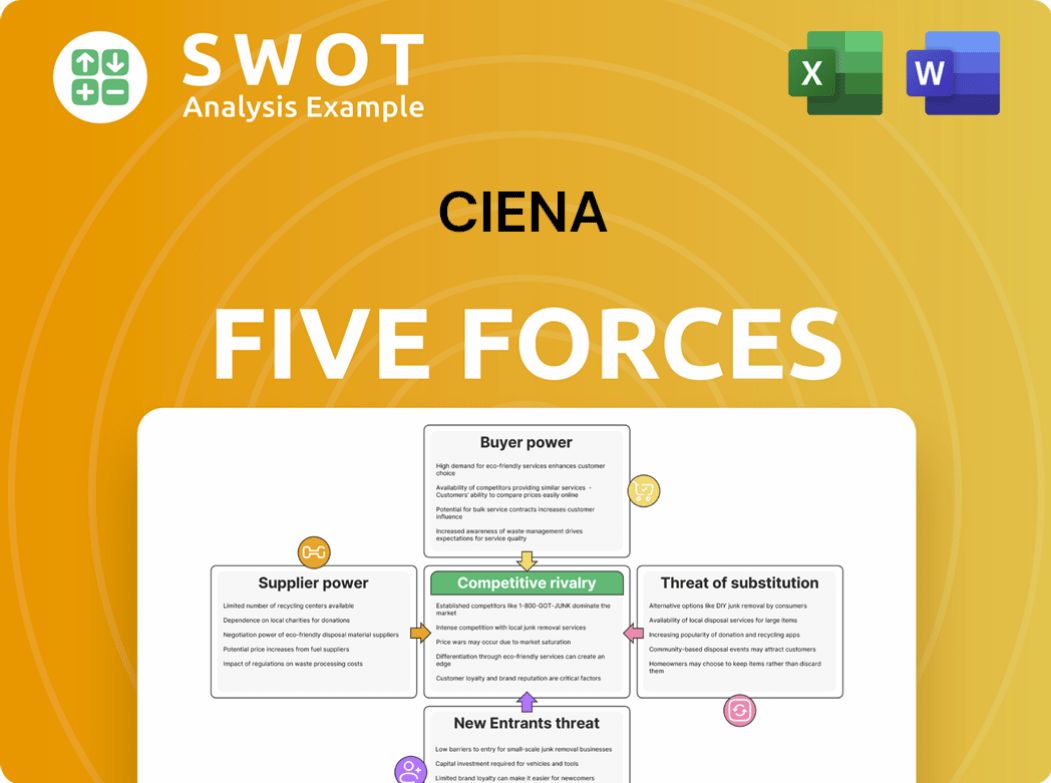
This preview presents the complete Porter's Five Forces analysis of Ciena. The content, structure, and insights here reflect the final, downloadable document. Expect the same detailed industry evaluation, including threat of new entrants, and more. This fully formatted analysis is ready for immediate use; your purchased version mirrors this.

Porter's Five Forces Analysis Template

A Must-Have Tool for Decision-Makers
Ciena's Porter's Five Forces reveal a dynamic competitive landscape. Buyer power stems from diverse telecom clients, influencing pricing. Supplier power from component makers, impacts costs. Threats of new entrants remain moderate due to high barriers. Substitute threats emerge from software-defined networking. Competitive rivalry is intense amongst major players.
Our full Porter's Five Forces report goes deeper—offering a data-driven framework to understand Ciena's real business risks and market opportunities.
Suppliers Bargaining Power

Supplier Concentration
Supplier concentration significantly impacts Ciena's operations. A few dominant suppliers increase their power. In 2024, consider how many firms provide key components. A concentrated market share boosts supplier influence; for example, a single chip supplier could raise prices.
Uniqueness of Inputs
Suppliers with unique inputs wield considerable power over Ciena. If Ciena depends on specialized components, like certain optical modules, from limited sources, those suppliers gain leverage. Switching to alternatives impacts product quality and performance, diminishing Ciena's bargaining position. In 2024, Ciena's reliance on specific vendors for key technologies, which is about 35%, could elevate supplier power.
Switching Costs for Ciena
Switching costs measure the difficulty Ciena faces when changing suppliers, impacting supplier power. Higher switching costs, often due to complex tech or contracts, boost supplier leverage. Ciena's reliance on specific components and long-term agreements with suppliers like II-VI Inc. (now Coherent) can create significant switching costs. In 2024, the telecommunications equipment market saw supplier consolidation, further increasing these costs.

Supplier's Threat of Forward Integration
Suppliers gain power by potentially integrating forward, becoming Ciena's competitors. This threat weakens Ciena's negotiating stance if suppliers possess the necessary resources. Assess how likely major suppliers are to enter the networking systems market, and gauge the potential fallout. For example, a key chip manufacturer could design its own networking equipment. In 2024, Ciena's revenue was around $4.07 billion, making any supplier's forward integration a significant risk.
- Forward integration risk: Key chip or component suppliers could become competitors.
- Resource assessment: Evaluate supplier capabilities to enter networking systems.
- Impact on Ciena: Weaker bargaining position and potential market share loss.
- Financial data: Ciena's 2024 revenue was $4.07 billion, highlighting the stakes.
Importance of Ciena to Suppliers
Ciena's influence over its suppliers hinges on their reliance on Ciena's business. If Ciena constitutes a small fraction of a supplier's income, the supplier holds more leverage. This is because the supplier isn't as vulnerable to Ciena's demands. Assess how crucial Ciena's orders are to the financial health of its primary suppliers. In 2024, Ciena's revenue was approximately $4.1 billion, which is a key factor.
- Supplier Concentration: If a supplier has few other major customers, Ciena's bargaining power increases.
- Switching Costs: High switching costs for Ciena to change suppliers weaken supplier power.
- Product Differentiation: Unique, specialized components give suppliers greater influence.
- Supplier Profitability: Suppliers with healthy profit margins can resist Ciena's price pressures.
Ciena's Supplier Power: Key Factors & $4.07B Revenue
Supplier bargaining power significantly affects Ciena. High supplier concentration, especially with unique components, boosts supplier leverage. Switching costs also matter, impacting Ciena's flexibility.
Forward integration by suppliers, potentially becoming competitors, further weakens Ciena. Ciena's financial impact on suppliers also affects bargaining power. In 2024, Ciena's revenue was around $4.07 billion, which is a factor.
| Factor | Impact on Ciena | 2024 Data |
|---|---|---|
| Concentration | Higher = Weaker Bargaining | Limited suppliers |
| Switching Costs | Higher = Weaker Power | Tech reliance |
| Forward Integration | Threatens Market Share | Revenue $4.07B |
Customers Bargaining Power

Customer Concentration
Customer concentration measures how much Ciena relies on its top clients. If a few big customers drive most sales, they gain strong bargaining power. In 2024, Ciena's revenue distribution among key clients is a critical factor. Analyzing Ciena's major customer segments reveals the revenue spread, impacting its market position.
Customer Switching Costs
Switching costs are a key factor in customer bargaining power for Ciena. These costs include expenses and disruptions when switching to a competitor. If switching costs are low, customers have more power to negotiate or switch easily. For Ciena, factors like the compatibility of their equipment and vendor lock-in influence switching ease. In 2024, Ciena's revenue was $3.99 billion, indicating its market position.

Availability of Substitute Products
The availability of substitute products significantly impacts customer bargaining power. Customers gain leverage when alternatives exist, allowing them to compare prices and features. Ciena faces competition from various tech providers. For example, in 2024, Cisco and Huawei offered similar networking solutions. This intensifies the pressure on Ciena.

Customer Knowledge
Customers with robust knowledge of Ciena's offerings and the broader market landscape can significantly influence pricing and terms. Informed customers can negotiate better deals, especially if they understand Ciena's cost structure. Assessing customer's technical expertise and market awareness is vital to gauge their bargaining strength. In 2024, Ciena's revenue was approximately $4.1 billion, and a significant portion comes from large telecom companies with considerable market knowledge.
- Customer knowledge directly impacts negotiation power.
- Technical expertise enhances bargaining leverage.
- Market awareness enables better deal assessment.
- Large customers often have greater influence.
Customer's Threat of Backward Integration
Customers of Ciena could choose to create their own networking solutions, decreasing their dependence on the company. The ability of these customers to do this, and how seriously they take the idea, is very important for Ciena. To figure out how likely this is, consider the technical skills and business goals of Ciena's biggest clients. For instance, if a major telecom player like AT&T or Verizon decided to develop their own gear, it would significantly affect Ciena. In 2024, Ciena's revenue was approximately $4.1 billion, with a gross margin of about 43%.
- AT&T and Verizon are key customers whose decisions greatly influence Ciena.
- Ciena's 2024 revenue was around $4.1 billion.
- Ciena's gross margin was about 43% in 2024.
- Backward integration threat impacts Ciena's negotiation power.
Ciena's Market Dynamics: Customer Power & Revenue
Customer bargaining power significantly affects Ciena's market position, particularly if concentrated among a few major clients. Low switching costs and the availability of substitute products amplify customer leverage. In 2024, Ciena's revenue was approximately $4.1 billion.
| Factor | Impact | 2024 Data |
|---|---|---|
| Customer Concentration | High concentration increases power. | Major clients influence sales. |
| Switching Costs | Low costs enhance customer power. | Ciena's market position is significant. |
| Substitutes | Availability empowers customers. | Cisco, Huawei are key competitors. |
Rivalry Among Competitors

Number of Competitors
Competitive rivalry intensifies with more competitors. Ciena faces strong competition. Key rivals include Cisco and Huawei, each with significant market share. Increased competition pressures profits, potentially impacting Ciena's financials. In 2024, Cisco's market share in networking equipment was around 30%.
Industry Growth Rate
Competitive rivalry intensifies in slow-growth markets. In 2024, the networking systems and services market exhibited moderate growth. Companies like Ciena battle fiercely for a slice of the pie when overall market expansion slows. This environment pressures profit margins and fuels innovation to maintain competitiveness. The networking market grew by about 5% in 2024.

Product Differentiation
Ciena's product differentiation impacts rivalry. Similar offerings lead to price wars, boosting competition. Ciena's solutions, like WaveLogic 5 Extreme, offer unique features. In 2024, Ciena's revenue was approximately $4.2 billion, showing market demand. This competitive advantage helps Ciena maintain its market position.

Switching Costs
Switching costs significantly influence competitive rivalry for Ciena. High switching costs, like those associated with complex network infrastructure, can protect Ciena from rivals. Conversely, low switching costs intensify competition. For instance, a 2024 report showed that network upgrades can cost millions, deterring quick vendor changes.
- Ciena's proprietary technologies may increase switching costs.
- Long-term contracts create customer lock-in, reducing rivalry.
- The complexity of integrating new systems can be costly.
- Competitive pricing from rivals can lower switching barriers.
Exit Barriers
High exit barriers, like specialized assets or contracts, boost rivalry. Firms might stay even if losing money, causing oversupply and price drops. Think about the difficulties and expenses of leaving the networking systems market.
- Ciena's exit costs include specialized equipment and long-term contracts.
- The networking market's high exit barriers keep competitors fighting.
- Overcapacity, driven by these barriers, can lead to price wars.
Ciena's Competitive Landscape: 2024 Insights
Competitive rivalry in Ciena's market is strong, influenced by market growth and differentiation. In 2024, the networking market showed moderate growth, intensifying competition. Ciena's unique offerings, like WaveLogic 5 Extreme, help differentiate it.
Switching costs and exit barriers also impact rivalry. High switching costs protect Ciena, while high exit barriers keep firms competing. In 2024, network upgrade costs deterred quick vendor changes.
Rivals like Cisco and Huawei significantly influence Ciena. The competitive landscape involves pricing pressures and innovation demands. Cisco held about 30% market share in 2024.
| Factor | Impact on Rivalry | 2024 Data Point |
|---|---|---|
| Market Growth | Slow growth intensifies competition | Networking market growth: ~5% |
| Differentiation | Unique offerings help | Ciena's revenue: ~$4.2B |
| Switching Costs | High costs protect | Network upgrades cost millions |
SSubstitutes Threaten

Availability of Substitutes
The threat of substitutes for Ciena is moderate. Customers could switch to alternative networking solutions, like those from Cisco or Huawei. The availability of these alternatives increases the pressure on Ciena to maintain competitive pricing. In 2024, Cisco's revenue reached $57 billion, showing strong competition.
Price Performance of Substitutes
The threat from substitutes hinges on price-performance comparisons. If alternatives provide similar functionality at a reduced cost, the threat intensifies. For instance, in 2024, Ciena's competitors, like Juniper Networks, offered comparable networking solutions at competitive prices. Customers are more likely to switch if savings are realized without sacrificing essential features. It is crucial to compare Ciena's pricing against substitute offerings.

Switching Costs to Substitutes
The threat of substitutes for Ciena depends on switching costs. If customers face low switching costs, alternatives become a significant threat, encouraging them to switch. High switching costs, however, protect Ciena. Analyze the expenses and difficulties of switching to substitutes. For instance, in 2024, the telecommunications sector saw about $10 billion in spending on new technologies, affecting switching decisions.

Customer Propensity to Substitute
Customer propensity to substitute examines how likely customers are to switch to alternatives. This depends on factors like brand loyalty, price sensitivity, and the availability of substitutes. A high propensity to substitute increases the threat. For example, in 2024, the rise of electric vehicles poses a substitute threat to traditional automakers.
- Brand loyalty can reduce substitution, as seen with Apple's products.
- Price is a key factor; cheaper alternatives increase the threat.
- Customer attitudes towards substitutes must be assessed.
- Availability and ease of access to substitutes matter.
Technological Advancements
Technological advancements pose a significant threat to Ciena. Innovations in areas like AI and cloud computing could lead to alternative solutions that fulfill customer needs more efficiently. New entrants leveraging these technologies might offer substitutes, potentially impacting Ciena's market share. It is crucial for Ciena to track technological trends to adapt and remain competitive. For instance, the global optical networking market was valued at approximately $17.5 billion in 2024.
- AI-driven network management could replace some of Ciena's traditional services.
- Cloud-based networking solutions might offer cost-effective alternatives.
- Emerging technologies like quantum computing could revolutionize networking.
- Ciena's R&D spending in 2024 was around 15% of its revenue.
Ciena's Rivals: Market Dynamics and Tech Threats
The threat of substitutes for Ciena is moderate, influenced by price, switching costs, and customer loyalty. Cisco and Juniper offer competitive alternatives. In 2024, the optical networking market was $17.5 billion.
Technological advancements, such as AI and cloud computing, pose a threat. Customer propensity to substitute is affected by brand loyalty and price sensitivity. Ciena's R&D spending in 2024 was about 15% of revenue.
The availability of substitutes impacts Ciena's market position, with potential shifts in customer behavior. The telecommunications sector saw about $10 billion in spending on new technologies in 2024.
| Factor | Impact on Ciena | 2024 Data |
|---|---|---|
| Competitors | Increased pressure | Cisco revenue: $57B |
| Switching Costs | Determines customer decisions | Telecom tech spending: $10B |
| Technological Advancements | Potential for disruption | Optical Networking Market: $17.5B |
Entrants Threaten

Barriers to Entry
High barriers to entry protect existing firms from new competitors, lowering the threat level. Significant capital needs, strict regulations, and strong brand loyalty create entry barriers. For instance, Ciena's industry requires substantial R&D investments. In 2024, the networking hardware market was valued at approximately $40 billion, highlighting the capital-intensive nature.
Capital Requirements
The capital needed to launch a networking systems firm is a major hurdle. Newcomers often find it tough to get the funds to compete. For example, initial investments can reach hundreds of millions of dollars. This includes R&D, manufacturing, and marketing costs.

Economies of Scale
Ciena, as an established player, enjoys economies of scale, lowering costs through bulk purchases and efficient operations. New entrants face significant challenges, needing substantial investment to match Ciena's cost structure. The networking systems industry, with its high R&D and manufacturing expenses, makes economies of scale a crucial barrier. In 2024, Ciena's gross margin was about 42%, reflecting its scale advantage.

Brand Loyalty
Strong brand loyalty significantly shields Ciena from new competitors. Established brands like Ciena boast a substantial customer base and positive reputations that new entrants struggle to match. The networking systems market exhibits moderate to high brand loyalty due to the technical nature of the products and the importance of reliability. For instance, Ciena’s revenue in fiscal year 2024 reached $4.09 billion, demonstrating strong customer retention.
- Ciena’s strong market presence hinders new entrants.
- Customer trust in established brands is a key barrier.
- The complexity of networking solutions increases loyalty.
- Ciena's substantial revenue reflects customer loyalty.
Access to Distribution Channels
New entrants often grapple with accessing established distribution channels, which poses a significant threat. Existing firms frequently possess exclusive agreements or strong relationships with distributors, creating a barrier. This can limit the reach of new companies, impacting their ability to compete effectively. Assessing the ease of access to these channels is crucial for evaluating the threat level. For example, in 2024, the telecom industry saw increased consolidation, potentially strengthening existing distribution networks.
- Exclusive agreements with distributors can significantly hinder new entrants.
- Strong relationships between existing firms and distributors create barriers.
- Limited access impacts new companies' ability to reach customers.
- Assessing distribution channel accessibility is key for threat evaluation.
Ciena's Fortress: Barriers to Entry
The threat of new entrants to Ciena is moderate due to high barriers. Substantial capital needs, like R&D, protect Ciena. Established brand loyalty and distribution networks further shield it.
| Factor | Impact | Example (2024 Data) |
|---|---|---|
| Capital Requirements | High investment needed | Networking hardware market valued at ~$40B |
| Brand Loyalty | Protects market share | Ciena's FY24 Revenue: $4.09B |
| Distribution Channels | Access is challenging | Increased industry consolidation |
Porter's Five Forces Analysis Data Sources
This analysis uses annual reports, industry publications, and market research. It also utilizes SEC filings and analyst reports for insights.
