

Cloud Software Group Porter's Five Forces Analysis
Fully Editable
Tailor To Your Needs In Excel Or Sheets
Professional Design
Trusted, Industry-Standard Templates
Pre-Built
For Quick And Efficient Use
No Expertise Is Needed
Easy To Follow
Cloud Software Group Bundle

What is included in the product
 Detailed Word Document
Tailored exclusively for Cloud Software Group, analyzing its position within its competitive landscape.

 Customizable Excel Spreadsheet
Customize pressure levels based on new data or evolving market trends.
Preview Before You Purchase
Cloud Software Group Porter's Five Forces Analysis
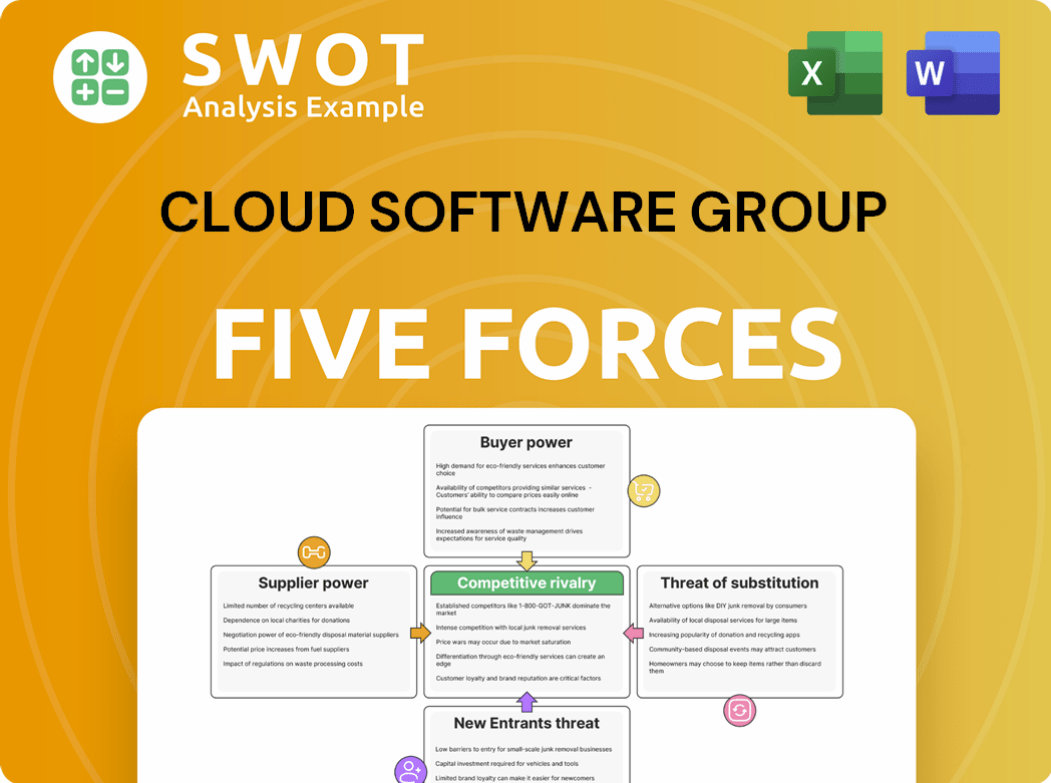
This preview offers the full Cloud Software Group Porter's Five Forces Analysis. Expect this complete, in-depth document upon purchase.

Porter's Five Forces Analysis Template

A Must-Have Tool for Decision-Makers
Cloud Software Group operates in a dynamic software market shaped by complex competitive forces. Their supplier power is moderate, influenced by the availability of specialized talent. Buyer power varies, depending on the segment and customer contracts. The threat of new entrants is significant, fueled by technological advancements. Substitutes, particularly cloud-based solutions, pose a substantial threat.
Ready to move beyond the basics? Get a full strategic breakdown of Cloud Software Group’s market position, competitive intensity, and external threats—all in one powerful analysis.
Suppliers Bargaining Power

Supplier concentration impacts pricing
Cloud Software Group's profitability is vulnerable to supplier power. In 2024, the IT services market saw significant consolidation, potentially increasing supplier concentration. This situation enables suppliers to dictate terms, raising costs for Cloud Software Group. Analyze the size and number of key suppliers and the uniqueness of their services. High concentration may squeeze profit margins.
Switching costs affect supplier leverage
Switching costs significantly influence supplier power. Cloud Software Group's leverage increases when switching suppliers is difficult and expensive. High costs, like those associated with data migration, favor suppliers. This lock-in effect strengthens suppliers, impacting negotiation power. In 2024, the SaaS market saw a 15% increase in vendor lock-in due to complex integrations.
Supplier's brand reputation matters
Suppliers with strong brand recognition can often demand higher prices. A supplier's brand equity significantly impacts their bargaining power. Reputable suppliers often have more influence due to quality. For example, in 2024, premium software vendors increased prices by 5-10%.

Impact of essential input scarcity
The bargaining power of suppliers for Cloud Software Group (CSG) is significantly influenced by the availability of essential inputs. If key components or services are scarce, suppliers gain leverage, potentially raising prices or dictating unfavorable terms. This is particularly relevant in the tech industry, where specialized skills and proprietary technologies can create supply-side bottlenecks. CSG must carefully analyze its supply chains to identify potential vulnerabilities.
- Component shortages, such as those seen in the semiconductor industry, can increase supplier power.
- The cost of software development skills rose 5-10% in 2024 due to talent scarcity.
- Proprietary technology suppliers can demand premium pricing.
- Diversifying suppliers mitigates supplier power.
Forward integration by suppliers
Forward integration by suppliers is a key consideration. Suppliers entering the software market intensifies competition, potentially increasing their power. Analyze if key suppliers develop competing solutions or expand offerings. This can reshape the landscape and affect Cloud Software Group's options.
- Market analysis in 2024 shows increasing supplier diversification.
- Competition is rising, with an estimated 15% of suppliers expanding service offerings.
- This trend could affect Cloud Software Group's market share.
Supplier Power Dynamics: Challenges Ahead
Cloud Software Group faces supplier power challenges, especially due to market consolidation. High switching costs and vendor lock-in, which rose 15% in SaaS during 2024, strengthen suppliers' positions. Brand recognition also allows suppliers to demand higher prices, with premium vendors increasing prices by 5-10% in 2024.
| Factor | Impact | 2024 Data |
|---|---|---|
| Market Consolidation | Increases Supplier Concentration | IT services market saw significant consolidation |
| Switching Costs | Elevate Supplier Leverage | SaaS vendor lock-in increased by 15% |
| Brand Recognition | Permits Higher Prices | Premium software vendors increased prices by 5-10% |
Customers Bargaining Power

Customer concentration influences pricing
Cloud Software Group faces customer bargaining power. Large customers can pressure prices, impacting revenue. Assessing customer distribution and major client significance is crucial. A concentrated customer base amplifies buyer power. In 2024, the top 10 customers might account for a significant portion of revenue, influencing pricing negotiations.
Switching costs limit customer options
Switching costs for Cloud Software Group's customers are generally low, as they can move to competitors like Microsoft or Salesforce. This ease of transition significantly boosts customer bargaining power. In 2024, the cloud computing market saw increased competition, reducing customer lock-in. This heightened price sensitivity, forcing Cloud Software Group to remain competitive.
Customer knowledge drives negotiation
Customers armed with information can push for better deals and service. Cloud Software Group's customers vary in technical expertise, from novices to tech-savvy enterprises. Customers with strong knowledge can easily compare Cloud Software Group's offerings to competitors, improving their negotiation position. In 2024, the average customer churn rate in the software industry was about 15%, highlighting the importance of customer satisfaction and retention through negotiation.

Availability of alternative solutions
The availability of alternative solutions significantly impacts customer bargaining power. Cloud Software Group faces competition from various software providers, including major players like Microsoft, Salesforce, and smaller niche companies. The breadth of options allows customers to easily switch vendors if they are not satisfied with the pricing, features, or service provided by Cloud Software Group. This abundance of choices increases customer leverage, making them more price-sensitive and able to negotiate favorable terms.
- Cloud software market revenue was projected to reach $171.5 billion in 2024.
- The global CRM software market is expected to reach $114.48 billion by 2028.
- Switching costs in the software industry can be high, but alternatives are readily available.
Price sensitivity affects purchasing
Price-sensitive customers often prioritize cost over features, which can significantly affect purchasing decisions. Assessing the price elasticity of demand for Cloud Software Group's products is crucial. In 2024, the software-as-a-service (SaaS) market saw varied price sensitivities across different customer segments. High price sensitivity indeed strengthens customer bargaining power. This can influence purchasing decisions, potentially leading to a focus on cheaper alternatives or aggressive price negotiations.
- Price sensitivity leads to cost-focused decisions.
- Price elasticity assessment is crucial.
- SaaS market showed variable price sensitivities in 2024.
- High price sensitivity empowers customers.
Customer Power Shapes Cloud Software Deals
Customer bargaining power influences Cloud Software Group, impacting pricing and service terms. Low switching costs and a competitive market empower customers. Customers with ample choices, like alternatives to Microsoft or Salesforce, can negotiate better deals. The SaaS market’s $171.5 billion revenue in 2024 highlights this dynamic.
| Factor | Impact | 2024 Data |
|---|---|---|
| Switching Costs | Low | Increased competition in the cloud market |
| Alternative Solutions | Many | CRM market projected to reach $114.48B by 2028 |
| Price Sensitivity | High | SaaS market saw varied price sensitivities |
Rivalry Among Competitors

Market concentration shapes competition
Market concentration significantly influences competitive dynamics. Highly concentrated markets, often with a few dominant players, tend to experience less intense price wars. In 2024, Cloud Software Group operates in markets where concentration varies, impacting its competitive landscape. Lower market concentration usually leads to fiercer competition and potential margin pressure. Data from 2024 shows varying levels of concentration across the software segments Cloud Software Group engages in, affecting its strategic approach.
Product differentiation influences rivalry
Strong product differentiation often eases competitive pressures. Cloud Software Group's unique offerings should be assessed for their value. Distinctive products allow premium pricing, lessening direct rivalry. In 2024, the cloud software market grew, yet differentiation remains key for success. Consider their specific features and customer perception.

Industry growth rate impacts intensity
Slower industry growth can make competition fiercer as companies battle for a bigger slice of the pie. Keep an eye on the growth rate of the enterprise software market and its specific areas. In 2024, the global enterprise software market is estimated at $672.2 billion. Low growth can often spark tougher competition, potentially leading to price cuts and reduced profitability. The enterprise software market is projected to grow to $797.4 billion by 2028.

Exit barriers affect market dynamics
High exit barriers can intensify competition among firms, keeping them locked in the market. Assessing the costs and hurdles Cloud Software Group faces when leaving a market is crucial. These barriers often include significant investments in specialized assets or long-term contracts. Consequently, intense competition and reduced profitability are likely outcomes when exit is difficult.
- High exit barriers can trap firms, increasing rivalry.
- Evaluate the costs and difficulties of Cloud Software Group's market exits.
- High exit barriers exacerbate competition and reduce profitability.
Competitive intelligence is crucial
Competitive intelligence is essential for Cloud Software Group. Understanding competitor strategies is vital for navigating rivalry in the cloud software market. Continuously monitor and analyze the moves of competitors such as Microsoft and Salesforce. Effective competitive intelligence informs strategic decisions and responses. For instance, in 2024, Microsoft's cloud revenue increased by 22%.
- Monitor competitor pricing models and service offerings.
- Analyze market share shifts among key players.
- Assess the impact of new product launches and updates.
- Evaluate competitor marketing and sales strategies.
Cloud Software Group: Competitive Dynamics
Competitive rivalry within Cloud Software Group's markets hinges on several factors. Market concentration varies; lower concentration intensifies competition. Product differentiation offers some protection, allowing premium pricing. The enterprise software market, valued at $672.2B in 2024, sees intense competition, especially with slower growth.
| Factor | Impact | Example |
|---|---|---|
| Market Concentration | Lower concentration increases competition | Varies across Cloud Software Group segments |
| Product Differentiation | Allows premium pricing, reduces rivalry | Assess unique offerings |
| Market Growth | Slower growth intensifies rivalry | 2024 Enterprise Software Market: $672.2B |
SSubstitutes Threaten

Availability of alternative solutions
Cloud Software Group faces the threat of substitutes due to the availability of alternatives. Customers might switch to on-premise software or other cloud providers. A wide array of substitutes, like open-source solutions, increases the threat. This limits Cloud Software Group's ability to raise prices. For example, in 2024, the market share of cloud-based services grew by 21%.
Price-performance ratio of substitutes
Substitutes with attractive price-performance ratios can lure customers away. Consider the cost and features of alternatives versus Cloud Software Group's products. If substitutes offer better value, the threat increases. For example, in 2024, open-source software saw a 15% adoption increase, posing a challenge to proprietary vendors.

Switching costs to alternatives
The threat of substitutes is heightened by low switching costs, which makes it easier for customers to adopt alternatives. Customers can readily transition to rival software solutions. Low switching costs amplify the threat of substitutes. For instance, in 2024, the average cost to switch software was about $1,500, a low barrier.

Customer perception of substitutes
Customer perception heavily shapes the threat of substitutes. If clients view alternatives positively, adoption rates accelerate. Assessing quality and suitability is crucial; favorable perceptions amplify substitution risks. For instance, in 2024, the rise of open-source software posed a significant threat to proprietary cloud solutions. This shift highlights how customer preference can reshape market dynamics.
- Positive perceptions of substitutes drive adoption.
- Quality and suitability assessments are key.
- Favorable views increase substitution risks.
- Open-source software's rise in 2024 exemplifies this.
Emerging technologies as substitutes
Emerging technologies pose a significant threat to Cloud Software Group. New technologies can quickly displace established solutions. It's crucial to monitor innovations that could replace their offerings. Proactive adaptation is essential to counter this threat.
- AI-powered automation tools are gaining traction, potentially automating tasks currently handled by Cloud Software Group's software.
- Low-code/no-code platforms enable businesses to create custom applications, reducing reliance on pre-built software solutions.
- The SaaS market is projected to reach $232.85 billion in 2024, highlighting the competitive landscape.
Cloud Software Group's $232.85B SaaS Battle
Cloud Software Group faces a substantial threat from substitutes like on-premise software and open-source solutions. These alternatives, including Software-as-a-Service (SaaS), can lure customers away, especially if they offer better value. The market is competitive; the SaaS market hit $232.85B in 2024.
| Factor | Impact | 2024 Data |
|---|---|---|
| SaaS Market Growth | High | $232.85B |
| Open-Source Adoption | Increasing threat | 15% increase |
| Switching Costs | Low | $1,500 average |
Entrants Threaten

Barriers to entry are critical
High entry barriers significantly deter new competitors in the cloud software market. New companies face obstacles like substantial capital requirements and the need for advanced tech to compete. Significant barriers, such as established brand recognition, protect companies like Cloud Software Group, reducing the threat of new entrants. In 2024, the cloud computing market is projected to reach over $600 billion, but only a few major players control most of it.
Capital requirements for entry
Cloud Software Group's market entry demands substantial capital, deterring new competitors. Assessing the financial resources, consider the costs of infrastructure and R&D. High capital needs limit smaller, underfunded companies. For example, setting up a data center can cost millions. Therefore, the threat is moderate.

Brand loyalty among customers
Strong brand loyalty is a significant barrier for new cloud software competitors. Cloud Software Group's customer base shows a high level of brand preference, with many users sticking to their current providers. This established loyalty gives Cloud Software Group a clear competitive advantage, reducing the likelihood of customers switching. Recent reports show that customer retention rates in the cloud software sector average around 85% in 2024, underscoring the importance of brand loyalty.

Regulatory hurdles impact entry
Regulatory hurdles significantly influence the threat of new entrants in the cloud software market. Stringent regulations, such as data privacy laws like GDPR and CCPA, can limit market access for new players. Compliance with these regulations demands substantial investment in infrastructure and legal expertise, increasing the time and cost of market entry. For example, the cost of GDPR compliance alone can range from $1 million to $10 million for large companies.
- Data privacy laws limit access.
- Compliance costs increase market entry time and expenses.
- Regulatory requirements demand significant investment.
Access to distribution channels
New entrants in the cloud software market face hurdles in accessing distribution channels. Established companies like Cloud Software Group (CSG) often have strong partnerships and established customer bases, making it difficult for newcomers to compete. The cost of reaching customers through existing channels can be prohibitive, impacting profitability. Restricted access to these channels presents a significant barrier to entry, potentially limiting market disruption.
- Cloud Software Group (CSG) is exploring a potential sale as of January 2024.
- The cloud computing market is highly competitive with many established players.
- Access to distribution channels is crucial for reaching customers.
- New entrants may struggle to build the necessary distribution networks.
Cloud Software: High Hurdles to Jump
New cloud software entrants encounter substantial barriers. High capital needs and tech requirements hinder entry. Strong brand loyalty, with 85% retention rates in 2024, provides Cloud Software Group an advantage.
| Entry Barrier | Impact | Example (2024 Data) |
|---|---|---|
| Capital Needs | High | Data center setup: millions |
| Brand Loyalty | High | 85% customer retention rate |
| Regulations | Significant | GDPR compliance: $1M-$10M |
Porter's Five Forces Analysis Data Sources
Our analysis is fueled by public company filings, industry reports, and competitive intelligence databases for robust competitive insights.
