

Domino's Pizza Porter's Five Forces Analysis
Fully Editable
Tailor To Your Needs In Excel Or Sheets
Professional Design
Trusted, Industry-Standard Templates
Pre-Built
For Quick And Efficient Use
No Expertise Is Needed
Easy To Follow
Domino's Pizza Bundle

What is included in the product
 Detailed Word Document
Tailored exclusively for Domino's Pizza, analyzing its position within its competitive landscape.

 Customizable Excel Spreadsheet
Identify industry threats and strengths with clear force visualizations to guide strategic decisions.
Full Version Awaits
Domino's Pizza Porter's Five Forces Analysis
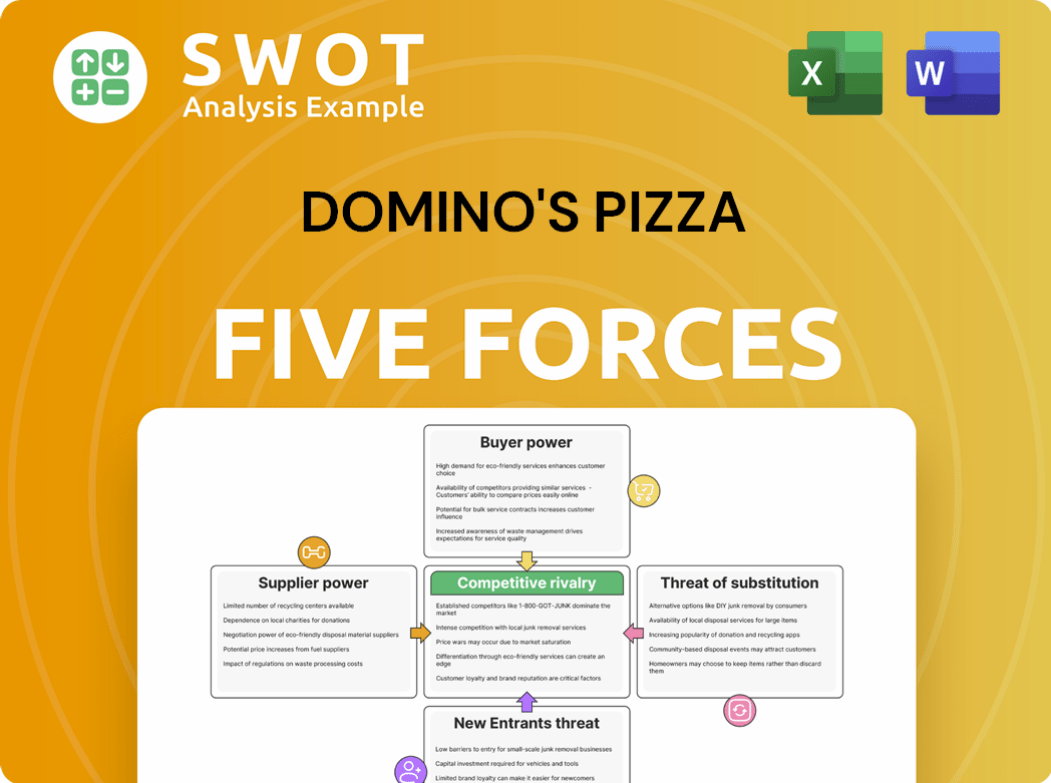
The preview showcases the complete Porter's Five Forces analysis for Domino's Pizza. This detailed document covers competitive rivalry, supplier power, buyer power, the threat of substitutes, and the threat of new entrants. You're viewing the exact analysis you'll receive immediately after your purchase. This is the full, ready-to-use file, offering a comprehensive overview of Domino's competitive landscape. No changes or revisions are necessary; start using it now.

Porter's Five Forces Analysis Template

Elevate Your Analysis with the Complete Porter's Five Forces Analysis
Domino's Pizza navigates a complex competitive landscape. Intense rivalry exists among pizza chains, but the brand benefits from strong brand recognition and established delivery infrastructure. Supplier power is moderate, with commodity price fluctuations impacting costs. The threat of new entrants is also moderate due to high startup costs and established market players. Buyer power is considerable, as consumers have numerous choices and price sensitivity. Finally, the threat of substitutes, including other food delivery options, is a constant factor.
The complete report reveals the real forces shaping Domino's Pizza’s industry—from supplier influence to threat of new entrants. Gain actionable insights to drive smarter decision-making.
Suppliers Bargaining Power

Limited Supplier Options
Domino's Pizza, in its Five Forces analysis, faces supplier bargaining power due to its reliance on a few key suppliers for essentials. This concentration gives suppliers some negotiation power, particularly for specialized or premium ingredients. However, Domino's mitigates this risk. They use long-term contracts, like the one with Leprino Foods. This helps secure pricing and supply stability. In 2024, Domino's spent around $1.2 billion on food, beverages, and packaging.
Large-Scale Purchasing Power
Domino's, with over 21,300 stores globally in 2024, wields substantial purchasing power. This immense scale allows for advantageous negotiations with suppliers. Bulk buying of ingredients and packaging gives Domino's a cost edge. In 2023, Domino's spent billions on supplies.

Standardized Ingredient Requirements
Domino's leverages standardized ingredient specs, giving it control over suppliers. This standardization enables supplier switching, curbing supplier power. The company enforces criteria for food safety, ethical sourcing, and sustainability. In 2024, Domino's spent approximately $4 billion on food and supplies. This strategy helps Domino's maintain competitive pricing.

Long-Term Contracts
Domino's Pizza leverages long-term contracts to manage supplier relationships effectively. These agreements, crucial for securing ingredients like cheese and dough, help stabilize costs. By locking in prices, Domino's reduces supplier bargaining power, ensuring consistent supply. However, these contracts might limit flexibility to explore potentially better deals.
- In 2024, Domino's spent approximately $1.8 billion on food, beverages, and packaging.
- Long-term contracts help manage expenses, with cheese prices being a key factor.
- These contracts typically span several years, providing supply chain stability.
- Price fluctuations in ingredients can significantly impact profitability.
Potential for Local Sourcing
Domino's Pizza has opportunities to source ingredients locally, especially fresh produce. This move could offer greater flexibility and lessen reliance on major suppliers. Diversifying the supply base is a strategic move to counter supplier bargaining power. Local sourcing may also provide access to unique regional products. In 2024, Domino's spent approximately $1.7 billion on food, showcasing the scale of its supply chain.
- Local sourcing can enhance supply chain resilience.
- It allows for the incorporation of regional specialties.
- This approach can lead to cost savings.
- It supports local economies.
Supplier Dynamics: Balancing Act for the Pizza Giant
Domino's Pizza's supplier bargaining power is moderate, influenced by reliance on key suppliers. They utilize long-term contracts and standardization to mitigate supplier power, securing supply and managing costs. In 2024, Domino's spent around $1.8 billion on food, beverages, and packaging. The company's size and strategic sourcing further balance these relationships.
| Factor | Impact on Supplier Power | Domino's Strategy |
|---|---|---|
| Concentration of Suppliers | Increases Supplier Power | Long-term contracts, standardization |
| Domino's Purchasing Power | Reduces Supplier Power | Bulk buying, global scale |
| Ingredient Standardization | Reduces Supplier Power | Supplier switching, stringent criteria |
Customers Bargaining Power

Low Switching Costs
Customers have low switching costs in the pizza market. Many pizza places exist, making it easy to switch. This gives customers strong bargaining power. Domino's must always offer good value. In 2024, Domino's revenue was around $4.6 billion.
Price Sensitivity
The pizza market is extremely price-sensitive, with customers frequently comparing prices between brands. Domino's caters to a value-conscious market, with customers attracted to deals and loyalty programs. This price sensitivity boosts customer bargaining power. In 2024, Domino's focused on promotions and its Rewards program to counter this, with over 30 million active members.

Availability of Information
Customers' access to info about pizza chains, like Domino's, is vast. Online reviews and price comparisons enable informed choices. This transparency lets customers demand better value. Domino's needs a great reputation and high-quality offerings to satisfy these informed customers.

Customization Options
Customers today expect personalized food experiences. Domino's responds with crust, topping, and sauce choices. This customization boosts satisfaction but also gives customers leverage. In 2024, Domino's saw a 3.5% increase in same-store sales.
- Customization drives customer expectations.
- Domino's offers extensive personalization options.
- Customer bargaining power increases with choice.
- Sales growth reflects the impact of these trends.
Aggregator Platforms
Domino's Pizza partners with platforms like Uber Eats, offering customers more ordering choices. This convenience boosts customer power. Customers can easily compare Domino's prices against competitors on these aggregators. Domino's needs strong aggregator strategies to keep customers.
- Aggregator platforms may account for 10-20% of Domino's total sales.
- Customers can switch to competitors with a few clicks, increasing price sensitivity.
- Domino's must offer competitive pricing and promotions on these platforms.
- Domino's faces increased competition through these platforms, which intensifies the customer's bargaining power.
Pizza Power: Customer's Edge vs. Domino's Strategy
Customers can easily switch pizza providers, giving them strong bargaining power. Price sensitivity and wide access to info amplify this power. Domino's counters with value, loyalty, and customization.
| Aspect | Impact | Domino's Response |
|---|---|---|
| Switching Costs | Low, many pizza choices. | Value, Rewards programs. |
| Price Sensitivity | High, deal-focused market. | Promotions, loyalty program (30M+ members). |
| Information Access | Extensive online reviews. | Great reputation and quality. |
Rivalry Among Competitors

Intense Competition
The pizza industry is highly competitive, featuring national chains, regional brands, and local pizzerias. Domino's faces direct competition from Pizza Hut, Papa John's, and Little Caesars. In 2024, Pizza Hut's revenue was approximately $5.5 billion, while Domino's reached around $4.6 billion. This competition demands constant innovation and strategic differentiation to maintain market share.
Value-Focused Strategies
Many pizza chains are using value-focused strategies to attract customers, especially with consumer spending feeling the pressure. Domino's has launched its 'Hungry for MORE' strategy, focusing on value to boost traffic. The pizza competition is heating up, with rivals offering discounts and loyalty programs. In 2024, Domino's same-store sales rose, but competition remains fierce.

Technological Innovation
Technological innovation is pivotal in the pizza market. Domino's has invested significantly in tech, including online ordering and delivery tracking. In 2024, digital orders accounted for over 75% of Domino's U.S. sales. This tech advantage helps, but constant innovation is key to staying ahead.

Market Share Battles
Domino's faces intense competition in the pizza market, especially from delivery and carryout services. They've been actively fighting for market share, and in 2024, they managed to grab about 1 percentage point in the quick-service restaurant (QSR) pizza segment. This shows their competitive strength, but the battle continues. Staying ahead means constant innovation and keeping customers happy.
- Domino's QSR pizza market share gain in 2024: approximately 1 percentage point.
- Ongoing market share battles in delivery and carryout.
- Need for continuous innovation and efficiency improvements.
- Focus on enhancing customer satisfaction.
Global Expansion
The competitive rivalry intensifies globally, where Domino's battles international pizza chains and local eateries. Domino's has a robust international footprint, yet faces growth pressures and currency fluctuations. To succeed, it must tailor strategies to suit regional tastes and diverse markets. In 2024, international sales represented a significant portion of Domino's revenue.
- International sales accounted for approximately 55% of Domino's total revenue in 2024.
- Domino's operates in over 90 international markets.
- Foreign currency exchange rates impacted international revenues by approximately $20 million in 2024.
- Domino's opened 627 net new stores internationally in 2024.
Pizza Wars: Can Domino's Outpizza the Competition?
Domino's faces intense competition, with Pizza Hut's $5.5B 2024 revenue. Value-focused strategies, such as Domino's 'Hungry for MORE,' are crucial for boosting traffic. Technological innovation, including online ordering, is key to staying competitive.
| Metric | Domino's (2024) | Competitors (Approx. 2024) |
|---|---|---|
| U.S. Sales from Digital Orders | Over 75% | Varies by chain |
| International Revenue | ~55% of total | Varies |
| QSR Pizza Market Share Gain | ~1 percentage point | Varies |
| Net New International Stores | 627 | Varies |
SSubstitutes Threaten

Other Pizza Chains
The threat from other pizza chains like Pizza Hut and Papa John's is significant for Domino's. These competitors provide similar pizza options, making it easy for customers to switch. In 2024, Pizza Hut's global revenue reached $10.2 billion, indicating strong competition. Domino's needs to stand out through its unique offerings to maintain its market position.
Fast Food Alternatives
Domino's encounters the threat of substitutes from various fast-food options. These include burgers, chicken, sandwiches, and tacos, all vying for the same customer base seeking quick and affordable meals. In 2024, the fast-food industry generated over $300 billion in sales, indicating strong competition. To stay competitive, Domino's needs to offer great value and a diverse menu. This must appeal to a wide range of preferences.

Restaurant Meals
Restaurant meals, including dine-in and takeout, are substitutes for Domino's. Consumers might opt for a restaurant, especially for events. Domino's competes by offering convenience, value, and quality. In 2024, the U.S. restaurant industry generated over $1 trillion in sales, showing substantial competition.

Home-Cooked Meals
Home-cooked meals pose a notable threat to Domino's Pizza. Consumers are increasingly health-conscious and budget-aware, often opting for home-prepared food. The convenience of meal kits and online recipes further simplifies home cooking. Domino's must continually compete with these substitutes.
- In 2024, the home meal replacement market was valued at approximately $15 billion.
- Meal kit services saw a 10% growth in 2024.
- Domino's same-store sales growth in 2024 was around 2%.
Frozen Pizzas
Frozen pizzas pose a significant threat to Domino's due to their convenience and affordability. Consumers can easily purchase frozen pizzas from various grocery stores. This accessibility makes frozen pizzas a quick, at-home meal option, competing directly with Domino's for customer dollars. To combat this, Domino's needs to emphasize its unique selling points.
- Market share of frozen pizza in the U.S. in 2024: Approximately $6.5 billion.
- Average price of a frozen pizza: Between $5 and $10.
- Domino's 2024 revenue: Approximately $4.5 billion in the U.S.
- Domino's must focus on fresh ingredients, customized options, and delivery.
Pizza Giant's Rivals: Billions at Stake!
Domino's faces substantial threats from substitutes. Fast food, restaurant meals, and home-cooked options compete directly for customers. Frozen pizzas also pose a threat due to convenience and cost.
| Substitute Type | 2024 Market Size/Sales | Domino's Strategy |
|---|---|---|
| Fast Food | $300B+ (Industry Sales) | Offer value & variety |
| Restaurant Meals | $1T+ (U.S. Sales) | Focus on conv. & quality |
| Home-Cooked | $15B (Home Meal Rpl.) | Highlight speed & taste |
Entrants Threaten

Franchise Model
Domino's Pizza faces the threat of new entrants, particularly due to its franchise model. This model allows new competitors to enter the market more easily. Aspiring entrepreneurs can franchise with existing pizza brands, lowering initial investment. However, Domino's counters this threat with strong brand recognition; in 2024, Domino's global brand value hit approximately $7.3 billion, its established supply chain, and operational expertise.
Local Pizzerias
Local pizzerias present a threat to Domino's, especially in areas with strong community ties. These businesses often offer unique flavors and personalized service. To compete, Domino's focuses on its consistent brand, easy ordering, and competitive pricing. In 2024, the pizza market was valued at $47 billion, with local players holding a significant share.

Online Ordering Platforms
The emergence of online ordering platforms poses a significant threat. New pizza businesses can now enter the market easily. They bypass traditional storefronts with virtual kitchens, using platforms like DoorDash and Uber Eats. Domino's needs to use its digital strength to stay ahead, as in 2024, online orders made up over 70% of its sales.

Capital Requirements
Capital requirements pose a significant threat to new entrants in the pizza industry. While a local pizzeria might start with a modest investment, a national chain like Domino's needs substantial funds. Building brand recognition, setting up a supply chain, and creating tech infrastructure are costly. This financial barrier makes it tough for newcomers to compete.
- Domino's spent $600 million on marketing in 2023.
- The cost to open a Domino's franchise can range from $150,000 to $500,000.
- Establishing a robust supply chain requires significant upfront investment.
- Technology infrastructure, like online ordering systems, adds to startup costs.
Brand Recognition
Domino's Pizza benefits from strong brand recognition, a significant advantage against new entrants. This established brand loyalty makes it difficult for newcomers to attract customers quickly. Building this level of trust and awareness requires substantial investment and time. Domino's continues to protect its market position through consistent marketing efforts.
- In 2024, Domino's spent millions on advertising to maintain brand visibility.
- New entrants struggle to compete with Domino's established customer base.
- Brand recognition translates to immediate consumer trust.
- Ongoing marketing is crucial for sustaining a competitive edge.
Domino's: New Entrants' Challenge
The threat of new entrants to Domino's Pizza is moderate. The franchise model allows for easier market entry, countered by Domino's brand strength and established supply chains. However, high capital requirements act as a barrier. In 2024, Domino's spent millions on advertising.
| Factor | Impact | Data |
|---|---|---|
| Franchise Model | Facilitates entry | Franchise cost $150-500k |
| Brand Strength | Competitive edge | $7.3B Brand Value (2024) |
| Capital Needs | Barrier to entry | $600M Marketing (2023) |
Porter's Five Forces Analysis Data Sources
Our analysis utilizes diverse sources, including company filings, market research, industry reports, and economic databases, to provide a comprehensive assessment.
