

Advanced Info Service Bundle

How Did Advanced Info Service Become Thailand's Telecom Titan?
Advanced Info Service (AIS) isn't just a telecommunications company; it's a story of pioneering spirit and strategic foresight in Thailand. From its inception in 1986, AIS has navigated a rapidly evolving digital landscape, transforming from a fledgling venture into the nation's leading mobile network operator. This journey reveals crucial insights into the company's remarkable growth and its impact on Thailand's connectivity.

AIS's early adoption of mobile communication technologies, including its initial GSM network, laid the groundwork for its future dominance in the Thailand telecommunications sector. The company's commitment to innovation, evident in its continuous upgrades to 3G, 4G, and now 5G, has been a key driver of its success. For a deeper dive into the strategic decisions that shaped AIS, consider exploring the Advanced Info Service SWOT Analysis.
What is the Advanced Info Service Founding Story?
The story of Advanced Info Service Public Company Limited (AIS) began on January 24, 1986. It was founded by Thaksin Shinawatra, who saw an opportunity in Thailand's growing telecommunications sector. The aim was to bring mobile phone services to more people, a relatively new concept at the time.
Shinawatra, with his background in computer science and business, understood the potential of mobile technology. He envisioned a future where mobile communication would be accessible to a wider audience. This vision led to the creation of AIS, setting the stage for its role in Thailand's telecommunications landscape.
AIS secured a concession to operate a 900 MHz mobile phone network, marking its entry into the market. Initial funding came from investments by the founder. The company's establishment coincided with Thailand's economic growth, which provided a favorable environment for new ventures, especially those related to modern technology. Understanding the local market was key to navigating regulations and building the infrastructure for mobile communication. You can learn more about the Marketing Strategy of Advanced Info Service.

Key Founding Facts
AIS was established in 1986 by Thaksin Shinawatra, capitalizing on the emerging demand for mobile phone services in Thailand.
- The company's initial focus was on providing mobile phone services.
- AIS secured a concession to operate a 900 MHz mobile phone network.
- The founding team's expertise in technology and the local market was crucial for success.
- The company's establishment was supported by Thailand's economic growth.
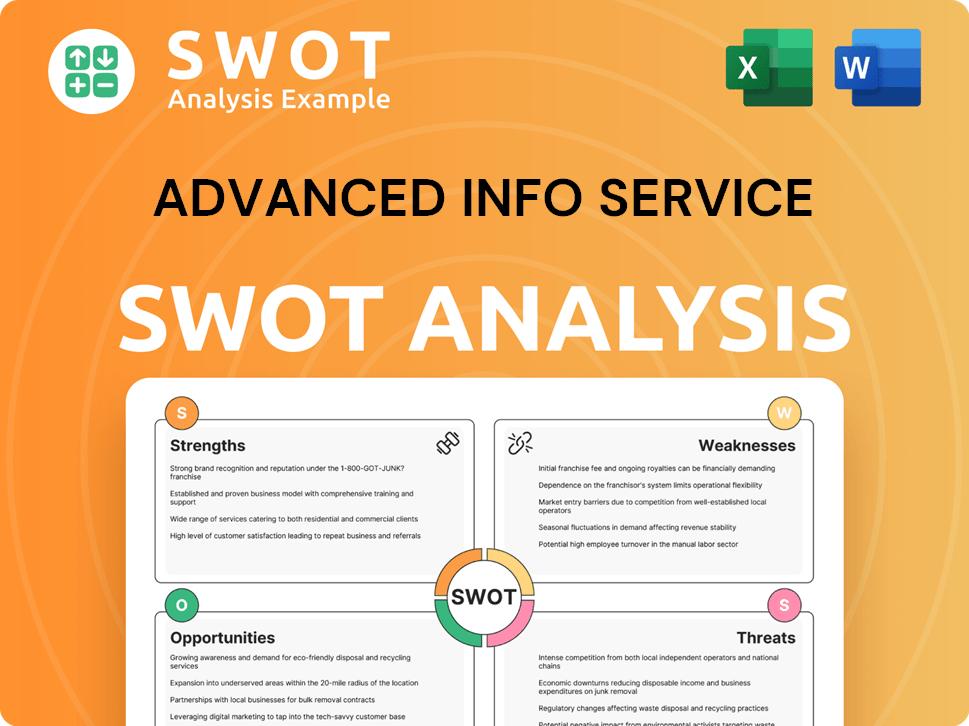
Advanced Info Service SWOT Analysis
- Complete SWOT Breakdown
- Fully Customizable
- Editable in Excel & Word
- Professional Formatting
- Investor-Ready Format
What Drove the Early Growth of Advanced Info Service?
The early years of Advanced Info Service (AIS) were marked by significant growth and expansion, transforming it from a fledgling startup into a dominant player in the Thailand telecommunications sector. Following its establishment in 1986, the company quickly capitalized on the rising demand for mobile connectivity. This period was characterized by strategic network expansion and diversification of services, laying the groundwork for its future success.
 Early Network Launch and Subscriber Growth
AIS launched its 900 MHz mobile phone network, a pivotal move that drove early adoption. Initial focus was on voice services, gradually introducing supplementary features to meet evolving consumer needs. Aggressive marketing and expanding network coverage were key drivers in rapidly growing the subscriber base. By the early 1990s, the company was already establishing a strong foothold in the market.
Service Diversification and Infrastructure Development
AIS began to diversify its service offerings beyond basic mobile calls, adapting to evolving consumer needs. Continuous rollout of network infrastructure across various regions of Thailand significantly increased accessibility. While specific figures for early capital raises are not readily available, the company's sustained growth indicates successful financial backing and reinvestment.
Market Reception and Competitive Landscape
The market reception to AIS's services was overwhelmingly positive, addressing a clear market gap. The competitive landscape in the early years was less intense, allowing AIS to establish a strong foothold. Strategic shifts during this period focused on network expansion and service diversification, laying the groundwork for its future dominance. The company's ability to adapt and innovate helped secure its position.
Public Listing and Strategic Focus
By 1994, AIS had become a publicly listed company on the Stock Exchange of Thailand, a testament to its rapid growth and market confidence. Leadership transitions saw professional management taking the helm as the company scaled, further solidifying its operational capabilities. For more insights into the company's business model, consider reading this article: Revenue Streams & Business Model of Advanced Info Service.
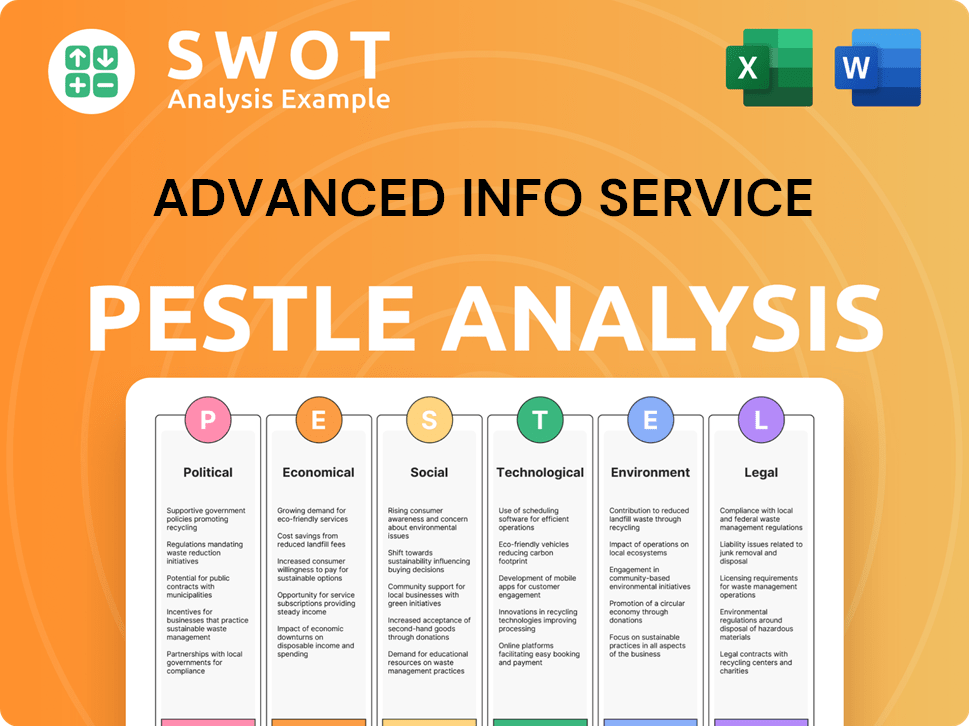
Advanced Info Service PESTLE Analysis
- Covers All 6 PESTLE Categories
- No Research Needed – Save Hours of Work
- Built by Experts, Trusted by Consultants
- Instant Download, Ready to Use
- 100% Editable, Fully Customizable
What are the key Milestones in Advanced Info Service history?
Advanced Info Service (AIS) has a rich history marked by significant milestones that have shaped Thailand's telecommunications landscape. From its early days as a pioneer in mobile communication to its current position as a leading mobile network operator, AIS has consistently adapted and evolved to meet the changing demands of the market. The company's journey is a testament to its resilience and commitment to innovation, as it continues to play a crucial role in Thailand's digital transformation. For more insights into their target audience, check out Target Market of Advanced Info Service.
| Year | Milestone |
|---|---|
| Late 1980s | Pioneered the introduction of mobile communication in Thailand, establishing the foundation for a digitally connected nation. |
| Early 2000s | Launched the first GSM network in Thailand, significantly expanding mobile services. |
| 2010s | Deployed 3G and 4G networks, enhancing mobile internet and data services across the country. |
| 2020 | Launched 5G services, marking a new era of high-speed mobile connectivity. |
| 2024 | Continued expanding its 5G network, aiming for 90% population coverage. |
AIS has consistently been at the forefront of technological advancements, introducing industry-first innovations such as 3G, 4G, and 5G services in Thailand. The company has also expanded its digital services and enterprise solutions through significant partnerships, including collaborations in smart city solutions and IoT applications.

3G Network Launch
AIS was among the first to launch 3G services, significantly improving mobile data speeds and connectivity for its customers. This advancement supported the growing demand for mobile internet and multimedia applications.
4G Network Deployment
AIS quickly adopted 4G technology, enhancing mobile broadband capabilities and providing faster and more reliable internet access. This improved user experience and supported the growth of data-intensive applications.
5G Network Expansion
AIS has been rapidly expanding its 5G network, aiming for extensive coverage across Thailand. This expansion is designed to support advanced applications and services, including IoT and smart city initiatives.
Digital Services Integration
AIS has integrated various digital services, such as mobile payments, entertainment platforms, and cloud services, to enhance customer experience. These services are designed to complement its core mobile offerings.
Enterprise Solutions
AIS has expanded its enterprise solutions portfolio, offering services such as IoT, cloud computing, and cybersecurity to businesses. These solutions support digital transformation across various industries.
Smart City and IoT Initiatives
AIS actively participates in smart city projects and IoT applications, demonstrating its commitment to digital transformation beyond traditional mobile services. These initiatives aim to improve urban living and efficiency.
AIS has faced significant challenges, including intense competition from other telecommunication providers and the need for substantial capital expenditure to upgrade its network infrastructure. The company has also navigated market saturation in certain segments, requiring strategic diversification.
Intense Market Competition
The telecommunications market in Thailand is highly competitive, with several major players vying for market share. This competition puts pressure on pricing and service offerings.
Capital Expenditure
Upgrading and maintaining network infrastructure, especially with the rollout of 5G, requires significant capital investment. This expenditure impacts financial performance and strategic planning.
Market Saturation
The mobile market in Thailand has reached a level of saturation, making it challenging to acquire new customers. This saturation necessitates diversification into new service areas.
Technological Transitions
The transition to new technologies, such as 5G, requires massive investments and strategic planning to ensure seamless adoption and return on investment. This includes managing the lifecycle of older technologies.
Diversification of Revenue Streams
To mitigate risks associated with market saturation, AIS has focused on diversifying its revenue streams. This includes expanding into fixed broadband and digital services to complement its mobile offerings.
Regulatory Changes
The telecommunications industry is subject to regulatory changes that can impact operations and investment strategies. AIS must adapt to these changes to maintain compliance and competitiveness.
Advanced Info Service Business Model Canvas
- Complete 9-Block Business Model Canvas
- Effortlessly Communicate Your Business Strategy
- Investor-Ready BMC Format
- 100% Editable and Customizable
- Clear and Structured Layout

What is the Timeline of Key Events for Advanced Info Service?
The history of Advanced Info Service (AIS) is marked by significant milestones. Founded in 1986 by Thaksin Shinawatra, AIS quickly became a key player in the Thailand telecommunications sector. The company launched its 900 MHz mobile phone network in 1990, and by 1994, it was listed on the Stock Exchange of Thailand. AIS expanded its network, introducing GPRS and EDGE services in the 2000s. The launch of 3G in 2011 and 4G in 2015 further solidified its position as a leading mobile network operator. In 2019, AIS secured 5G spectrum licenses, followed by the commercial launch of its 5G network in 2020. As of 2024, AIS continues to invest heavily in 5G infrastructure and digital services, aiming for 90% population coverage.
| Year | Key Event |
|---|---|
| 1986 | Advanced Info Service (AIS) is established by Thaksin Shinawatra. |
| 1990 | AIS launches its 900 MHz mobile phone network, entering the Thailand telecommunications market. |
| 1994 | AIS becomes a publicly listed company on the Stock Exchange of Thailand. |
| 2000s | AIS expands network coverage and introduces GPRS and EDGE services. |
| 2011 | AIS launches its 3G network, improving mobile data speeds. |
| 2015 | AIS begins its 4G service rollout, strengthening its mobile broadband position. |
| 2019 | AIS secures 5G spectrum licenses, preparing for next-generation connectivity. |
| 2020 | AIS commercially launches its 5G network, leading in 5G deployment in Thailand. |
| 2024 | AIS continues to expand its 5G network, aiming for 90% population coverage and investing in digital infrastructure. |
| 2025 | AIS is projected to continue its focus on 5G expansion, fiber broadband growth, and the development of new digital services and enterprise solutions, leveraging AI and IoT. |
5G Expansion and Coverage
AIS plans to further expand its 5G network to ensure extensive coverage across Thailand. This expansion is crucial for unlocking new revenue streams from industrial applications and smart city solutions. The company aims to achieve nearly ubiquitous coverage, enhancing connectivity for both consumers and businesses. This will support the growing demand for high-speed data and advanced digital services.
Fixed Broadband Growth
AIS is also focused on strengthening its fixed broadband business. The company aims to increase its market share in the home internet sector. This strategic move is driven by the increasing demand for reliable and high-speed internet access in households across Thailand. Investing in fiber broadband is a key priority.
Digital Services and Innovation
AIS is heavily investing in the development of digital services, including cloud computing, cybersecurity, and IoT solutions. These services are designed to cater to the evolving needs of both consumers and enterprises. The company's commitment to innovation is expected to maintain its leading position in the market. This includes the introduction of cutting-edge technologies.
Market Position and Strategy
Analyst predictions suggest that AIS will maintain its dominant position in the Thai telecommunications market. This is driven by its robust infrastructure, continuous innovation, and diversified service portfolio. The company's leadership emphasizes a commitment to sustainable growth and leveraging technology to improve the lives of Thais. To learn more about the company's ownership, check out the Owners & Shareholders of Advanced Info Service.
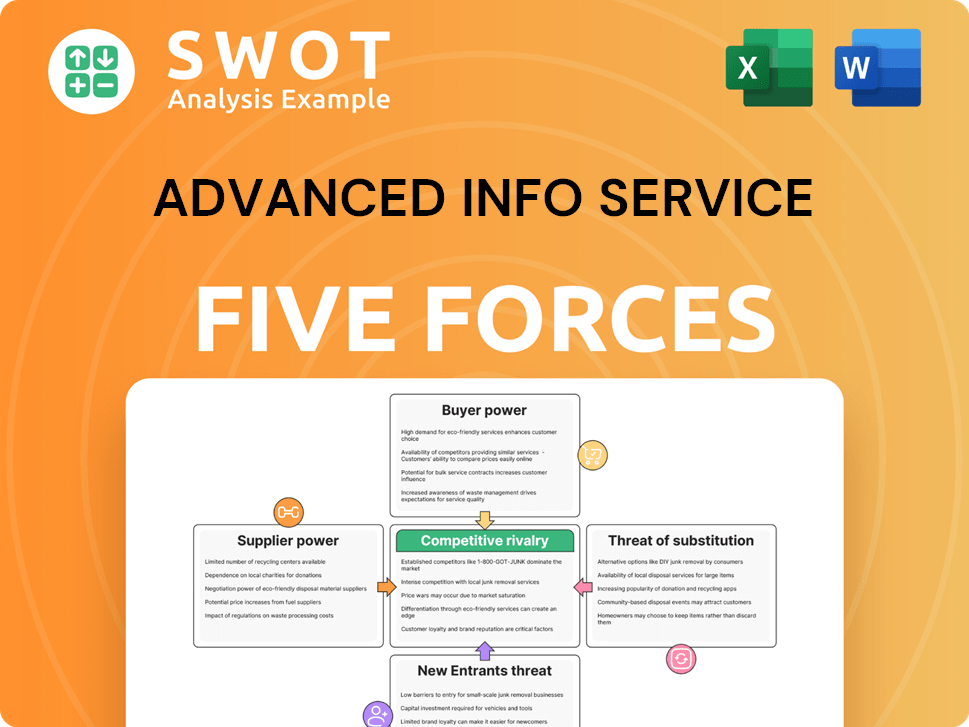
Advanced Info Service Porter's Five Forces Analysis
- Covers All 5 Competitive Forces in Detail
- Structured for Consultants, Students, and Founders
- 100% Editable in Microsoft Word & Excel
- Instant Digital Download – Use Immediately
- Compatible with Mac & PC – Fully Unlocked
Related Blogs

- What is Competitive Landscape of Advanced Info Service Company?
- What is Growth Strategy and Future Prospects of Advanced Info Service Company?
- How Does Advanced Info Service Company Work?
- What is Sales and Marketing Strategy of Advanced Info Service Company?
- What is Brief History of Advanced Info Service Company?
- Who Owns Advanced Info Service Company?
- What is Customer Demographics and Target Market of Advanced Info Service Company?
Disclaimer
All information, articles, and product details provided on this website are for general informational and educational purposes only. We do not claim any ownership over, nor do we intend to infringe upon, any trademarks, copyrights, logos, brand names, or other intellectual property mentioned or depicted on this site. Such intellectual property remains the property of its respective owners, and any references here are made solely for identification or informational purposes, without implying any affiliation, endorsement, or partnership.
We make no representations or warranties, express or implied, regarding the accuracy, completeness, or suitability of any content or products presented. Nothing on this website should be construed as legal, tax, investment, financial, medical, or other professional advice. In addition, no part of this site—including articles or product references—constitutes a solicitation, recommendation, endorsement, advertisement, or offer to buy or sell any securities, franchises, or other financial instruments, particularly in jurisdictions where such activity would be unlawful.
All content is of a general nature and may not address the specific circumstances of any individual or entity. It is not a substitute for professional advice or services. Any actions you take based on the information provided here are strictly at your own risk. You accept full responsibility for any decisions or outcomes arising from your use of this website and agree to release us from any liability in connection with your use of, or reliance upon, the content or products found herein.