

Allegion Bundle

How did Allegion become a global security leader?
Allegion, a leading Allegion SWOT Analysis, secures spaces worldwide, but its origins are surprisingly recent. Born from a strategic split from Ingersoll Rand in 2013, Allegion quickly emerged as a pure-play security company. This focused approach allowed Allegion to concentrate on innovative solutions, from mechanical locks to advanced access control systems.

Tracing the Allegion company timeline reveals a rapid ascent in the security industry. The separation from Ingersoll Rand was a pivotal moment, enabling Allegion to capitalize on the growing demand for sophisticated security solutions. Understanding the Allegion history is crucial to grasping its current market position and future potential as a leading security company.
What is the Allegion Founding Story?
The Allegion company officially launched its independent operations on December 1, 2013. This marked a significant shift, stemming from a strategic decision by Ingersoll Rand plc to spin off its security business. The move aimed to create two focused, publicly traded entities.
The separation was announced in December 2012, with the goal of allowing each company to better pursue its strategic objectives. This involved a new capital structure, management team, and strategic focus for Allegion. The spin-off was designed to unlock shareholder value by allowing the security segment to capitalize on the growing global demand for safety and access solutions.
While there isn't a single 'founder,' Allegion's origins are rooted in Ingersoll Rand's corporate strategy. The leadership team, including CEO Dave Petratis, played a key role in shaping Allegion's initial vision. The existing business model was to continue and expand security hardware and software offerings, including brands like Schlage and LCN. Initial funding came from assets and equity transferred during the spin-off. The name 'Allegion' was chosen to reflect concepts of allegiance and alliance in the security industry.

Key Highlights of Allegion's Founding
Allegion's inception was a strategic move by Ingersoll Rand to create a dedicated security company.
- The spin-off occurred on December 1, 2013.
- The company inherited established brands such as Schlage and LCN.
- The name 'Allegion' reflects its commitment to partnerships in the security sector.
- The spin-off allowed Allegion to immediately become a global player.
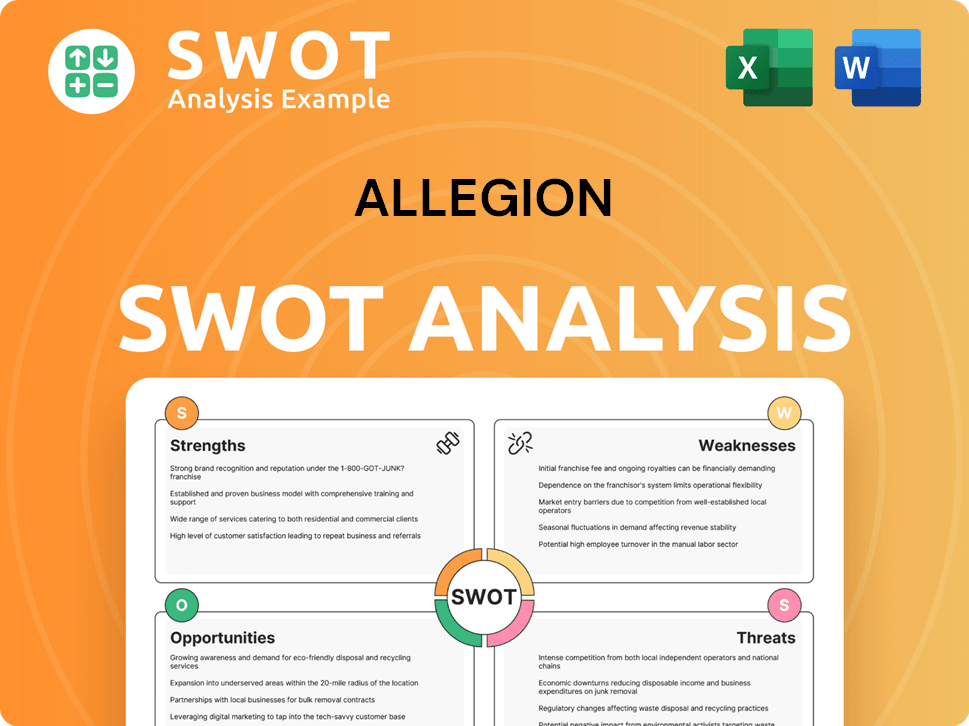
Allegion SWOT Analysis
- Complete SWOT Breakdown
- Fully Customizable
- Editable in Excel & Word
- Professional Formatting
- Investor-Ready Format
What Drove the Early Growth of Allegion?
Following its spin-off in December 2013, the Allegion company quickly established itself as a major player in the global security market. This early phase was marked by strategic expansions and a focus on integrating new technologies. The company leveraged its established brands to quickly gain market share and expand its product lines.
 Strategic Acquisitions
A key part of Allegion's early growth strategy was acquiring other companies. In 2014, the security company acquired Bricard, a French lock manufacturer, and in 2015, it acquired Republic Doors & Frames. These acquisitions helped Allegion expand its global presence and product offerings, particularly in the commercial market.
Product Innovation
Allegion also invested heavily in research and development to meet the changing needs of the security market. The company focused on integrating smart technology into its products, offering advanced security solutions for both homes and businesses. This commitment to innovation has been a key factor in its success.
Financial Performance and Global Expansion
Allegion's revenue has shown consistent growth, reaching $3.67 billion in 2023. The company expanded its operations globally, with a presence in North America, Europe, and Asia. This expansion, combined with a focus on innovation, has positioned Allegion as a leader in the security industry. Learn more about Allegion's core values and mission by reading about Allegion's mission.
Competitive Landscape
The competitive landscape, including both large and specialized firms, pushed Allegion to innovate. This led to strategic shifts towards integrated security solutions and connected technologies. Allegion continues to adapt and evolve, focusing on innovation and customer needs.
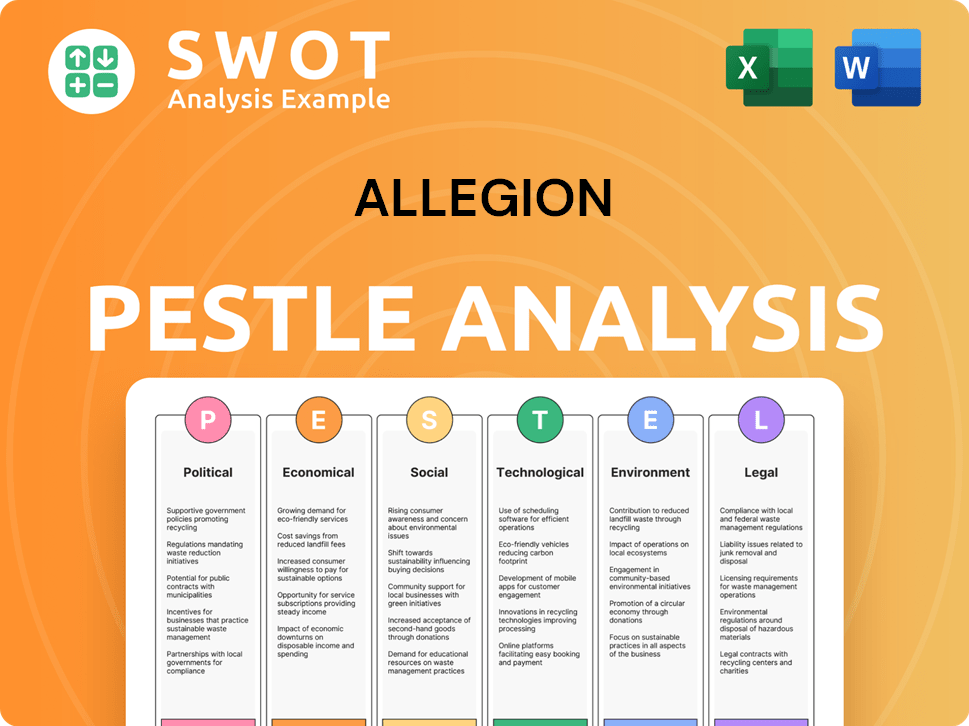
Allegion PESTLE Analysis
- Covers All 6 PESTLE Categories
- No Research Needed – Save Hours of Work
- Built by Experts, Trusted by Consultants
- Instant Download, Ready to Use
- 100% Editable, Fully Customizable
What are the key Milestones in Allegion history?
The Allegion company, a leading security company, has a rich history since its spin-off from Ingersoll Rand in 2013. This separation marked the beginning of a new era for the lock manufacturer, enabling it to focus on its own strategic direction and growth within the global security market. Allegion's journey has been characterized by significant milestones, innovative product development, and strategic responses to market challenges.
| Year | Milestone |
|---|---|
| 2013 | Allegion is established as a standalone, publicly traded company, separating from Ingersoll Rand. |
| 2014 | Allegion begins expanding its global footprint through strategic acquisitions and partnerships. |
| 2016 | The company launches several smart lock products, expanding its presence in the residential security market. |
| 2018 | Allegion acquires companies to strengthen its position in the electronic access control market. |
| 2020 | Allegion navigates the challenges of the COVID-19 pandemic, adapting its operations and supply chain. |
| 2023 | Allegion continues to innovate, focusing on integrated security solutions and expanding its product portfolio. |
Allegion's focus on innovation has been a key driver of its success, particularly in the realm of electronic access control and smart security solutions. The company has consistently invested in research and development to create advanced products and technologies, adapting to the evolving demands of the security market.

Smart Locks
Allegion has developed smart locks for residential use under the Schlage brand, offering enhanced security and convenience. These locks feature advanced technologies such as keyless entry, remote access, and integration with smart home platforms.
Access Control Systems
The company has created advanced access control systems for commercial applications, providing robust security solutions for businesses. These systems offer features like biometric authentication, audit trails, and integration with building management systems.
Wireless Connectivity
Allegion has integrated wireless connectivity into its products, allowing for remote monitoring and control. This enhances the convenience and security of its solutions, enabling users to manage access from anywhere.
Software and Integration
Allegion has developed software platforms and integrated its products with various smart home and building automation systems. This integration provides seamless access control and enhances overall security management.
Cybersecurity
Allegion has focused on strengthening the cybersecurity of its products to protect against cyber threats. This includes implementing encryption, secure protocols, and regular security updates to safeguard user data and system integrity.
Biometric Technology
Allegion has incorporated biometric technology, such as fingerprint and facial recognition, into its access control systems. This enhances security by providing advanced authentication methods and preventing unauthorized access.
Despite its achievements, Allegion, like other companies, has faced several challenges. These include intense competition from both established players and emerging technology companies, requiring continuous innovation and adaptation.
Competition
Allegion faces strong competition from both established security companies and new technology entrants. This competitive landscape necessitates ongoing innovation and differentiation to maintain market share.
Technological Advancements
The rapid pace of technological change requires Allegion to continuously invest in research and development. Staying ahead of the curve in areas like smart home integration and cybersecurity is crucial.
Supply Chain Disruptions
Economic fluctuations and supply chain disruptions, particularly in recent years, have posed operational challenges. Allegion has addressed these by optimizing its global supply chain and investing in resilient operational strategies.
Economic Factors
Economic downturns can impact the demand for security products, requiring Allegion to adapt its strategies. The company must remain flexible and responsive to changing market conditions.
Cybersecurity Threats
The increasing frequency and sophistication of cyberattacks pose a significant risk to security companies. Allegion must continuously enhance its cybersecurity measures to protect its products and customers.
Regulatory Compliance
Compliance with evolving regulations regarding data privacy and security is a constant challenge. Allegion must ensure its products and operations meet all relevant legal requirements.
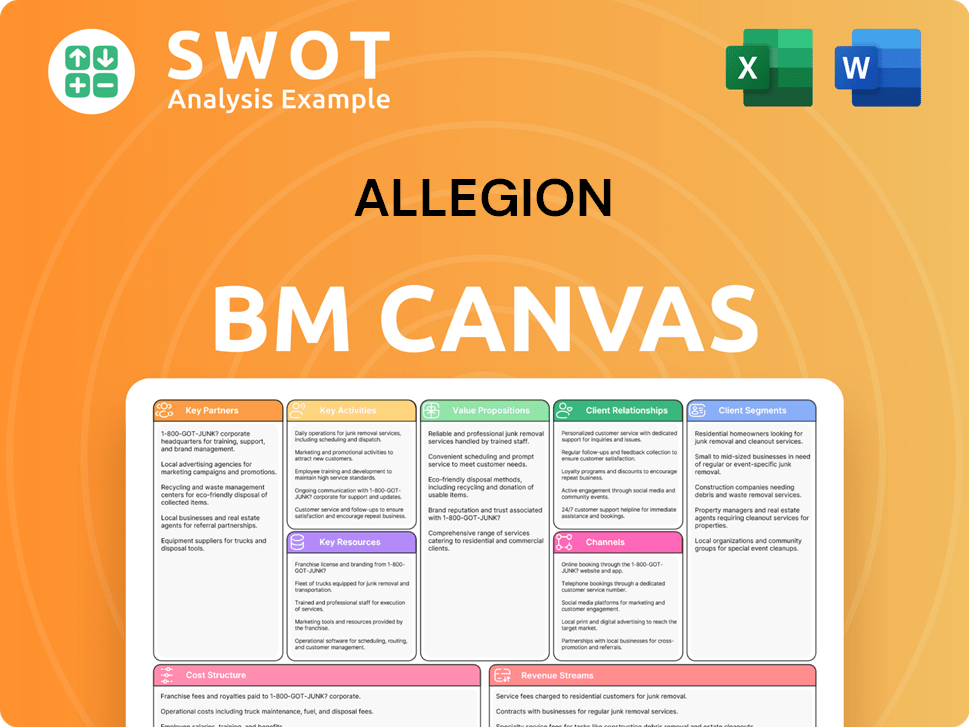
Allegion Business Model Canvas
- Complete 9-Block Business Model Canvas
- Effortlessly Communicate Your Business Strategy
- Investor-Ready BMC Format
- 100% Editable and Customizable
- Clear and Structured Layout
What is the Timeline of Key Events for Allegion?
The Allegion company has a rich history, marked by strategic moves and technological advancements. From its spin-off from Ingersoll Rand in 2013 to its continued focus on innovation, the company has consistently adapted to evolving market demands. Key milestones include significant acquisitions and investments in smart technology, driving its growth and solidifying its position as a leading security company.
| Year | Key Event |
|---|---|
| 2013 | Allegion spins off from Ingersoll Rand, becoming an independent, publicly traded company. |
| 2014 | Acquires Bricard, a leading French lock manufacturer, expanding its European presence. |
| 2015 | Acquires Republic Doors & Frames, enhancing its North American commercial offerings. |
| 2018 | Further expands its electronic security portfolio with strategic acquisitions. |
| 2020 | Navigates global supply chain challenges and shifts in market demand due to the COVID-19 pandemic. |
| 2021 | Continues to invest heavily in smart technology and integrated access solutions. |
| 2022 | Achieves significant revenue growth, demonstrating resilience and market strength. |
| 2023 | Reports a full-year revenue of $3.67 billion, a testament to its sustained growth. |
| 2024 | Focuses on expanding its presence in emerging markets and enhancing its digital offerings. |
| 2025 | Expected to continue leveraging technological advancements, particularly in AI and IoT, for enhanced security solutions. |
Global Expansion
Allegion is set to broaden its global reach, especially in developing economies. This strategy aligns with increasing demands for modern security infrastructure in these regions. The company aims to capitalize on emerging market growth to sustain its expansion and strengthen its global footprint.
Technological Innovation
Innovation remains a core focus, with a strong emphasis on electronic security. Allegion is investing in cloud-based access control and biometric solutions. The company is also expected to leverage advancements in AI and IoT to enhance security solutions, creating more integrated and efficient systems.
Integrated Solutions
Allegion is poised to capitalize on the trend of integrated building technologies. The company will offer holistic security solutions that connect with other building management systems. This integrated approach provides enhanced security and operational efficiency, meeting the growing demand for smart building solutions.
Market Trends and Outlook
Industry trends like smart technology adoption and touchless access solutions will positively impact Allegion. Analyst predictions suggest continued growth for the company within the evolving security market. Leadership emphasizes sustainable growth, operational excellence, and delivering shareholder value, ensuring a strong future.
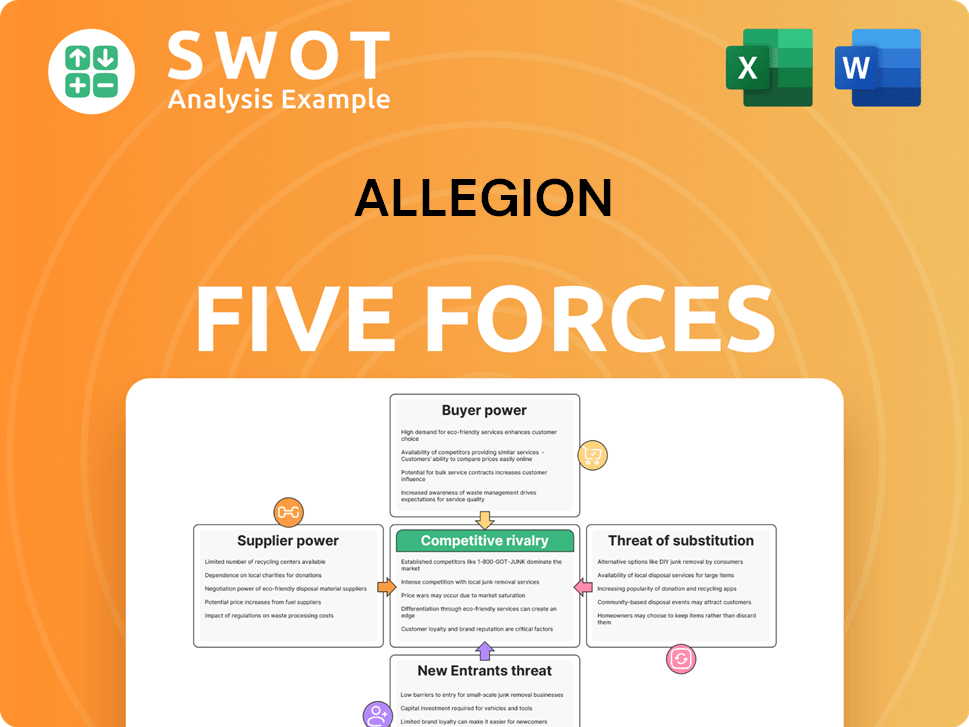
Allegion Porter's Five Forces Analysis
- Covers All 5 Competitive Forces in Detail
- Structured for Consultants, Students, and Founders
- 100% Editable in Microsoft Word & Excel
- Instant Digital Download – Use Immediately
- Compatible with Mac & PC – Fully Unlocked
Related Blogs

- What is Competitive Landscape of Allegion Company?
- What is Growth Strategy and Future Prospects of Allegion Company?
- How Does Allegion Company Work?
- What is Sales and Marketing Strategy of Allegion Company?
- What is Brief History of Allegion Company?
- Who Owns Allegion Company?
- What is Customer Demographics and Target Market of Allegion Company?
Disclaimer
All information, articles, and product details provided on this website are for general informational and educational purposes only. We do not claim any ownership over, nor do we intend to infringe upon, any trademarks, copyrights, logos, brand names, or other intellectual property mentioned or depicted on this site. Such intellectual property remains the property of its respective owners, and any references here are made solely for identification or informational purposes, without implying any affiliation, endorsement, or partnership.
We make no representations or warranties, express or implied, regarding the accuracy, completeness, or suitability of any content or products presented. Nothing on this website should be construed as legal, tax, investment, financial, medical, or other professional advice. In addition, no part of this site—including articles or product references—constitutes a solicitation, recommendation, endorsement, advertisement, or offer to buy or sell any securities, franchises, or other financial instruments, particularly in jurisdictions where such activity would be unlawful.
All content is of a general nature and may not address the specific circumstances of any individual or entity. It is not a substitute for professional advice or services. Any actions you take based on the information provided here are strictly at your own risk. You accept full responsibility for any decisions or outcomes arising from your use of this website and agree to release us from any liability in connection with your use of, or reliance upon, the content or products found herein.