

TC Energy Bundle

What Defines TC Energy's Legacy?
From its humble beginnings to its current stature, TC Energy has become a cornerstone of North America's energy landscape. Did you know that in February 2025, TC Energy completed the Southeast Gateway pipeline project 13% under budget? This achievement underscores the company's operational excellence and strategic vision.

Founded in 1951 as Trans-Canada Pipe Lines Limited in Calgary, Alberta, the TC Energy SWOT Analysis reveals a company that has consistently adapted and expanded. This brief history of TC Energy company will delve into the key milestones, including significant acquisitions and projects, that have shaped this leading pipeline company. Explore the evolution of this Canadian energy giant and its impact on the energy infrastructure across North America.
What is the TC Energy Founding Story?
The story of TC Energy, formerly known as TransCanada, began in 1951. It was established by a Special Act of Parliament as Trans-Canada Pipe Lines Limited. The primary goal was to develop the TransCanada Pipeline, now known as the Canadian Mainline.
The company's headquarters were initially in Calgary, Alberta, Canada. The vision was to transport natural gas from Western Canada to Eastern Canadian markets. James Anderson, the first president, led the founding team starting in 1954.
The initial capital investment for the TransCanada Pipeline construction was $350 million. This project aimed to connect the abundant natural gas resources in the west with the energy demands of the east. The original business model focused on pipeline operations, providing essential natural gas transmission services.

Brief History of TC Energy
TC Energy's history is marked by its pivotal role in Canadian energy infrastructure.
- Incorporated in 1951 as Trans-Canada Pipe Lines Limited.
- Focused on building and operating the TransCanada Pipeline (Canadian Mainline).
- The initial investment for the pipeline was $350 million.
- The company's initial focus was transporting natural gas from Western to Eastern Canada.
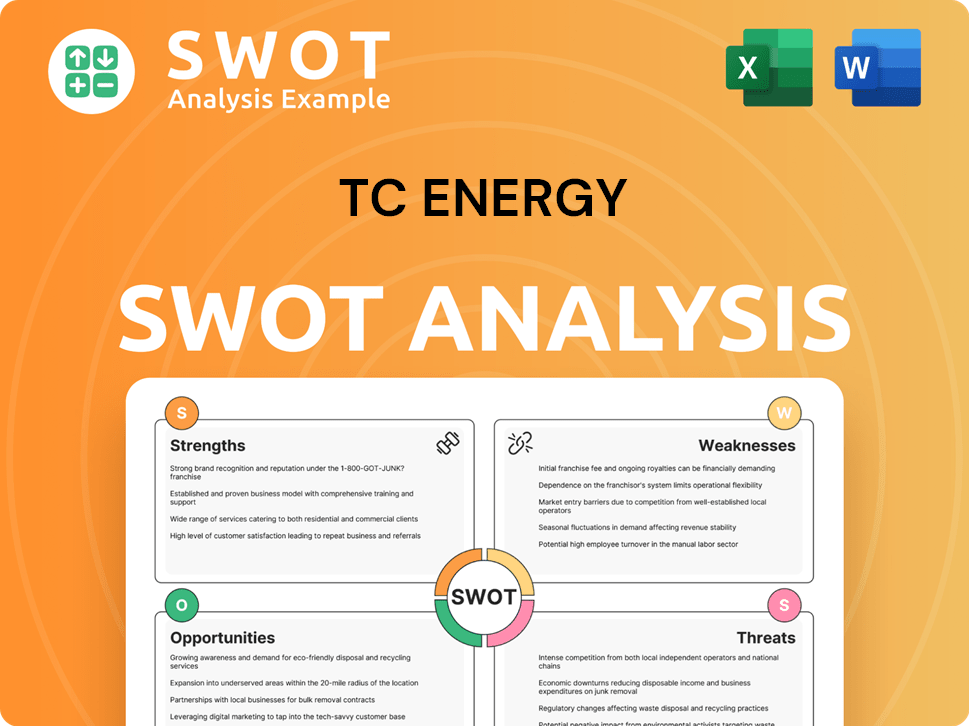
TC Energy SWOT Analysis
- Complete SWOT Breakdown
- Fully Customizable
- Editable in Excel & Word
- Professional Formatting
- Investor-Ready Format
What Drove the Early Growth of TC Energy?
The early years of TC Energy, formerly known as Trans-Canada Pipe Lines Limited, were marked by significant infrastructure development and strategic acquisitions. This pipeline company laid the groundwork for its future as a major player in the North American energy market. The company's expansion strategy included both organic growth and strategic mergers, shaping its portfolio and market presence.
 Founding and Early Infrastructure
Founded in 1951, Trans-Canada Pipe Lines Limited began with the ambitious goal of transporting natural gas across Canada. A key milestone was the completion of the TransCanada Pipeline in 1958, a critical piece of Canadian energy infrastructure that connected Alberta's gas fields to Eastern Canada. This project established the company's core business of natural gas transportation.
Expansion into the U.S. Market
The company broadened its reach beyond Canada in 1971 with the acquisition of Great Lakes Gas Transmission, marking its initial entry into the U.S. market. This strategic move expanded its operational footprint and provided access to new markets and revenue streams. This expansion was a precursor to further growth south of the border.
Mergers and Diversification
In 1998, TransCanada Pipelines merged with NOVA Corporation's pipeline business, retaining the TransCanada name. This merger transformed the company into one of North America's largest energy infrastructure services companies, significantly diversifying its portfolio. The merger broadened its scope beyond natural gas pipelines to include power generation.
Further U.S. Expansion
The acquisition of Columbia Pipeline Group in 2016 further solidified TransCanada's presence in the United States. This acquisition added numerous projects and assets, significantly increasing the company's operational scale. The expansion led to a rise in legal advice requests related to jurisdictional licensing and stamping requirements.
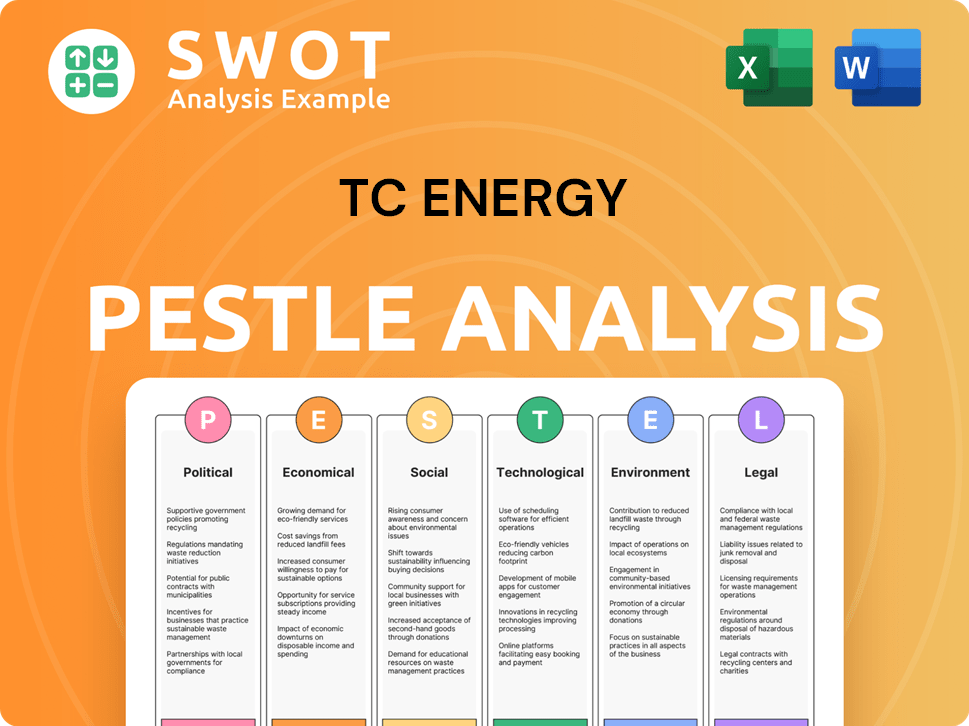
TC Energy PESTLE Analysis
- Covers All 6 PESTLE Categories
- No Research Needed – Save Hours of Work
- Built by Experts, Trusted by Consultants
- Instant Download, Ready to Use
- 100% Editable, Fully Customizable
What are the key Milestones in TC Energy history?
The TC Energy history is marked by significant milestones, including the construction of the TransCanada Pipeline and strategic expansions. The company has adapted and grown, reflecting its commitment to the energy sector and its infrastructure development.
| Year | Milestone |
|---|---|
| 1958 | Completion of the TransCanada Pipeline, a major achievement in Canadian engineering. |
| 1998 | Diversification into power generation, expanding its business portfolio. |
| 2016 | Acquisition of Columbia Pipeline Group, expanding the natural gas pipeline network in the U.S. |
| 2019 | Rebranding to TC Energy, reflecting a broader focus on various forms of energy infrastructure. |
| 2024 | Spin-off of the Liquids Pipelines business into South Bow Corporation, streamlining focus. |
| May 2025 | Announcement of $2.4 billion in new natural gas and nuclear power generation projects. |
TC Energy has consistently embraced innovation to enhance its operations and environmental impact. Early adoption of remote monitoring systems and the exploration of hydrogen-blending pilots are examples of this commitment.

Remote Monitoring
Early adoption of remote monitoring equipment for cathodic protection systems in the late 1990s improved data collection. This reduced travel to remote sites, enhancing efficiency.
Hydrogen Blending Pilots
Exploration of hydrogen-blending pilots shows a 15% greenhouse gas reduction potential in existing gas pipelines. This initiative supports sustainable energy practices.
AI-Driven Leak Detection
Development of AI-driven leak detection systems (patent #CA2024-124) enhances safety and security. This technology improves operational efficiency.
Northwoods Project
The Northwoods project is one of the new natural gas projects. This project is part of the $2.4 billion investment in new energy projects.
Bruce Power Unit 5 Upgrade
The Bruce Power Unit 5 upgrade is part of the nuclear power generation projects. This upgrade is also part of the $2.4 billion investment in new energy projects.
The pipeline company has faced challenges, including regulatory impacts and market volatility. Despite these, TC Energy has shown resilience through strategic financial decisions and operational adjustments.
National Energy Program Impact
The National Energy Program (NEP) in the 1980s increased regulation and government intervention. This policy significantly impacted the company's operations.
Market Volatility
Market volatility and macroeconomic uncertainties pose ongoing challenges. TC Energy manages these through strategic financial planning.
Financial Performance
Comparable EBITDA increased by 6% year-over-year to $10 billion in 2024. Segmented earnings jumped 57% to $8 billion, demonstrating strong financial health.
Strategic Divestitures
The spin-off of the Liquids Pipelines business into South Bow Corporation streamlined focus. This move reduced debt and enhanced financial flexibility.
Capital Allocation
Disciplined capital allocation reflects a commitment to financial health. This approach supports operational efficiency and long-term sustainability.
Indigenous Group Ownership
The energy sector sees a growing trend toward inclusive investment. Indigenous groups are entering the ownership structure of energy infrastructure.
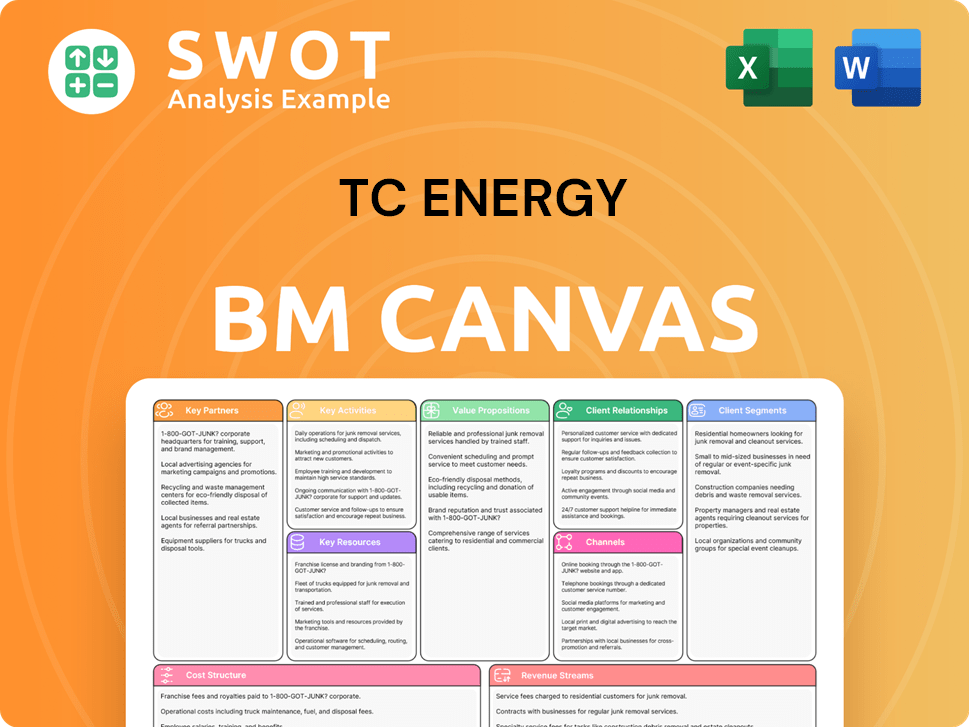
TC Energy Business Model Canvas
- Complete 9-Block Business Model Canvas
- Effortlessly Communicate Your Business Strategy
- Investor-Ready BMC Format
- 100% Editable and Customizable
- Clear and Structured Layout
What is the Timeline of Key Events for TC Energy?
The Growth Strategy of TC Energy has evolved significantly since its inception. Founded in 1951 as Trans-Canada Pipe Lines Limited, the company has grown through strategic acquisitions and expansions. Key milestones include the completion of the TransCanada Pipeline in 1958, entry into the U.S. market in 1971, and a merger with NOVA Corporation in 1998. The acquisition of Columbia Pipeline Group in 2016 further solidified its presence in the U.S. natural gas pipeline network. The company rebranded to TC Energy in 2019, reflecting its broader energy infrastructure focus.
| Year | Key Event |
|---|---|
| 1951 | Founded as Trans-Canada Pipe Lines Limited in Calgary, Alberta. |
| 1958 | Completed the TransCanada Pipeline (now Canadian Mainline). |
| 1971 | Acquired Great Lakes Gas Transmission, expanding into the U.S. market. |
| 1998 | Merged with NOVA Corporation's pipeline business, diversifying into power generation. |
| 2016 | Acquired Columbia Pipeline Group, further expanding U.S. natural gas pipeline network. |
| 2019 | Rebranded to TC Energy. |
| October 1, 2024 | Spin-off of Liquids Pipelines business into South Bow Corporation. |
| November 2024 | Announced fiscal 2025 comparable EBITDA guidance of C$10.7 billion to C$10.9 billion. |
| November 2024 | Announced four new growth projects totaling approximately C$1.5 billion in gross capital expenditures. |
| February 2025 | Southeast Gateway pipeline project achieves mechanical completion, 13% under budget. |
| March 31, 2025 | Mexico Natural Gas Pipelines set a total daily record flow of 4.1 Bcf. |
| May 1, 2025 | Southeast Gateway pipeline expected to be in service. |
| May 2025 | Announced $2.4 billion in new natural gas and nuclear power projects. |
| May 2025 | Reaffirmed 2025 comparable EBITDA outlook of $10.7 billion to $10.9 billion. |
| Late May 2025 | Expected CNE approval for the Southeast Gateway Pipeline. |
Future Growth in Natural Gas
TC Energy anticipates a significant increase in North American natural gas demand. Projections indicate an increase of over 30% by 2035, reaching 160 billion cubic feet per day from 120 billion cubic feet per day in 2023. This growth is fueled by rising LNG exports and the shift from coal to gas in power generation.
Projected Financial Performance
The company is focused on disciplined capital allocation and maximizing asset value. TC Energy expects a comparable EBITDA growth rate of approximately five to seven percent through 2027. They anticipate placing roughly $8.5 billion of projects into service in 2025, with expectations of being about 15% under budget.
Strategic Initiatives and Projects
TC Energy's secured project backlog has grown to $28 billion, including new projects like the Northwoods project and the Bruce Unit 5 Major Component Replacement. The Southeast Gateway pipeline is expected to be in service by May 1, 2025. In May 2025, the company announced $2.4 billion in new natural gas and nuclear power projects.
Sustainability and Environmental Goals
TC Energy is committed to achieving net-zero emissions from its operations by 2050. The company's leadership emphasizes safety, operational excellence, and responsible environmental practices. These efforts are aligned with meeting contemporary energy demands and contributing to a more sustainable future.
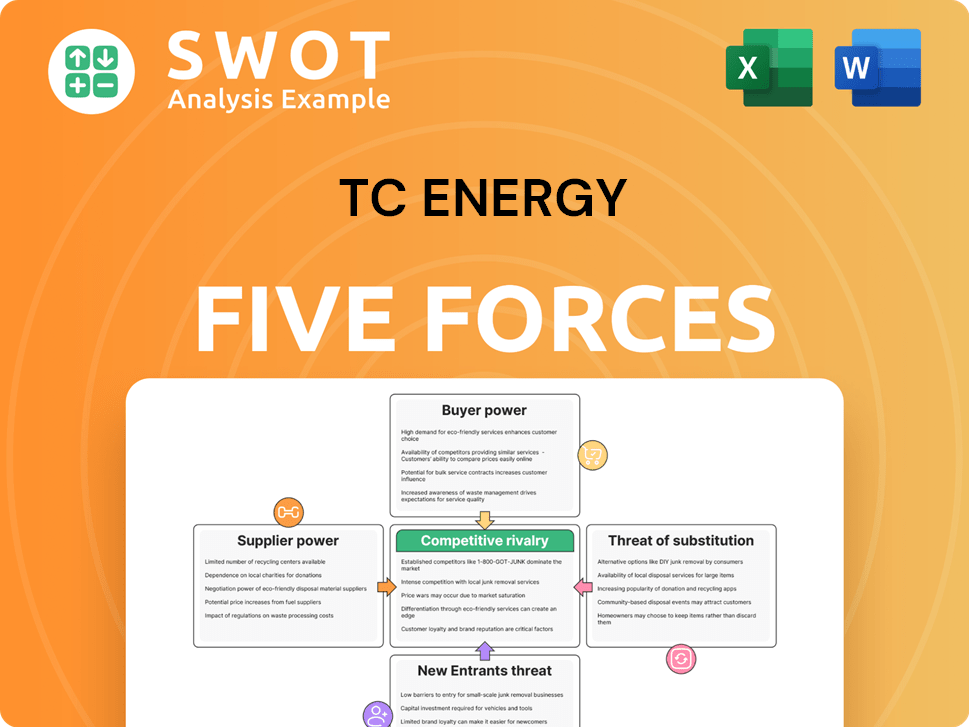
TC Energy Porter's Five Forces Analysis
- Covers All 5 Competitive Forces in Detail
- Structured for Consultants, Students, and Founders
- 100% Editable in Microsoft Word & Excel
- Instant Digital Download – Use Immediately
- Compatible with Mac & PC – Fully Unlocked
Related Blogs

- What is Competitive Landscape of TC Energy Company?
- What is Growth Strategy and Future Prospects of TC Energy Company?
- How Does TC Energy Company Work?
- What is Sales and Marketing Strategy of TC Energy Company?
- What is Brief History of TC Energy Company?
- Who Owns TC Energy Company?
- What is Customer Demographics and Target Market of TC Energy Company?
Disclaimer
All information, articles, and product details provided on this website are for general informational and educational purposes only. We do not claim any ownership over, nor do we intend to infringe upon, any trademarks, copyrights, logos, brand names, or other intellectual property mentioned or depicted on this site. Such intellectual property remains the property of its respective owners, and any references here are made solely for identification or informational purposes, without implying any affiliation, endorsement, or partnership.
We make no representations or warranties, express or implied, regarding the accuracy, completeness, or suitability of any content or products presented. Nothing on this website should be construed as legal, tax, investment, financial, medical, or other professional advice. In addition, no part of this site—including articles or product references—constitutes a solicitation, recommendation, endorsement, advertisement, or offer to buy or sell any securities, franchises, or other financial instruments, particularly in jurisdictions where such activity would be unlawful.
All content is of a general nature and may not address the specific circumstances of any individual or entity. It is not a substitute for professional advice or services. Any actions you take based on the information provided here are strictly at your own risk. You accept full responsibility for any decisions or outcomes arising from your use of this website and agree to release us from any liability in connection with your use of, or reliance upon, the content or products found herein.