

Essity Bundle

How Does Essity Stack Up in the Global Hygiene and Health Arena?
The hygiene and health market is a dynamic battleground, constantly reshaped by innovation and consumer preferences. Essity, a global leader, is a key player in this evolving landscape. Its strategic moves and product advancements consistently put it at the forefront of industry discussions, making understanding its competitive position crucial.

This analysis will delve into the Essity SWOT Analysis to explore its market position, key rivals, and competitive advantages. We'll examine the Essity competitive landscape, including its market share, and how it navigates the ever-changing trends and challenges within the Essity industry. This deep dive into Essity competitors and market analysis will provide valuable insights for investors and business strategists alike.
Where Does Essity’ Stand in the Current Market?
Understanding the Essity competitive landscape involves recognizing its strong market positions across several key segments. The company operates within the Essity industry, focusing on hygiene and health products. A detailed Essity market analysis reveals the company's strategic strengths and areas for growth.
Essity's core operations revolve around three main segments: Personal Care, Consumer Tissue, and Professional Hygiene. The value proposition of Essity lies in providing essential hygiene and health products globally, with a focus on innovation, sustainability, and customer needs. This approach has solidified its Essity market share in several key areas.
Essity's market position is characterized by its leadership in several key segments. For instance, in 2023, Essity's net sales reached approximately SEK 147 billion, demonstrating its substantial scale and financial health. This financial performance is a critical factor in assessing its competitive standing. Essity's strategy includes a focus on sustainable solutions and digital transformation.
 Personal Care Market Leadership
Essity is the global market leader in incontinence products under the TENA brand. This segment continues to see growth, driven by an aging global population and increased awareness. The company's expertise and established distribution channels support its dominant position in this market.
Consumer Tissue Market Position
Essity holds a top-three market position globally in consumer tissue products. Brands like Plenty and Edet contribute to this strong presence. The company's geographic reach is extensive, with significant presence in Europe and North America, and growing in emerging markets.
Professional Hygiene Leadership
Through its Tork brand, Essity is a leading global provider of hygiene solutions for businesses and institutions. This segment serves a diverse range of customers, from offices to healthcare facilities. Essity's focus on digital tools enhances its professional hygiene offerings.
Geographic Market Presence
Essity's geographic presence is a key factor in its market position. The company maintains strong positions in mature markets, such as Europe and North America. Essity is actively investing in emerging markets for future growth.

Strategic Shifts and Financial Performance
Essity is strategically emphasizing sustainable solutions and digital transformation. E-commerce channels and digital tools are being developed to enhance professional hygiene offerings. The company's financial health, with net sales around SEK 147 billion in 2023, showcases its scale and market strength.
- Focus on sustainable products and practices.
- Expansion of e-commerce channels.
- Investment in digital tools for professional hygiene.
- Strong financial performance, with substantial net sales.
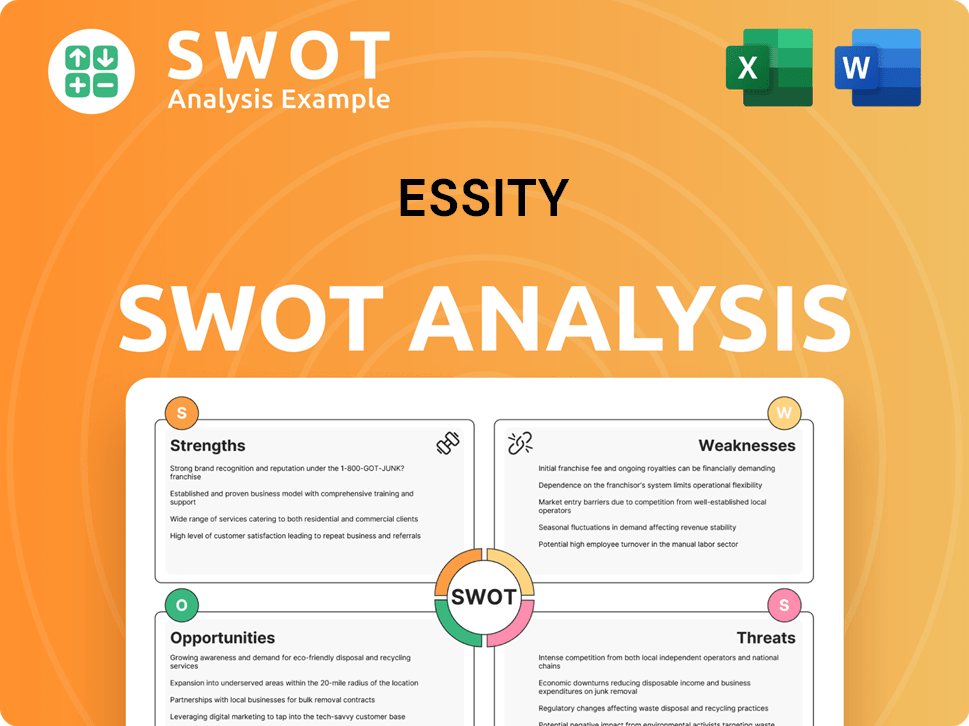
Essity SWOT Analysis
- Complete SWOT Breakdown
- Fully Customizable
- Editable in Excel & Word
- Professional Formatting
- Investor-Ready Format
Who Are the Main Competitors Challenging Essity?
Understanding the Essity competitive landscape is crucial for assessing its market position and strategic direction. The company operates in diverse segments, each facing unique competitive pressures. This analysis delves into the key players challenging Essity across its core business areas, providing insights into their strengths, strategies, and market dynamics.
The Essity market analysis reveals a complex interplay of global and regional competitors. These competitors vary in size, scope, and product offerings, influencing Essity's strategies for maintaining and growing its market share. Competitive pressures stem from pricing, innovation, distribution networks, and brand recognition.
This overview aims to provide a comprehensive understanding of Essity competitors and the broader Essity industry dynamics. By examining the competitive landscape, stakeholders can better evaluate Essity's performance, identify potential risks and opportunities, and inform strategic decision-making.

Personal Care Competitors
In the personal care segment, Essity faces significant competition, particularly in the adult incontinence market. Key competitors include global giants like Kimberly-Clark and Procter & Gamble. These companies compete through strong brand recognition and product innovation.
Consumer Tissue Competitors
The consumer tissue segment is highly competitive, with major players such as Kimberly-Clark and Procter & Gamble. These competitors engage in intense price competition and promotional activities. Regional and private label brands also pose challenges.
Professional Hygiene Competitors
In professional hygiene, Essity's Tork brand competes with Kimberly-Clark Professional and Georgia-Pacific Professional. The competition focuses on product performance, service, and cost-effectiveness. New entrants with innovative solutions also disrupt the market.
Market Dynamics
The competitive landscape is dynamic, with mergers and acquisitions impacting raw material costs and competitive dynamics. Market share is influenced by factors such as brand loyalty, distribution networks, and product innovation. Sustainability initiatives are also becoming increasingly important.
Strategic Considerations
Essity must continually adapt its strategies to maintain a competitive edge. This includes focusing on innovation, optimizing distribution, and responding to changing consumer preferences. Understanding the competitive environment is critical for long-term success.
Financial Performance
Analyzing Essity's financial performance compared to rivals is essential. This involves comparing revenue growth, profitability, and market share. For instance, in 2024, Essity's net sales increased by 7.7%, showing its ability to navigate the competitive landscape effectively.
Key Competitors and Their Strategies
The competitive landscape is shaped by the strategies of key players. Understanding these strategies provides insight into the challenges and opportunities Essity faces. For example, Kimberly-Clark's focus on brand recognition and product innovation directly impacts Essity's market position.
- Kimberly-Clark: Employs strong brand recognition (e.g., Depend, Kleenex) and extensive distribution networks. They focus on continuous product innovation in absorbent hygiene and tissue products.
- Procter & Gamble: Leverages vast marketing power and a broad product portfolio (e.g., Always Discreet, Charmin). Their strategy includes aggressive marketing campaigns and product diversification.
- Georgia-Pacific: Competes in the consumer tissue and professional hygiene segments (e.g., Brawny, Quilted Northern). They focus on cost-effectiveness and bulk solutions, particularly in the professional market.
- Regional and Private Label Brands: These brands often have strong local brand loyalty and established distribution networks, especially in Europe. They compete on price and targeted marketing.
- New Entrants: In professional hygiene, new entrants offer innovative, technology-driven hygiene solutions, impacting the market.
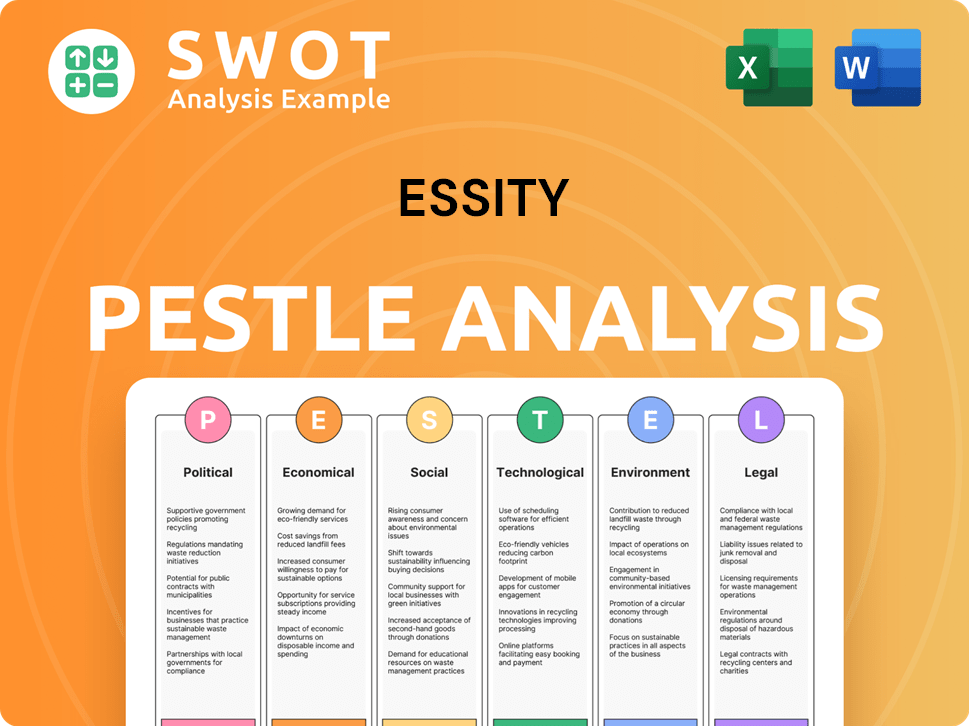
Essity PESTLE Analysis
- Covers All 6 PESTLE Categories
- No Research Needed – Save Hours of Work
- Built by Experts, Trusted by Consultants
- Instant Download, Ready to Use
- 100% Editable, Fully Customizable
What Gives Essity a Competitive Edge Over Its Rivals?
Understanding the Brief History of Essity is crucial for analyzing its competitive advantages within the Essity competitive landscape. The company distinguishes itself through a blend of strong brand recognition, a vast global reach, and a dedication to innovation and sustainability. These factors contribute to its ability to maintain a leading position in the hygiene and health sector, setting it apart from its Essity competitors.
Essity's strategic focus on consumer needs, especially in healthcare and professional settings, allows for tailored product development and service offerings. Continuous investment in technology, brand building, and sustainable practices reinforces its competitive edge. This approach is particularly relevant in today's market, where consumers and businesses increasingly prioritize environmental responsibility.
The company's success is underpinned by its strong financial performance. For instance, in 2024, Essity reported net sales of approximately SEK 157 billion. This financial strength supports its capacity to invest in innovation and expansion, further solidifying its market position. A deep dive into an Essity market analysis reveals how these elements combine to create a robust competitive strategy.
Brand Strength and Market Leadership
Essity's brands, such as TENA and Tork, hold significant market share and high consumer trust. These brands benefit from decades of recognition, translating into customer loyalty and pricing power. This brand equity is a key component of Essity's competitive advantages and helps it maintain a strong position in the Essity industry.
Global Distribution Network
Essity's products are available in approximately 150 countries, a vast network that enables economies of scale. This extensive distribution network enhances cost efficiencies in production and logistics. This global presence is a critical factor in the Essity competitive landscape, allowing it to reach a broad customer base.
Innovation and Product Development
The company continuously invests in research and development to introduce new and improved products. Recent innovations include advancements in absorbent materials, sustainable tissue production, and smart hygiene solutions. These efforts are crucial for maintaining a competitive edge in the dynamic market.
Sustainability Initiatives
Essity's commitment to sustainability, including circular business models and responsible sourcing, resonates with environmentally conscious consumers. This focus on sustainability acts as a competitive differentiator, enhancing brand image and aligning with evolving consumer preferences. This is a key aspect of Essity's strategies for market dominance.
Key Competitive Advantages
Essity's competitive advantages are built on brand strength, global reach, innovation, and sustainability. These factors contribute to its ability to maintain a leading position in the hygiene and health sector. The company's focus on these areas helps it navigate challenges in the market and maintain its competitive positioning.
- Strong brand equity and market leadership in key categories.
- Extensive global distribution network with a presence in approximately 150 countries.
- Continuous investment in research and development for product innovation.
- Commitment to sustainability, including circular business models and responsible sourcing.
Essity Business Model Canvas
- Complete 9-Block Business Model Canvas
- Effortlessly Communicate Your Business Strategy
- Investor-Ready BMC Format
- 100% Editable and Customizable
- Clear and Structured Layout

What Industry Trends Are Reshaping Essity’s Competitive Landscape?
The Essity competitive landscape is significantly shaped by industry trends, regulatory changes, and the evolving demands of consumers. The company faces both challenges and opportunities in a market characterized by innovation, sustainability concerns, and the rise of digital solutions. A thorough Essity market analysis reveals a complex interplay of factors influencing its strategic direction and future growth prospects.
Understanding the Essity industry dynamics is crucial for assessing its competitive position. The company's ability to adapt to new technologies, address sustainability issues, and navigate economic uncertainties will be critical for maintaining and enhancing its market share. This analysis provides insights into the key drivers and potential hurdles that will shape Essity's future.
Industry Trends
Technological advancements are driving innovation in product design, manufacturing, and supply chain management. The increasing focus on health and well-being, coupled with an aging global population, boosts demand for personal care items. The rise of smart hygiene solutions, like connected dispensers, offers opportunities to improve customer efficiency.
Future Challenges
Intense price competition, particularly in the consumer tissue segment, presents a challenge. Economic downturns and supply chain disruptions can impact raw material costs and consumer spending. Regulatory changes, especially concerning environmental impact and product safety, require continuous adaptation in production processes and formulations.
Opportunities
Significant growth potential exists in emerging markets, where hygiene standards are improving and disposable incomes are rising. Product innovations, such as advanced absorbent materials and personalized hygiene solutions, offer avenues for expansion. Strategic partnerships with technology companies or healthcare providers could strengthen market position.
Competitive Positioning
Essity's competitive position is evolving towards greater emphasis on digitalization, personalized solutions, and a circular business model. The company is well-positioned to capitalize on the growing demand for sustainable and eco-friendly products. This involves investing in renewable materials and reducing carbon emissions.
Key Strategies for Market Dominance
To maintain and enhance its market share, Essity focuses on several key strategies. These include continuous innovation in product development, expansion in emerging markets, and strategic partnerships. The company also emphasizes sustainability and digital transformation to meet evolving consumer demands.
- Product Innovation: Developing advanced absorbent materials and personalized hygiene solutions.
- Geographic Expansion: Targeting emerging markets with rising disposable incomes.
- Sustainability Initiatives: Investing in renewable materials and reducing carbon emissions.
- Digital Transformation: Embracing digital health services and smart hygiene solutions.
The Essity competitive landscape is influenced by various factors, including Essity competitors and market dynamics. Understanding the company’s Essity market share and its strategies for success is crucial for a comprehensive analysis. For a deeper understanding of Essity's business model and revenue streams, consider exploring Revenue Streams & Business Model of Essity.
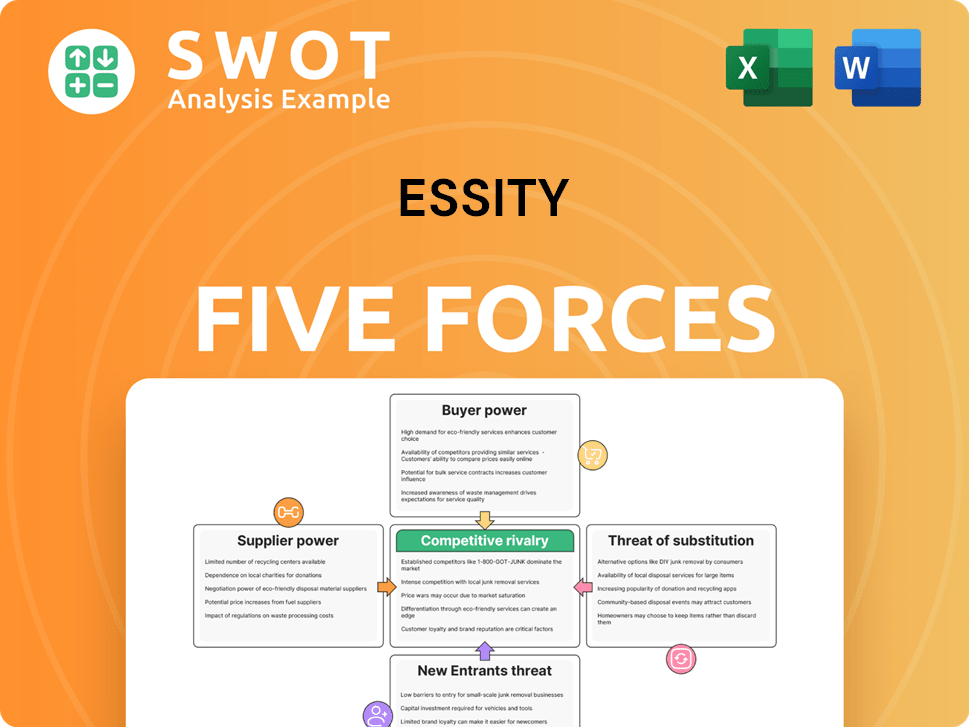
Essity Porter's Five Forces Analysis
- Covers All 5 Competitive Forces in Detail
- Structured for Consultants, Students, and Founders
- 100% Editable in Microsoft Word & Excel
- Instant Digital Download – Use Immediately
- Compatible with Mac & PC – Fully Unlocked
Related Blogs

- What are Mission Vision & Core Values of Essity Company?
- What is Growth Strategy and Future Prospects of Essity Company?
- How Does Essity Company Work?
- What is Sales and Marketing Strategy of Essity Company?
- What is Brief History of Essity Company?
- Who Owns Essity Company?
- What is Customer Demographics and Target Market of Essity Company?
Disclaimer
All information, articles, and product details provided on this website are for general informational and educational purposes only. We do not claim any ownership over, nor do we intend to infringe upon, any trademarks, copyrights, logos, brand names, or other intellectual property mentioned or depicted on this site. Such intellectual property remains the property of its respective owners, and any references here are made solely for identification or informational purposes, without implying any affiliation, endorsement, or partnership.
We make no representations or warranties, express or implied, regarding the accuracy, completeness, or suitability of any content or products presented. Nothing on this website should be construed as legal, tax, investment, financial, medical, or other professional advice. In addition, no part of this site—including articles or product references—constitutes a solicitation, recommendation, endorsement, advertisement, or offer to buy or sell any securities, franchises, or other financial instruments, particularly in jurisdictions where such activity would be unlawful.
All content is of a general nature and may not address the specific circumstances of any individual or entity. It is not a substitute for professional advice or services. Any actions you take based on the information provided here are strictly at your own risk. You accept full responsibility for any decisions or outcomes arising from your use of this website and agree to release us from any liability in connection with your use of, or reliance upon, the content or products found herein.