

Dropbox Bundle

Can Dropbox Conquer the Future of Collaboration?
Dropbox's journey from a simple file-sharing tool to a comprehensive content collaboration platform is a compelling story of adaptation and innovation. The 2021 acquisition of DocSend was a game-changer, signaling a strategic pivot beyond its initial cloud storage roots. With hundreds of millions of users globally, how does Dropbox plan to maintain its momentum in the competitive cloud services industry?

This analysis will explore the Dropbox SWOT Analysis, its growth strategy, and future prospects, examining its evolution from a file sharing platform to a key player in the cloud storage market. We'll delve into the Dropbox business model, evaluating its expansion plans, and assessing its ability to compete with industry giants. Understanding Dropbox's approach to user growth, revenue, and market share is crucial for anyone looking to understand the company's long-term viability and potential for investment.
How Is Dropbox Expanding Its Reach?
The expansion initiatives of the company are centered on evolving beyond simple cloud storage. The goal is to become a comprehensive workspace designed for content collaboration. This involves broadening the product portfolio to meet a wider array of business needs. This is done by integrating tools like DocSend and developing features such as Dropbox Sign.
These initiatives aim to diversify revenue streams. They also seek to attract new customer segments. These include small and medium-sized businesses (SMBs) and larger enterprises. These businesses are looking for streamlined document workflows and secure e-signature capabilities. The company is focusing on deepening engagement with current users. It also aims to attract new users through an expanded suite of tools. These tools address the entire content lifecycle.
The company's strategy includes continuous efforts to penetrate new markets. This is achieved through localized offerings and partnerships. The emphasis is on the complete content lifecycle. This includes creation, storage, sharing, signing, and analytics. The company is leveraging its existing user base to drive growth. The company is also focusing on attracting new users through an expanded suite of tools.
 Expanding Product Offerings
The company has expanded its product offerings to include features beyond basic cloud storage. The integration of DocSend and the development of Dropbox Sign (formerly HelloSign) are key examples. These additions aim to provide a more comprehensive workspace solution for users. This approach helps to meet the evolving needs of businesses.
Targeting SMBs and Enterprises
A significant part of the company's expansion strategy involves targeting small and medium-sized businesses (SMBs). They also focus on larger enterprises. This is done by providing tools for document workflows and secure e-signatures. The company aims to capture a larger share of the market. This includes businesses looking for efficient content management solutions.
Global Market Penetration
While specific timelines for geographical expansion are less frequently highlighted, the company's global user base indicates ongoing efforts to enter new markets. This is achieved through localized offerings and strategic partnerships. The company is focused on adapting its services to meet the unique needs of different regions. This helps to drive international growth.
Focus on the Content Lifecycle
The company's expansion strategy emphasizes addressing the entire content lifecycle. This includes creation, storage, sharing, signing, and analytics. By offering a suite of integrated tools, the company aims to provide a seamless user experience. This comprehensive approach helps to increase user engagement and attract new customers.
The company's expansion strategy is dynamic, adapting to market trends and user needs. The focus on integrating new tools and features demonstrates a commitment to providing comprehensive solutions. This approach is designed to enhance the company's competitive position in the cloud storage market. The company's success depends on its ability to innovate and meet the evolving demands of its user base. For more insights, you can also check the Brief History of Dropbox.

Key Expansion Initiatives
The company's expansion initiatives are focused on enhancing its value proposition. This involves expanding its product portfolio and targeting new customer segments. The integration of DocSend and Dropbox Sign are key examples of these efforts.
- Product Diversification: Expanding beyond cloud storage to offer a comprehensive workspace.
- Targeting New Segments: Attracting SMBs and enterprises with streamlined document workflows.
- Global Market Penetration: Continuous efforts to enter new markets through localized offerings.
- Content Lifecycle Focus: Addressing the entire content lifecycle, from creation to analytics.
Dropbox SWOT Analysis
- Complete SWOT Breakdown
- Fully Customizable
- Editable in Excel & Word
- Professional Formatting
- Investor-Ready Format

How Does Dropbox Invest in Innovation?
The company's growth strategy heavily relies on innovation and technology to maintain its competitive edge in the cloud storage market. This involves a strong emphasis on enhancing user experience and productivity through intelligent features. The company continuously invests in research and development, particularly in artificial intelligence (AI), to integrate cutting-edge technologies into its platform.
One of the core strategies is to optimize its cloud infrastructure for performance, security, and scalability. The company aims to attract and retain users in a highly competitive market by improving efficiency and offering a more intelligent content experience. These technological advancements directly contribute to growth objectives.
The company's approach to digital transformation is evident in its continuous efforts to optimize its cloud infrastructure for performance, security, and scalability. While specific patents or industry awards are not always publicly detailed in real-time, the company's consistent updates to its core platform and the introduction of new AI-driven functionalities demonstrate its commitment to innovation.

AI-Powered Features
The company is actively developing AI-powered search capabilities to enhance content discovery. They are also working on content organization tools and automation features.
Infrastructure Optimization
Continuous efforts are made to optimize the cloud infrastructure for performance, security, and scalability. This ensures a reliable and efficient service for users.
User Experience Enhancement
The focus is on improving user experience through features that streamline workflows. This includes reducing manual effort for users through automation.
Competitive Advantage
Technological advancements are crucial for attracting and retaining users in the competitive cloud storage market. Innovation helps to differentiate the platform.
Growth Objectives
These technological advancements directly contribute to the company's growth objectives. They improve efficiency and offer a more intelligent content experience.
Digital Transformation
The company is committed to digital transformation through continuous updates to its core platform. New AI-driven functionalities are regularly introduced.
The company's commitment to innovation is evident in its consistent updates and the introduction of new AI-driven functionalities. For example, the integration of AI in content organization and search is aimed at improving user productivity. These efforts are crucial for the company's target market and its future prospects.
Key Technological Initiatives
The company focuses on several key technological initiatives to drive growth and maintain a competitive edge. These initiatives are designed to improve user experience, enhance productivity, and optimize the platform's performance.
- AI Integration: Development of AI-powered features for search, content organization, and automation to streamline workflows.
- Cloud Infrastructure Optimization: Continuous efforts to improve performance, security, and scalability of the cloud infrastructure.
- User Experience Enhancement: Focus on creating a more intelligent content experience to attract and retain users.
- Productivity Tools: Introduction of new features and updates to help users manage and share files more efficiently.
- Security Enhancements: Implementation of advanced security measures to protect user data and maintain trust.
Dropbox PESTLE Analysis
- Covers All 6 PESTLE Categories
- No Research Needed – Save Hours of Work
- Built by Experts, Trusted by Consultants
- Instant Download, Ready to Use
- 100% Editable, Fully Customizable

What Is Dropbox’s Growth Forecast?
The financial outlook for Dropbox is centered on sustainable growth, with a focus on increasing average revenue per user (ARPU) and expanding its paying user base. For the full year of 2024, the company projects revenue to be between $2.510 billion and $2.525 billion. This forecast indicates a steady financial performance, supported by strategic initiatives aimed at acquiring and retaining customers within the cloud storage market.
Dropbox's financial strategy supports its growth initiatives by allocating resources towards product innovation, sales, and marketing efforts. The company's freemium business model is a key component, converting free users into paying subscribers through enhanced features and storage options. This approach allows Dropbox to capitalize on the increasing demand for file sharing platforms.
Dropbox's consistent profitability and cash flow generation provide the necessary capital for internal investments and potential strategic acquisitions to further its growth trajectory. The company continues to navigate the competitive landscape, as discussed in the competitive analysis, focusing on innovation and user experience to maintain its market position. This focus is crucial for Dropbox’s long-term success.
Revenue Projections
Dropbox anticipates revenue in the range of $2.510 billion to $2.525 billion for 2024. This projection reflects the company's expectation of continued growth in the cloud storage market. The revenue forecast is a key indicator of the Dropbox growth strategy.
Operating Margin
The company projects a non-GAAP operating margin between 31.0% and 31.5% for 2024. This demonstrates Dropbox's efficiency in managing its operational costs while continuing to invest in growth. The operating margin is crucial for assessing the company's financial health.
Free Cash Flow
Dropbox expects free cash flow to be in the range of $870 million to $880 million for 2024. This significant cash flow provides the company with financial flexibility for investments and strategic initiatives. Free cash flow is a key metric for assessing the company's financial performance.
Investment and Funding
Dropbox's consistent profitability and cash flow generation provide the necessary capital for internal investments and potential strategic acquisitions to further its growth trajectory. The company's financial stability supports its expansion plans within the file sharing platform sector.
Key Financial Metrics
Dropbox's financial health is supported by several key metrics that drive its growth. These metrics are essential for understanding the Dropbox business model and its future prospects.
- Revenue Growth: The company's revenue projections indicate a focus on sustainable growth.
- Profitability: The non-GAAP operating margin reflects efficient cost management.
- Cash Flow: Strong free cash flow provides financial flexibility for investments.
- User Base Expansion: Increasing the paying user base is a key strategy.
Dropbox Business Model Canvas
- Complete 9-Block Business Model Canvas
- Effortlessly Communicate Your Business Strategy
- Investor-Ready BMC Format
- 100% Editable and Customizable
- Clear and Structured Layout

What Risks Could Slow Dropbox’s Growth?
The path forward for the company, like any tech firm, isn't without its hurdles. Several risks and obstacles could impact its progress. Understanding these challenges is crucial for assessing the potential of its growth strategy and future prospects.
Intense competition in the cloud storage market, coupled with evolving regulatory landscapes, presents significant challenges. Internal operational complexities and the rapid pace of technological advancements further contribute to the need for strategic adaptation. Addressing these risks is critical for the company's continued success and market position.
The company faces ongoing challenges in the competitive cloud storage market. Tech giants such as Google, Microsoft, and Amazon offer competing services, often integrated within broader enterprise solutions. This competition can put pressure on pricing and market share, impacting revenue and growth.
Regulatory Compliance
Data privacy and security regulations pose another significant risk. The company must continuously adapt to evolving compliance requirements across different jurisdictions. Failure to comply can lead to legal and financial penalties, damaging its reputation and user trust.
Operational Risks
Reliance on third-party infrastructure providers introduces operational risks. Issues with these providers could disrupt service availability and affect the user experience. Ensuring robust infrastructure and contingency plans are essential to mitigate these risks.
Technological Disruption
Rapid advancements in AI and other technologies present both opportunities and challenges. The company needs to continuously innovate to remain relevant and competitive. Significant investment in research and development is necessary to stay ahead of the curve.
Internal Management
Managing a large global user base and integrating new features while maintaining platform stability are ongoing challenges. Scaling operations and ensuring a seamless user experience require efficient internal processes and robust infrastructure. This directly impacts the Owners & Shareholders of Dropbox.
Market Dynamics
Market dynamics and emerging threats demand continuous adaptation. Changes in user behavior, technological shifts, and economic factors can all influence the company's performance. Being agile and responsive to these changes is crucial for sustained success.
Mitigation Strategies
The company mitigates these risks through ongoing product differentiation, robust security measures, and adherence to global data regulations. It also continuously invests in its technology stack to adapt to market dynamics and emerging threats, ensuring its long-term viability and competitiveness in the cloud storage market. The focus is on providing value to users and maintaining a strong market position.
Competitive Landscape
The competitive landscape includes major players like Google Drive, Microsoft OneDrive, and Amazon Drive. These competitors offer similar services, often integrated with broader ecosystems, which increases the pressure on pricing and market share. The company must continually innovate to differentiate itself and maintain its user base. The company's ability to innovate and adapt will be critical for its future success.
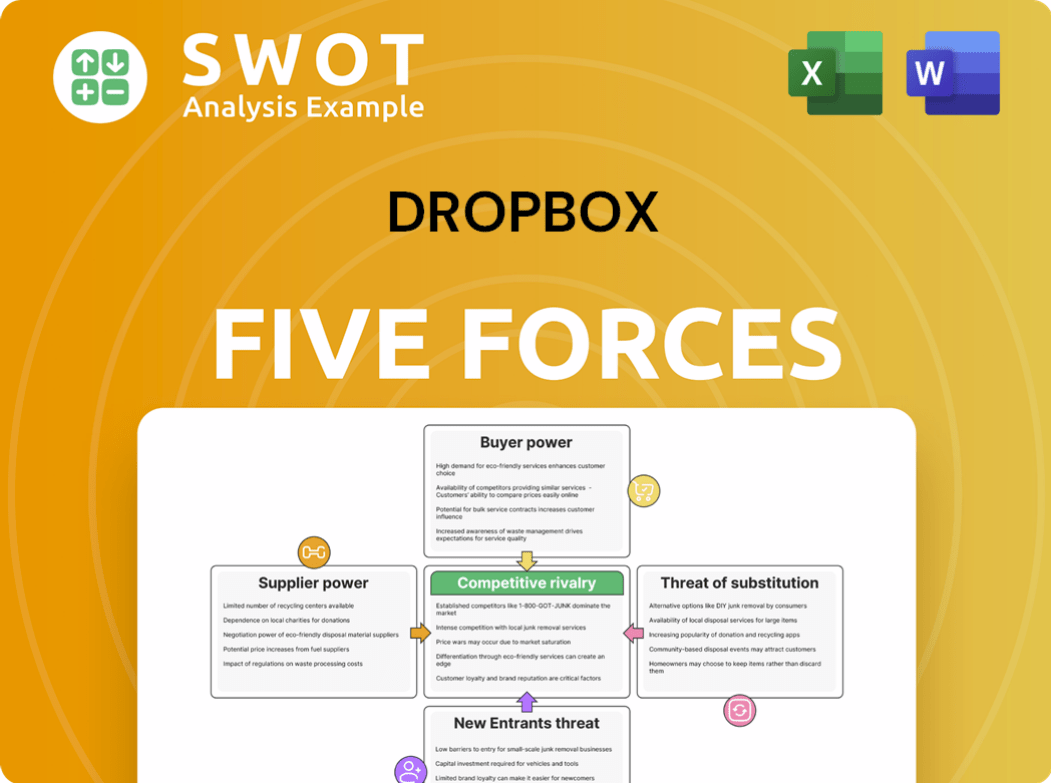
Dropbox Porter's Five Forces Analysis
- Covers All 5 Competitive Forces in Detail
- Structured for Consultants, Students, and Founders
- 100% Editable in Microsoft Word & Excel
- Instant Digital Download – Use Immediately
- Compatible with Mac & PC – Fully Unlocked
Related Blogs

- What are Mission Vision & Core Values of Dropbox Company?
- What is Competitive Landscape of Dropbox Company?
- How Does Dropbox Company Work?
- What is Sales and Marketing Strategy of Dropbox Company?
- What is Brief History of Dropbox Company?
- Who Owns Dropbox Company?
- What is Customer Demographics and Target Market of Dropbox Company?
Disclaimer
All information, articles, and product details provided on this website are for general informational and educational purposes only. We do not claim any ownership over, nor do we intend to infringe upon, any trademarks, copyrights, logos, brand names, or other intellectual property mentioned or depicted on this site. Such intellectual property remains the property of its respective owners, and any references here are made solely for identification or informational purposes, without implying any affiliation, endorsement, or partnership.
We make no representations or warranties, express or implied, regarding the accuracy, completeness, or suitability of any content or products presented. Nothing on this website should be construed as legal, tax, investment, financial, medical, or other professional advice. In addition, no part of this site—including articles or product references—constitutes a solicitation, recommendation, endorsement, advertisement, or offer to buy or sell any securities, franchises, or other financial instruments, particularly in jurisdictions where such activity would be unlawful.
All content is of a general nature and may not address the specific circumstances of any individual or entity. It is not a substitute for professional advice or services. Any actions you take based on the information provided here are strictly at your own risk. You accept full responsibility for any decisions or outcomes arising from your use of this website and agree to release us from any liability in connection with your use of, or reliance upon, the content or products found herein.