

Cenovus Energy Bundle

How Does Cenovus Energy Thrive in the Volatile Energy Market?
Cenovus Energy, a leading Canadian oil and natural gas company, is a key player in North America's energy sector. With operations spanning Canada, the United States, and the Asia Pacific region, Cenovus plays a crucial role in the development, production, and marketing of crude oil, natural gas, and natural gas liquids. In 2024, Cenovus reported a revenue of $50 billion, showcasing its significant presence and growth potential within the Cenovus Energy SWOT Analysis.

Understanding Cenovus operations is vital for anyone seeking insights into the energy sector's dynamics. The company's integrated business model, encompassing both upstream and downstream operations, allows it to navigate market fluctuations effectively. This article will explore Cenovus Energy's core operations, revenue streams, strategic initiatives, and future outlook, providing a comprehensive overview of its business mechanisms and financial performance, including its oil sands production.
What Are the Key Operations Driving Cenovus Energy’s Success?
Cenovus Energy operates as an integrated energy company, playing a crucial role in the development, production, refining, and marketing of crude oil, natural gas, and refined petroleum products. Its core offerings include crude oil, natural gas, and natural gas liquids, which are sold across various North American markets. The company serves a diverse clientele, ranging from industrial clients to regional markets for refined products. Understanding the intricacies of Cenovus operations is key to grasping its market position.
The operational structure of Cenovus is divided into Upstream and Downstream segments. Upstream activities focus on the exploration, extraction, and production of hydrocarbons, particularly from oil sands projects in northern Alberta using Steam-Assisted Gravity Drainage (SAGD) technology. This segment also includes conventional oil and gas assets across Western Canada, as well as offshore production. Downstream operations involve upgrading, refining, and marketing activities across Canada and the United States.
Cenovus's integrated Cenovus business model allows it to capture value across the entire energy value chain. This approach enhances overall profitability and operational efficiency. Its competitive advantages stem from its high-quality asset base, strong financial position, operational flexibility, cost discipline, and strategic asset management. For a deeper dive into the competitive landscape, consider exploring the Competitors Landscape of Cenovus Energy.
 Upstream Operations
Upstream operations involve the exploration, extraction, and production of hydrocarbons. Key assets include oil sands projects in Alberta and conventional oil and gas assets in Western Canada. The company also has offshore production assets. In 2024, total upstream production averaged 797,200 BOE/d.
Downstream Operations
Downstream operations focus on upgrading, refining, and marketing activities. Cenovus operates refineries in Canada and the United States. Total downstream crude throughput in 2024 averaged 646,900 bbls/d, a 15% increase from 2023.
Value Proposition
Cenovus offers a low-cost, long-life resource base. It maintains a conservative capital structure and a disciplined investment approach. The company is focused on increasing shareholder returns. This integrated model enhances both profitability and operational efficiency.
Key Products
The primary products include crude oil, natural gas, and natural gas liquids. These are sold across North American markets. The company caters to a diverse range of customer segments, from industrial clients to regional markets.

Competitive Advantages
Cenovus benefits from a high-quality asset base and a strong financial position. It has operational flexibility and cost discipline. Strategic asset management is also a key factor. These elements contribute to its success in the energy sector.
- High-quality asset base
- Strong financial position
- Operational flexibility
- Cost discipline
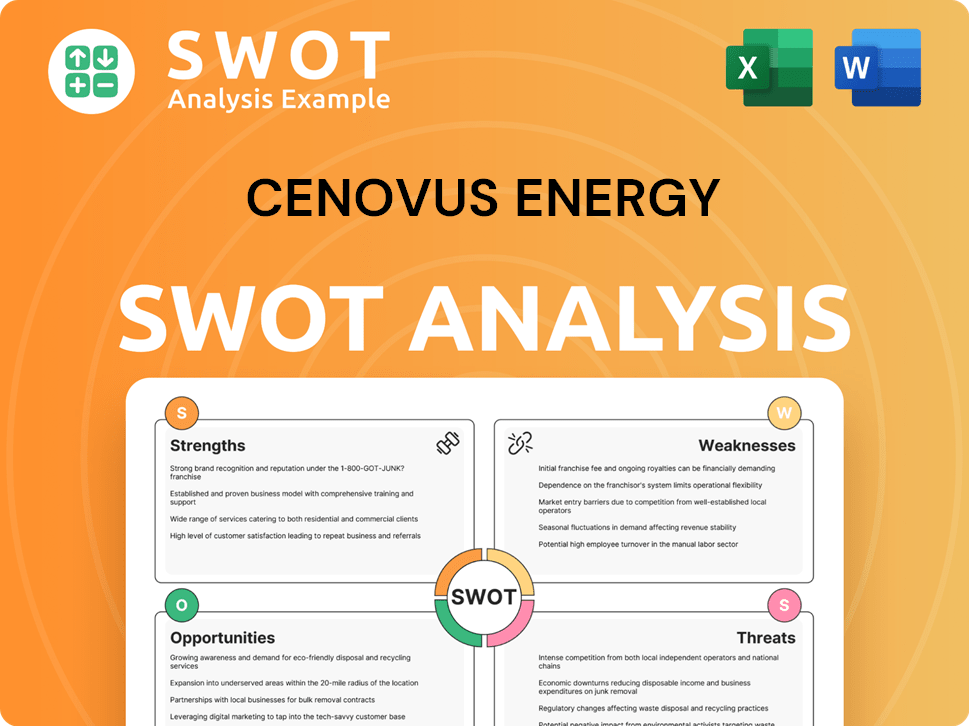
Cenovus Energy SWOT Analysis
- Complete SWOT Breakdown
- Fully Customizable
- Editable in Excel & Word
- Professional Formatting
- Investor-Ready Format
How Does Cenovus Energy Make Money?
Cenovus Energy, a prominent Canadian oil company, generates revenue primarily through the production and sale of crude oil, natural gas, and natural gas liquids. The company also benefits from its downstream operations, which involve refining crude oil into petroleum products. This integrated approach allows Cenovus to capture value across the entire energy value chain, contributing to its financial performance.
For the fiscal year 2024, Cenovus reported a total revenue of $50 billion, reflecting a 10% increase compared to the previous year. This growth was driven by increased production volumes and higher commodity prices, demonstrating the company's ability to capitalize on market dynamics. In terms of Canadian dollars, the annual revenue for 2024 reached C$58.99 billion, up from C$54.33 billion in 2023.
The Cenovus business model is designed to maximize profitability through an integrated approach. This includes upstream extraction, midstream transportation, and downstream refining and marketing. The company's financial strategy also plays a key role in its revenue generation and shareholder value.

Revenue Streams
Cenovus Energy's revenue streams are diversified across its operations. The main sources include the sale of crude oil, natural gas, and natural gas liquids, as well as income from its refining and marketing segment. The company's integrated model allows it to benefit from various aspects of the energy value chain.
Segment Contributions (2024)
The Oil Sands segment accounted for 60% of total revenue, highlighting its significance. Conventional assets contributed 25%, and Refining and Marketing made up 15%, showing a balanced revenue portfolio. The United States Refining segment was a major contributor, generating C$28.30 billion.
Monetization Strategies
Cenovus employs several monetization strategies to optimize value. These include capturing value across the energy value chain, disciplined capital management, and cost control. The company focuses on shareholder returns through dividends and share repurchases.
Shareholder Returns (2024)
Cenovus returned $3.2 billion to shareholders in 2024. This included $1.4 billion in share repurchases and $1.6 billion in common and preferred share dividends. This strategy reflects Cenovus's commitment to delivering value to its investors.
Capital Management
Cenovus's capital management strategy aims to maintain net debt near $4.0 billion. The company is committed to returning 100% of excess free funds flow to shareholders, demonstrating a disciplined approach to financial management. This approach supports long-term sustainability.
Downstream Focus
Cenovus focuses on cost control and improving the profitability of its downstream business. This strategic focus enhances overall financial performance. The refining segment plays a crucial role in the company's integrated business model.
Key Highlights
Cenovus Energy's financial performance in 2024 reflects its robust business model and effective monetization strategies. The company's integrated approach, combined with disciplined capital management and shareholder returns, positions it well in the energy sector.
- Total Revenue (2024): $50 billion
- Revenue Increase (YoY): 10%
- Canadian Revenue (2024): C$58.99 billion
- Oil Sands Contribution: 60% of total revenue
- Shareholder Returns (2024): $3.2 billion
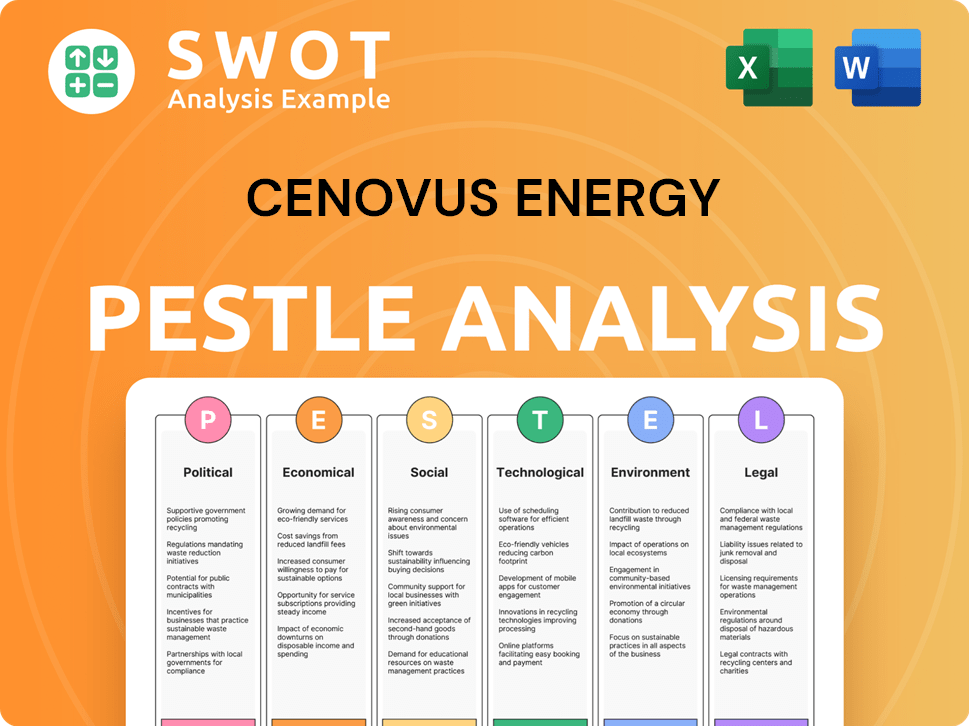
Cenovus Energy PESTLE Analysis
- Covers All 6 PESTLE Categories
- No Research Needed – Save Hours of Work
- Built by Experts, Trusted by Consultants
- Instant Download, Ready to Use
- 100% Editable, Fully Customizable
Which Strategic Decisions Have Shaped Cenovus Energy’s Business Model?
Cenovus Energy has achieved significant milestones, shaping its operations and financial performance. A pivotal strategic move was the 2017 acquisition of ConocoPhillips' Canadian assets, doubling its production and reserves. This was followed by the 2021 acquisition of Husky Energy, transforming Cenovus into a major Canadian oil and gas producer.
The company's strategic moves have positioned it strongly within the energy sector. In early 2024, Cenovus reached its mid-BBB credit rating target, reflecting its debt reduction efforts. In May 2024, the company increased its base dividend per common share from $0.140 to $0.180, or $0.720 annually, and declared a variable dividend of $0.135 per common share.
Despite challenges like crude oil price volatility, Cenovus maintains a strong competitive edge. Its integrated business model, high-quality assets, and financial strength contribute to its success. Solid operating performance, such as its U.S. refineries operating at a 93% utilization rate in Q2 2024, underscores its operational capabilities.
Key Milestones
Cenovus Energy's journey includes several key milestones. The 2017 acquisition of ConocoPhillips' Canadian assets was a pivotal move. In January 2021, the acquisition of Husky Energy further expanded its portfolio. These acquisitions significantly increased the company's production capacity and market presence.
Strategic Moves
Strategic moves have been central to Cenovus's growth. The acquisition of Husky Energy for C$3.9 billion in stock was a major transformation. Achieving its mid-BBB credit rating target in Q1 2024 demonstrates financial discipline. The recent dividend increases reflect a commitment to returning value to shareholders.
Competitive Edge
Cenovus's competitive advantages are rooted in its integrated business model. Its integrated operations, spanning upstream production, midstream transportation, and downstream refining, allow it to capture value across the entire energy value chain and mitigate risks. The company's oil sands operations are industry-leading with competitive sustaining capital and operating costs.
Financial Performance
Cenovus's financial performance reflects its strategic decisions. In Q3 2024, net earnings dropped 56% compared to Q3 2023 due to market challenges. Despite these fluctuations, the company's U.S. refineries maintained a high utilization rate. The dividend increases signal confidence in its financial stability.
Cenovus Energy's Strengths
Cenovus Energy's strengths lie in its integrated operations and high-quality assets. The company's ability to capture value across the entire energy value chain is a key advantage. Its oil sands operations, particularly at Foster Creek and Christina Lake, are industry-leading.
- Integrated business model enhances profitability and mitigates risks.
- High-quality asset base, including oil sands projects, ensures efficient production.
- Disciplined approach to capital allocation supports financial stability.
- Commitment to returning excess free funds flow to shareholders strengthens its position.
For a deeper dive into the company's history and evolution, consider reading the Brief History of Cenovus Energy.
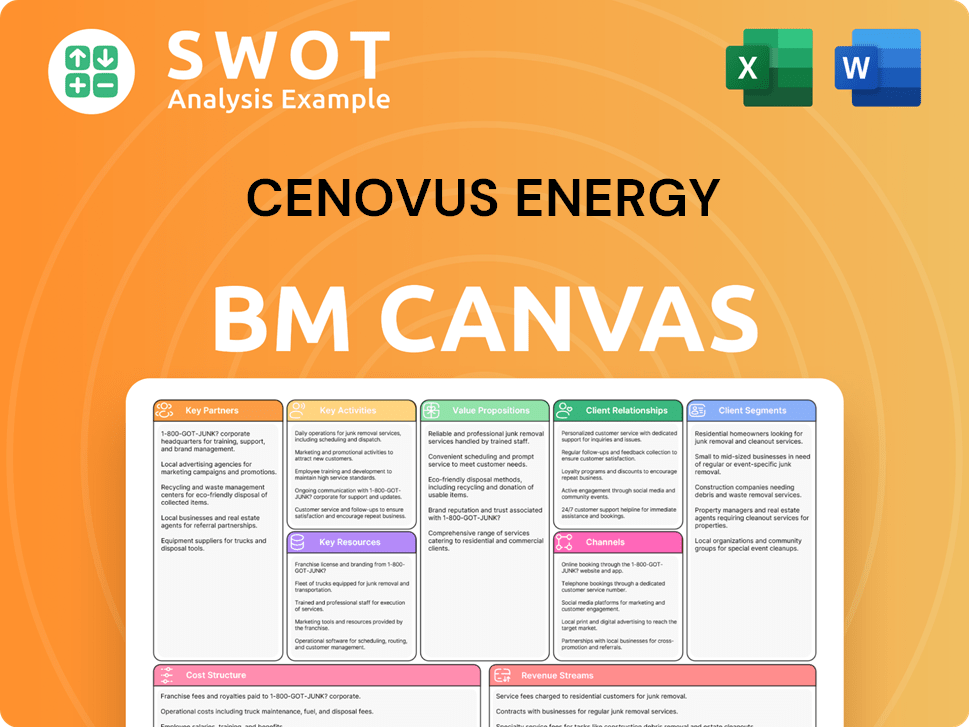
Cenovus Energy Business Model Canvas
- Complete 9-Block Business Model Canvas
- Effortlessly Communicate Your Business Strategy
- Investor-Ready BMC Format
- 100% Editable and Customizable
- Clear and Structured Layout
How Is Cenovus Energy Positioning Itself for Continued Success?
Cenovus Energy maintains a strong position within the Canadian energy sector, distinguishing itself through its integrated business model and technological capabilities. As a leading integrated oil and gas company, it is a major player in Canada's crude oil and natural gas production and refining sectors. The company's diverse portfolio, including oil sands, conventional, offshore, and refining assets, provides stable cash flow streams.
Despite its strong position, Cenovus faces key risks inherent in the energy sector, such as commodity price volatility, regulatory changes, and geopolitical factors. Fluctuations in crude oil prices can significantly impact the company's revenue. The company also navigates operational risks related to large-scale projects and maintenance activities, which can affect production volumes and costs.
Industry Position
Cenovus is a significant Canadian oil company, known for its integrated operations. Its business model includes oil sands production, conventional assets, and refining capabilities. This integration provides stability and diversification within the energy sector.
Key Risks
The primary risks for Cenovus include commodity price volatility and regulatory changes. Geopolitical factors and operational challenges also pose risks. These factors can influence Cenovus Energy's financial performance and operational outcomes.
Future Outlook
Cenovus is focused on strategic initiatives to sustain and expand its ability to generate profit. The company is targeting production growth and expansion of free funds flow. This involves capital investments in key projects and a commitment to shareholder returns. Explore the company's ownership structure through Owners & Shareholders of Cenovus Energy.
2025 Guidance
The company's 2025 corporate guidance projects upstream production between 805,000 and 845,000 BOE/d. Downstream crude unit utilization rates are expected between 90% and 95%. Capital investment for 2025 is planned between $4.6 billion and $5.0 billion.
Growth Initiatives and Financial Goals
Cenovus plans to achieve first oil from Narrows Lake by mid-2025 and install West White Rose offshore facilities in 2025. The company aims to drive production growth of 150,000 BOE/d by the end of 2028 and expand free funds flow.
- First oil from Narrows Lake by mid-2025.
- West White Rose offshore facilities installation in 2025.
- Production growth target of 150,000 BOE/d by the end of 2028.
- Commitment to returning 100% of excess free funds flow to shareholders.
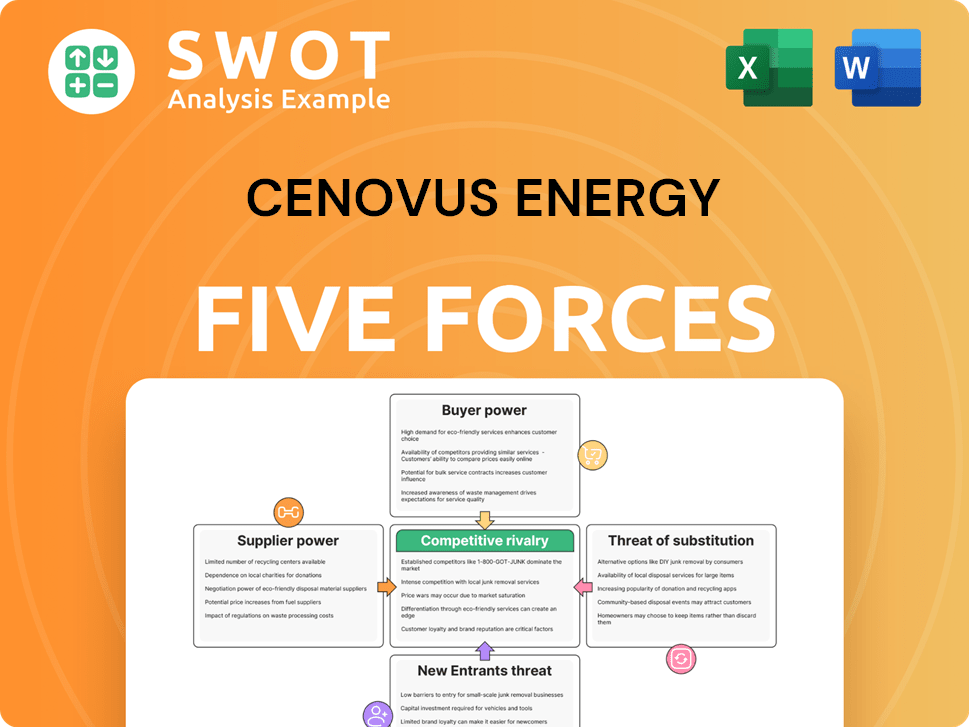
Cenovus Energy Porter's Five Forces Analysis
- Covers All 5 Competitive Forces in Detail
- Structured for Consultants, Students, and Founders
- 100% Editable in Microsoft Word & Excel
- Instant Digital Download – Use Immediately
- Compatible with Mac & PC – Fully Unlocked
Related Blogs

- What are Mission Vision & Core Values of Cenovus Energy Company?
- What is Competitive Landscape of Cenovus Energy Company?
- What is Growth Strategy and Future Prospects of Cenovus Energy Company?
- What is Sales and Marketing Strategy of Cenovus Energy Company?
- What is Brief History of Cenovus Energy Company?
- Who Owns Cenovus Energy Company?
- What is Customer Demographics and Target Market of Cenovus Energy Company?
Disclaimer
All information, articles, and product details provided on this website are for general informational and educational purposes only. We do not claim any ownership over, nor do we intend to infringe upon, any trademarks, copyrights, logos, brand names, or other intellectual property mentioned or depicted on this site. Such intellectual property remains the property of its respective owners, and any references here are made solely for identification or informational purposes, without implying any affiliation, endorsement, or partnership.
We make no representations or warranties, express or implied, regarding the accuracy, completeness, or suitability of any content or products presented. Nothing on this website should be construed as legal, tax, investment, financial, medical, or other professional advice. In addition, no part of this site—including articles or product references—constitutes a solicitation, recommendation, endorsement, advertisement, or offer to buy or sell any securities, franchises, or other financial instruments, particularly in jurisdictions where such activity would be unlawful.
All content is of a general nature and may not address the specific circumstances of any individual or entity. It is not a substitute for professional advice or services. Any actions you take based on the information provided here are strictly at your own risk. You accept full responsibility for any decisions or outcomes arising from your use of this website and agree to release us from any liability in connection with your use of, or reliance upon, the content or products found herein.