

Cirrus Logic Bundle

Who Really Controls Cirrus Logic?
Unraveling the Cirrus Logic SWOT Analysis is key to understanding the company's position in the dynamic semiconductor market. Knowing who owns Cirrus Logic is critical for investors, analysts, and anyone tracking the tech landscape. Examining the ownership structure reveals insights into strategic decisions, financial performance, and future growth potential.

Understanding the Cirrus Logic ownership structure provides a crucial lens through which to view the company's trajectory. From its inception as Patil Systems, Inc. to its current status as a publicly traded entity, the evolution of Cirrus Logic's history is intertwined with shifts in its ownership. This analysis will uncover the key players, from the founders to the major shareholders, offering a comprehensive overview of who controls this influential Cirrus Logic player in the tech world and its impact on Cirrus Logic stock.
Who Founded Cirrus Logic?
The story of Cirrus Logic begins with its founding by Dr. Suhas Patil in 1981, initially under the name 'Patil Systems, Inc.' in Salt Lake City. This marked the beginning of a journey that would lead to significant developments in the technology sector. The early days were crucial in establishing the company's direction and securing the initial financial backing necessary for growth.
In 1983, a pivotal reorganization occurred, involving Dr. Patil, Kamran Elahian, and venture capitalist Fred Nazem. Nazem's firm, Nazem and Company, provided the essential start-up funding. This restructuring was a key moment in the company's history, setting the stage for its future expansion and strategic focus. The company's move to Silicon Valley and subsequent renaming to Cirrus Logic in 1984 further solidified its position in the tech industry.
Other key figures, such as Steven Czapski, also played roles in the company's early development. The appointment of Michael Hackworth as president and CEO in January 1985 was another significant milestone, as he led the company until February 1999. This early leadership and the initial venture capital support were instrumental in shaping Cirrus Logic's focus on integrated circuit (IC) solutions for the growing PC components market.

Founding and Early Days
Dr. Suhas Patil founded the company as 'Patil Systems, Inc.' in Salt Lake City in 1981.
In 1983, the company was reorganized with the involvement of Kamran Elahian and venture capitalist Fred Nazem.
The company was renamed Cirrus Logic in 1984 after moving to Silicon Valley.
Key Players
Fred Nazem's firm provided the initial start-up financing.
Michael Hackworth served as president and CEO from January 1985 to February 1999.
Steven Czapski was also involved in the early stages.
Early Focus
The company initially focused on IC solutions for the PC components market.
Early venture capital backing was crucial for establishing the company's direction.
This focus helped establish the company in the growing tech market.
Ownership Structure
Specific equity splits for the founders are not publicly detailed.
The involvement of Fred Nazem indicates a structured initial financing arrangement.
The early ownership structure was shaped by venture capital investment.
Early Leadership
Michael Hackworth's long tenure as CEO provided stability.
His leadership helped guide the company through its formative years.
This early leadership was key to the company's initial success.
Market Focus
Cirrus Logic's early focus was on the expanding PC components market.
This strategic focus helped position the company for growth.
The company's products were designed for the evolving tech landscape.

Early Ownership and Leadership
Understanding the early ownership structure of Cirrus Logic, including the founders and venture capital involvement, is key to understanding its history. The company's initial financing from Nazem and Company, along with the leadership of Michael Hackworth, set the stage for its future. For more insights into the company's strategic direction and growth, consider reading about the Growth Strategy of Cirrus Logic.
- The founders included Dr. Suhas Patil, Kamran Elahian, and Steven Czapski.
- Fred Nazem, through Nazem and Company, provided initial venture capital.
- Michael Hackworth's long tenure as CEO was critical for early direction.
- The company's focus was on IC solutions for the PC components market.
Cirrus Logic SWOT Analysis
- Complete SWOT Breakdown
- Fully Customizable
- Editable in Excel & Word
- Professional Formatting
- Investor-Ready Format

How Has Cirrus Logic’s Ownership Changed Over Time?
The evolution of Cirrus Logic's ownership has been marked by significant milestones since its initial public offering (IPO) in 1989. The company, which trades on the Nasdaq under the ticker symbol CRUS, has seen its market capitalization fluctuate over time. As of June 2025, Cirrus Logic's market capitalization is approximately $5.17 billion USD. This figure reflects the company's valuation as determined by the stock market, influenced by factors such as financial performance, market trends, and investor sentiment.
The company's ownership structure is primarily institutional, reflecting the influence of large investment firms and funds. The dynamics of this ownership have shaped the company's strategic direction and governance. Acquisitions, such as the purchase of Crystal Semiconductor in 1991 and Wolfson Microelectronics in 2014, have played a crucial role in expanding Cirrus Logic's capabilities and market position. These strategic moves have supported the company's growth and adaptation within the competitive technology landscape.
| Ownership Category | Percentage of Shares | Approximate Value (Based on $5.17 Billion Market Cap) |
|---|---|---|
| Institutional Investors | Approximately 78.23% | Over $4.04 billion |
| Insiders | Approximately 0.58% | Around $30 million |
| Public Companies and Individual Investors | Approximately 21.19% | Around $1.09 billion |
The dominant presence of institutional investors, holding about 78.23% of the shares, underscores the significance of these entities in shaping Cirrus Logic's strategic direction. Key institutional shareholders include Vanguard Fiduciary Trust Co. with 10.80% of the shares, valued at over $609 million, as well as Vanguard Index Funds, iShares, Capitol Series Trust, and SPDR. Other notable investors are BlackRock, Inc., and State Street Global Advisors, Inc. These major shareholders influence the company's decisions and long-term strategies. The company's strong focus on mixed-signal processing competencies, especially after its strategic refocus in the mid-1990s, has been a key element in its success. The acquisition of Lion Semiconductor in 2021 for $335 million further strengthened its position.
Key Takeaways on Cirrus Logic Ownership
Cirrus Logic's ownership structure is primarily institutional, with a significant portion held by major investment firms.
- The company went public in 1989 and trades on the Nasdaq under the ticker symbol CRUS.
- As of June 2025, the market capitalization is approximately $5.17 billion USD.
- Strategic acquisitions, such as Crystal Semiconductor and Wolfson Microelectronics, have shaped the company.
- Vanguard is a major shareholder, holding 10.80% of the shares.
Cirrus Logic PESTLE Analysis
- Covers All 6 PESTLE Categories
- No Research Needed – Save Hours of Work
- Built by Experts, Trusted by Consultants
- Instant Download, Ready to Use
- 100% Editable, Fully Customizable

Who Sits on Cirrus Logic’s Board?
The current leadership of Cirrus Logic includes John Forsyth as Chief Executive Officer, who took on the role in January 2021 after previously serving as president since 2020. Jeff Woolard joined the company as Chief Financial Officer in February 2025. The board of directors is pivotal in overseeing the company's strategic direction and ensuring accountability to shareholders. Information regarding specific board members representing major shareholders is not readily available in public sources.
In July 2024, shareholders approved the election of all seven nominated directors with a significant majority of votes, indicating a strong alignment between the board and the shareholder base. This reflects the typical governance structure of a publicly traded company. The voting structure is generally one-share-one-vote, which is standard for companies listed on the Nasdaq exchange. There is no publicly available information suggesting the presence of dual-class shares or special voting rights that would give outsized control to specific entities beyond their proportional equity ownership. This structure ensures that the Cirrus Logic ownership is distributed proportionally among its shareholders.
| Leadership | Title | Year Joined |
|---|---|---|
| John Forsyth | Chief Executive Officer | 2021 |
| Jeff Woolard | Chief Financial Officer | 2025 |
| Board of Directors | Shareholder Approved | July 2024 |
Recent governance activities demonstrate ongoing adjustments to executive compensation and incentive structures. In July 2024, shareholders approved an amendment and restatement of the company's 2018 Long Term Incentive Plan. This expanded the number of shares available for issuance by an additional 2.67 million and extended the plan's expiration date to July 26, 2034. These decisions are typically approved by the board and then put to a shareholder vote, reflecting the company's commitment to aligning executive interests with shareholder value. For more insights into the company's business model, you can explore the Revenue Streams & Business Model of Cirrus Logic.
Key Governance Highlights
The board of directors plays a crucial role in the company's governance, ensuring accountability to shareholders.
- Shareholders approved the election of all nominated directors in July 2024.
- The voting structure is typically one-share-one-vote.
- The 2018 Long Term Incentive Plan was amended and restated in July 2024.
- The company's Cirrus Logic stock is traded on the Nasdaq.
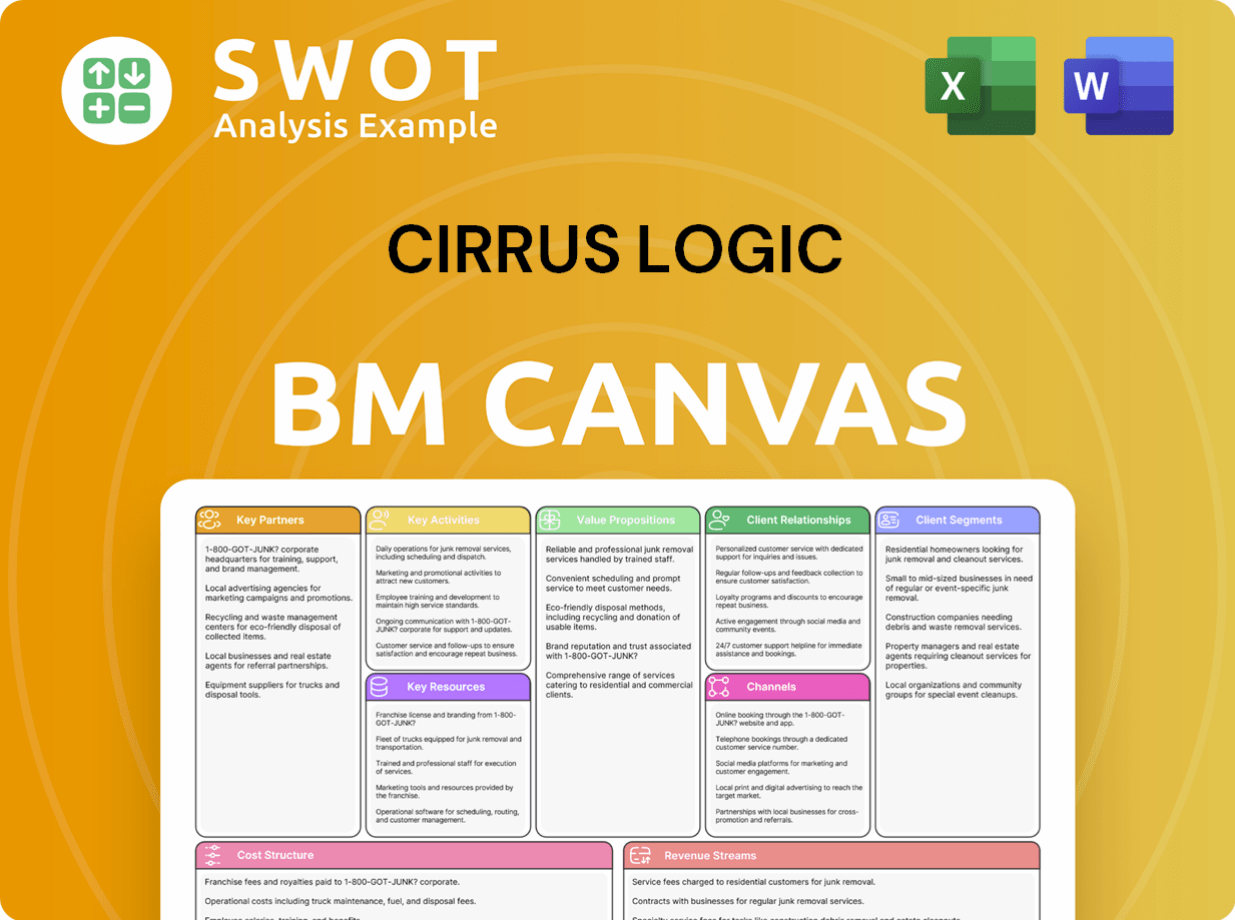
Cirrus Logic Business Model Canvas
- Complete 9-Block Business Model Canvas
- Effortlessly Communicate Your Business Strategy
- Investor-Ready BMC Format
- 100% Editable and Customizable
- Clear and Structured Layout
What Recent Changes Have Shaped Cirrus Logic’s Ownership Landscape?
In recent years, the ownership profile of Cirrus Logic has been shaped by strategic financial decisions and shifts in leadership. The company has actively engaged in share repurchases, aiming to enhance shareholder value. For instance, during the first quarter of fiscal year 2025 (ending June 29, 2024), Cirrus Logic repurchased $41.0 million in common stock, with a further authorization of up to an additional $500 million in March 2025. Stock buybacks totaled $70.06 million for the period ending December 30, 2024. As of August 2, 2024, the number of outstanding common shares was 53,411,205. These actions reflect a commitment to returning value to shareholders and managing the company's capital structure effectively. The question of 'Who owns Cirrus Logic' is significantly influenced by these ongoing financial strategies.
Leadership transitions have also played a role in shaping the company's direction. Jeff Woolard was appointed as Chief Financial Officer on February 24, 2025, succeeding Ulf Habermann, who served as interim CFO from May 2024. John Forsyth has been the CEO since January 2021. These changes in leadership can influence strategic decisions and the company's overall performance. Understanding the 'Cirrus Logic ownership' requires looking at both the financial maneuvers and the individuals guiding the company. The 'Cirrus Logic company profile' continues to evolve with these changes.
| Metric | Details | Date |
|---|---|---|
| Share Repurchases (Q1 FY2025) | $41.0 million | June 29, 2024 |
| Authorized Share Repurchase (March 2025) | Up to $500 million | March 2025 |
| Share Repurchases (Ending Dec 30, 2024) | $70.06 million | December 30, 2024 |
| Outstanding Common Shares | 53,411,205 | August 2, 2024 |
| Fiscal Year 2025 Revenue | $1.90 billion | Full Year 2025 |
| Automotive & Industrial Sales Contribution (FY2025) | Over 35% of total sales | Full Year 2025 |
The semiconductor industry's ownership landscape, including 'Cirrus Logic ownership structure,' is heavily influenced by institutional investors. The company's strategic shift towards diversifying its revenue streams, with over 35% of total sales in fiscal year 2025 coming from automotive and industrial markets, reflects an effort to reduce reliance on the smartphone market and foster sustainable growth. This diversification impacts the company's long-term strategy and its appeal to various investor types. Cirrus Logic's full fiscal year 2025 revenue reached $1.90 billion, marking a 6% increase. For more in-depth insights, you can explore the detailed analysis of Cirrus Logic's market position and financial performance.
 Who Owns Cirrus Logic?
Institutional investors hold a substantial portion of Cirrus Logic stock. The company is strategically diversifying its revenue streams, aiming for sustainable growth and reduced market volatility. The company's financial performance in fiscal year 2025 shows a 6% increase in revenue.
Leadership Changes
Jeff Woolard became CFO in February 2025, and John Forsyth is the CEO since January 2021. These leadership transitions can significantly impact the company's strategic direction and operational efficiency, influencing the company's future trajectory.
Financial Strategies
Cirrus Logic has been actively repurchasing its shares to enhance shareholder value. Share buybacks and strategic diversification are key components of the company's financial strategy. The company's fiscal year 2025 revenue reached $1.90 billion.
Market Position
Cirrus Logic is expanding into the automotive and industrial markets. These markets now account for over 35% of total sales in fiscal year 2025. The company's focus on diversification aims to reduce dependence on the smartphone market.
Cirrus Logic Porter's Five Forces Analysis
- Covers All 5 Competitive Forces in Detail
- Structured for Consultants, Students, and Founders
- 100% Editable in Microsoft Word & Excel
- Instant Digital Download – Use Immediately
- Compatible with Mac & PC – Fully Unlocked

Related Blogs

- What are Mission Vision & Core Values of Cirrus Logic Company?
- What is Competitive Landscape of Cirrus Logic Company?
- What is Growth Strategy and Future Prospects of Cirrus Logic Company?
- How Does Cirrus Logic Company Work?
- What is Sales and Marketing Strategy of Cirrus Logic Company?
- What is Brief History of Cirrus Logic Company?
- What is Customer Demographics and Target Market of Cirrus Logic Company?
Disclaimer
All information, articles, and product details provided on this website are for general informational and educational purposes only. We do not claim any ownership over, nor do we intend to infringe upon, any trademarks, copyrights, logos, brand names, or other intellectual property mentioned or depicted on this site. Such intellectual property remains the property of its respective owners, and any references here are made solely for identification or informational purposes, without implying any affiliation, endorsement, or partnership.
We make no representations or warranties, express or implied, regarding the accuracy, completeness, or suitability of any content or products presented. Nothing on this website should be construed as legal, tax, investment, financial, medical, or other professional advice. In addition, no part of this site—including articles or product references—constitutes a solicitation, recommendation, endorsement, advertisement, or offer to buy or sell any securities, franchises, or other financial instruments, particularly in jurisdictions where such activity would be unlawful.
All content is of a general nature and may not address the specific circumstances of any individual or entity. It is not a substitute for professional advice or services. Any actions you take based on the information provided here are strictly at your own risk. You accept full responsibility for any decisions or outcomes arising from your use of this website and agree to release us from any liability in connection with your use of, or reliance upon, the content or products found herein.