

Wacker Neuson Bundle

Who Really Owns Wacker Neuson?
Understanding a company's ownership structure is crucial for investors and strategists alike. Recent whispers of major shareholders potentially selling their stakes have put Wacker Neuson, a global leader in light and compact equipment, under the spotlight. This shift could significantly impact the company's future trajectory and strategic decisions.

Wacker Neuson, with its roots tracing back to 1848 in Dresden, Germany, has a rich history of innovation, evolving from a blacksmith's shop to a global powerhouse. As of April 25, 2025, the company's market capitalization stands at approximately €1.55 billion, with shares traded on the Frankfurt Stock Exchange. To gain a deeper understanding, we will explore the Wacker Neuson SWOT Analysis, ownership evolution, key investors, and the implications of recent developments for this prominent player in the construction and agricultural equipment sectors, including its Wacker Neuson company structure and Wacker Neuson ownership history.
Who Founded Wacker Neuson?
The story of Wacker Neuson ownership begins with Johann Christian Wacker, who established a blacksmith's shop in Dresden, Germany, in 1848. This marked the genesis of what would become a global leader in construction equipment. The company's early years were characterized by the Wacker family's strong control, setting the stage for its future development.
The 'Neuson' component of the company's name has roots in Austria, with the founding of Neuson Hydraulik GmbH in 1981. This entity initially focused on hydraulic mini excavators. The subsequent merger with Kramer-Werke GmbH in 2001 to form Neuson Kramer Baumaschinen AG was a pivotal move.
The merger of Wacker Construction Equipment AG and Neuson Kramer Baumaschinen AG in 2007 was a landmark event. This brought together two family-run businesses, creating Wacker Neuson AG. This strategic consolidation expanded product offerings and market reach, particularly in the compact equipment sector.

Early Beginnings
Johann Christian Wacker founded the company in 1848 as a blacksmith's shop. Industrial production started in 1875, marking the company's early expansion.
Neuson's Formation
Neuson Hydraulik GmbH was established in 1981 in Austria. The company specialized in hydraulic mini excavators, which were a key product.
The 2007 Merger
The merger of Wacker Construction Equipment AG and Neuson Kramer Baumaschinen AG occurred in 2007. This led to the creation of Wacker Neuson AG.
Family Ownership
The Wacker family held significant ownership before the merger. Both Wacker and Neuson were family-run businesses before the consolidation.
Market Expansion
The merger aimed to expand product offerings and sales reach. The focus was on growth opportunities in the compact equipment segment.
Weidemann Acquisition
In 2005, Wacker Construction Equipment AG acquired Weidemann GmbH. This expanded the company's presence in compact construction equipment and the agricultural sector.

Key Takeaways
Understanding the Wacker Neuson history reveals its evolution from a family-owned blacksmith shop to a global entity. The merger in 2007 was a crucial step in its development. For more insights into the company's financial performance and business model, you can read about the Revenue Streams & Business Model of Wacker Neuson.
- Johann Christian Wacker founded the company in 1848.
- Neuson Hydraulik GmbH was established in 1981.
- The merger of Wacker and Neuson took place in 2007.
- The company has a global presence with its headquarters in Munich, Germany.
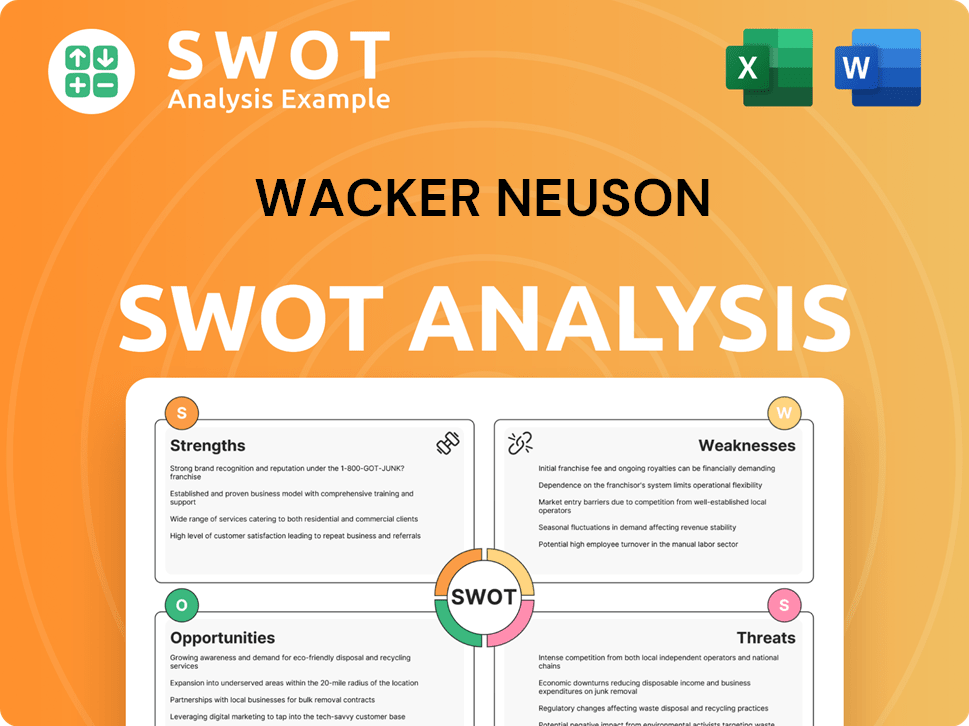
Wacker Neuson SWOT Analysis
- Complete SWOT Breakdown
- Fully Customizable
- Editable in Excel & Word
- Professional Formatting
- Investor-Ready Format
How Has Wacker Neuson’s Ownership Changed Over Time?
The evolution of ownership for the Wacker Neuson company is marked by its initial public offering (IPO) on May 15, 2007. This event, with shares listed on the Frankfurt Stock Exchange's Prime Standard, and subsequent inclusion in the SDAX in autumn 2007, significantly altered the company's ownership structure. As of June 19, 2024, the total number of shares outstanding is 70,140,000.
The shareholder structure of Wacker Neuson reflects a blend of family ownership and public investors. As of December 30, 2024, key stakeholders include Wacker-Werke GmbH & Co. KG, holding 30.24% of the shares, PIN Privatstiftung with 26.61%, and SWRW Verwaltungs-GmbH with 15.47%. The Wacker and Neunteufel families, through a share pool, control 58.0% of the company, with the remaining 42.0% available as free float.
| Shareholder | Shares Held (as of Dec 30, 2024) | Percentage |
|---|---|---|
| Wacker-Werke GmbH & Co. KG | 20,566,399 | 30.24% |
| PIN Privatstiftung | 18,096,120 | 26.61% |
| SWRW Verwaltungs-GmbH | 10,521,000 | 15.47% |
Institutional investors also play a role in the Wacker Neuson ownership. As of early 2025, Dimensional Fund Advisors LP held 2.00% (1,357,709 shares as of April 29, 2025), and The Vanguard Group, Inc. held 1.55% (1,056,234 shares as of February 27, 2025). BlackRock, Inc. holds 0.70% (476,677 shares as of April 29, 2025). The company's market capitalization as of April 25, 2025, was €1.55 billion, which is an increase of 31.50% in one year. For more insights, consider reading about the Growth Strategy of Wacker Neuson.
Key Takeaways on Wacker Neuson Ownership
Wacker Neuson's ownership structure is a mix of family control and public shareholders, with a significant portion held by the founding families. The company's dividend policy aims for a payout of 40% to 60% of Group earnings per share.
- Founding families maintain significant control.
- Institutional investors hold notable positions.
- Dividend policy reflects commitment to shareholder returns.
- Market capitalization reflects positive growth.
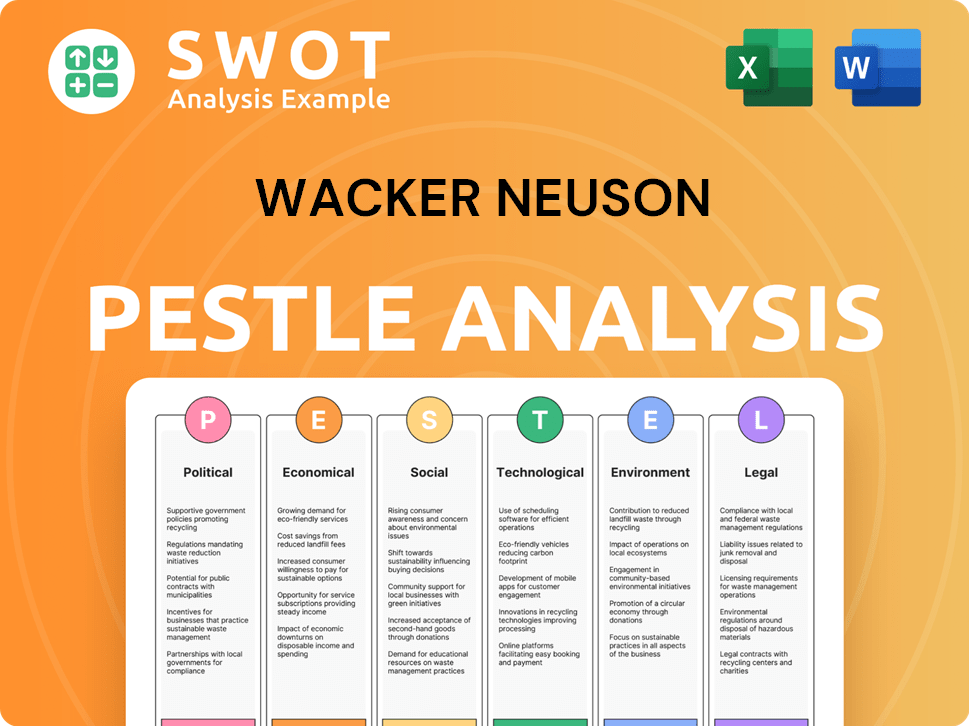
Wacker Neuson PESTLE Analysis
- Covers All 6 PESTLE Categories
- No Research Needed – Save Hours of Work
- Built by Experts, Trusted by Consultants
- Instant Download, Ready to Use
- 100% Editable, Fully Customizable
Who Sits on Wacker Neuson’s Board?
The Supervisory Board of the Wacker Neuson Group oversees the company's operations. As of 2025, the board is composed of six members. Hans Neunteufel chairs the Supervisory Board and also leads the Executive Board of the PIN Private Trust, a significant shareholder. Peter Riegler, elected at the Annual General Meeting on May 15, 2025, is also part of the Executive Board of PIN Private Trust. Ralph Wacker serves as the Deputy Chairman and is a Managing Partner at Wacker+Mattner GmbH. Other members include Prof. Dr. Matthias Schüppen, an attorney, auditor, and tax advisor, along with employee representatives Elvis Schwarzmair and Christian Kekelj.
The composition of the board reflects a mix of expertise, including financial, legal, and operational perspectives, ensuring comprehensive oversight of the company. This structure helps in making informed decisions and maintaining good corporate governance, which is crucial for the company's long-term success. Understanding the Wacker Neuson ownership structure is key to grasping the company's strategic direction.
| Board Member | Position | Affiliation |
|---|---|---|
| Hans Neunteufel | Chairman of the Supervisory Board | PIN Private Trust |
| Peter Riegler | Member of the Supervisory Board | PIN Private Trust |
| Ralph Wacker | Deputy Chairman of the Supervisory Board | Wacker+Mattner GmbH |
| Prof. Dr. Matthias Schüppen | Member of the Supervisory Board | Attorney, Auditor, Tax Advisor |
| Elvis Schwarzmair | Employee Representative | |
| Christian Kekelj | Employee Representative |
All shares in Wacker Neuson SE grant shareholders full voting rights, with each share entitling its holder to one vote. The company's share capital is €70,140,000, divided into 70,140,000 individual no-par-value nominal shares, each representing a proportionate amount of €1.00. This structure ensures that all shareholders have equal voting power. The German Securities Trading Act (WpHG) mandates that shareholders disclose their voting rights to the German Financial Services Supervisory Authority and the company itself when they reach certain thresholds. For more insights into the company's strategic direction, consider reading about the Growth Strategy of Wacker Neuson.
Voting Rights and Shareholder Influence
Shareholders have significant influence through their voting rights, with each share carrying one vote. The Annual General Meeting plays a crucial role in deciding on dividends and approving executive and supervisory board member remuneration.
- Each share equals one vote.
- Shareholders must disclose significant voting rights.
- Annual General Meeting approves key decisions.
- Remuneration systems were approved with high majorities.
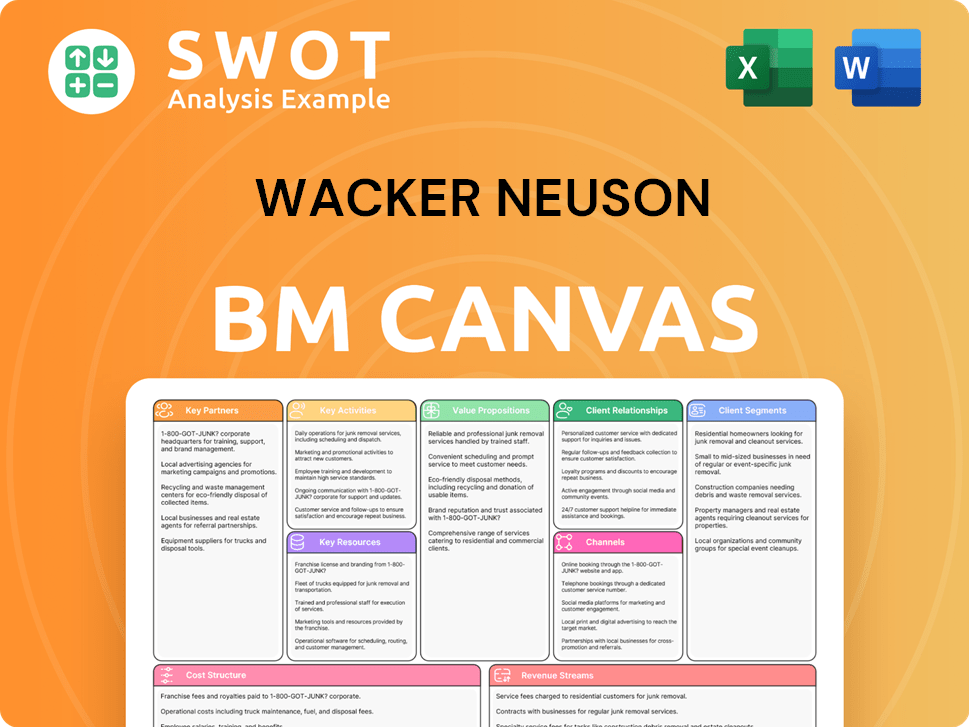
Wacker Neuson Business Model Canvas
- Complete 9-Block Business Model Canvas
- Effortlessly Communicate Your Business Strategy
- Investor-Ready BMC Format
- 100% Editable and Customizable
- Clear and Structured Layout
What Recent Changes Have Shaped Wacker Neuson’s Ownership Landscape?
Recent developments regarding Wacker Neuson ownership have captured significant attention. In early June 2025, reports indicated that major shareholders were exploring the potential sale of their stakes. This news triggered a notable surge in the company's stock, with shares climbing by over 60% in 2025, including a 9% increase on June 5, 2025, alone. Consequently, the company's market value reached €1.6 billion.
The company's strategic initiatives, such as the 'Fit for 2025' program, are designed to boost profitability through enhanced sales, cost reductions, and optimized production. Despite a decrease in revenue for fiscal year 2024 to €2,234.9 million, down 15.8% from the previous year, and an EBIT of €122.5 million, down 55.2%, the company saw a significant increase in free cash flow, reaching €184.6 million by the end of 2024. For 2025, Wacker Neuson anticipates revenue between €2,100 million and €2,300 million and an EBIT margin between 6.5% and 7.5%, reflecting expectations of improved profitability throughout the year, following a weak first quarter of 2025. This demonstrates the Wacker Neuson company's focus on financial health and strategic growth.
Wacker Neuson has been proactive in expanding its operations through strategic acquisitions. For example, in early 2024, the Wacker Neuson Group acquired a 45.5% stake in TorqueWerk GmbH, focusing on electric motor development. Furthermore, the full acquisition of Weidemann Nederland B.V. in May 2024 enhanced its sales channels in the agricultural sector. These moves, alongside the potential shift in Wacker Neuson ownership structure, highlight the dynamic nature of the company and its strategic responses to market opportunities. To understand more about the company's target market, you can read this article: Target Market of Wacker Neuson.
 Wacker Neuson Ownership: Recent Developments
Major shareholders of the company are exploring selling their stakes, which has led to stock price increases. The market value of the company reached €1.6 billion.
Financial Performance in 2024
The company's revenue for fiscal year 2024 was €2,234.9 million, with an EBIT of €122.5 million. Free cash flow increased to €184.6 million by the end of 2024.
Strategic Acquisitions
The company acquired a stake in TorqueWerk GmbH and fully acquired Weidemann Nederland B.V. in 2024. These acquisitions aim to expand its market presence.
Future Outlook
For 2025, the company anticipates revenue between €2,100 million and €2,300 million and an EBIT margin between 6.5% and 7.5%.
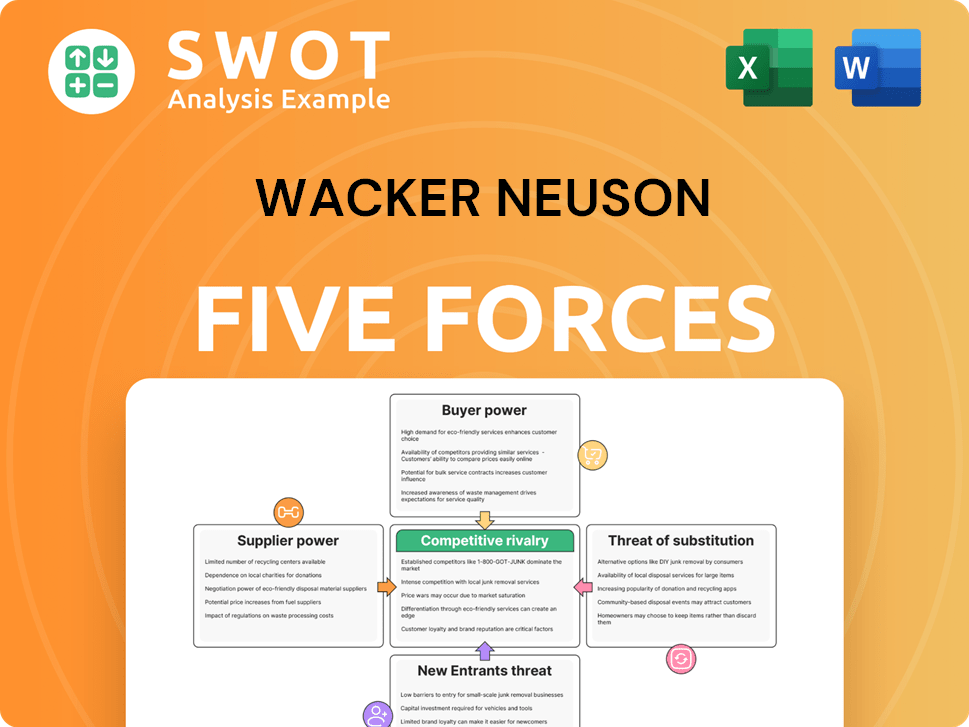
Wacker Neuson Porter's Five Forces Analysis
- Covers All 5 Competitive Forces in Detail
- Structured for Consultants, Students, and Founders
- 100% Editable in Microsoft Word & Excel
- Instant Digital Download – Use Immediately
- Compatible with Mac & PC – Fully Unlocked
Related Blogs

- What are Mission Vision & Core Values of Wacker Neuson Company?
- What is Competitive Landscape of Wacker Neuson Company?
- What is Growth Strategy and Future Prospects of Wacker Neuson Company?
- How Does Wacker Neuson Company Work?
- What is Sales and Marketing Strategy of Wacker Neuson Company?
- What is Brief History of Wacker Neuson Company?
- What is Customer Demographics and Target Market of Wacker Neuson Company?
Disclaimer
All information, articles, and product details provided on this website are for general informational and educational purposes only. We do not claim any ownership over, nor do we intend to infringe upon, any trademarks, copyrights, logos, brand names, or other intellectual property mentioned or depicted on this site. Such intellectual property remains the property of its respective owners, and any references here are made solely for identification or informational purposes, without implying any affiliation, endorsement, or partnership.
We make no representations or warranties, express or implied, regarding the accuracy, completeness, or suitability of any content or products presented. Nothing on this website should be construed as legal, tax, investment, financial, medical, or other professional advice. In addition, no part of this site—including articles or product references—constitutes a solicitation, recommendation, endorsement, advertisement, or offer to buy or sell any securities, franchises, or other financial instruments, particularly in jurisdictions where such activity would be unlawful.
All content is of a general nature and may not address the specific circumstances of any individual or entity. It is not a substitute for professional advice or services. Any actions you take based on the information provided here are strictly at your own risk. You accept full responsibility for any decisions or outcomes arising from your use of this website and agree to release us from any liability in connection with your use of, or reliance upon, the content or products found herein.