

Teleflex Bundle

How is Teleflex Transforming the Medical Landscape?
Teleflex Incorporated (NYSE: TFX) is a global force in medical technology, with a market cap of $5.85 billion as of April 2025. The Teleflex SWOT Analysis reveals the company's strategic moves and its impact on the healthcare sector. Known for its critical care and surgical applications, Teleflex medical offers a diverse portfolio of single-use medical devices.

With its planned split into two companies by mid-2026, understanding Teleflex's business model and its revenue streams is more critical than ever. This restructuring aims to unlock shareholder value, creating a 'RemainCo' and a 'NewCo', which are key to navigating the evolving healthcare landscape. This deep dive will explore Teleflex's strategies, product portfolio, and financial performance, providing insights into how this medical technology leader shapes patient care.
What Are the Key Operations Driving Teleflex’s Success?
The Teleflex company creates value by developing, manufacturing, and distributing a wide array of medical devices. These devices are designed to improve patient health and quality of life. The company primarily serves hospitals and healthcare providers worldwide, focusing on innovation and patient outcomes.
Its core operations involve extensive research and development to create innovative solutions. Teleflex operates manufacturing facilities globally to ensure a reliable supply. It uses a global distribution network and a direct sales force to reach healthcare providers in various markets.
The company's commitment to continuous innovation is a key differentiator. Strategic acquisitions, like Palette Life Sciences for Barrigel, enhance its product offerings and market presence. This approach translates into customer benefits through expanded access to advanced medical technologies.
 Core Products
Teleflex's product portfolio includes vascular access devices, interventional cardiology products, surgical instruments, anesthesia products, and urology devices. These products are designed to address various medical needs and improve patient care. The company focuses on creating devices that are both effective and easy to use for healthcare professionals.
Operational Processes
Operational processes at Teleflex involve significant investment in research and development. It also includes global manufacturing, a comprehensive distribution network, and strategic sourcing. The company focuses on lean manufacturing to optimize its supply chain and improve efficiency. These processes ensure the delivery of high-quality medical devices.
Value Proposition
Teleflex offers value through its focus on innovation, patient outcomes, and clinician needs. Its products aim to reduce complications and improve treatment outcomes. The company's customer-centric approach provides tailored offerings to meet the specific needs of healthcare providers. This focus enhances the value proposition for both patients and healthcare professionals.
Market Presence
Teleflex has a significant global market presence, serving healthcare providers worldwide. Its products are used in various medical settings, contributing to improved patient care. The company's strategic acquisitions, such as the acquisition of Palette Life Sciences, further strengthen its market position. This expansion allows Teleflex to reach more customers.

Key Strengths
Teleflex's key strengths include a diverse product portfolio, a global distribution network, and a focus on innovation. The company's commitment to quality and patient outcomes differentiates it in the market. These strengths contribute to its ability to serve healthcare providers effectively.
- Diverse product portfolio spanning multiple therapeutic areas.
- Global manufacturing and distribution capabilities.
- Commitment to continuous innovation and patient outcomes.
- Strategic acquisitions to enhance product offerings.
Teleflex SWOT Analysis
- Complete SWOT Breakdown
- Fully Customizable
- Editable in Excel & Word
- Professional Formatting
- Investor-Ready Format

How Does Teleflex Make Money?
The Teleflex company generates revenue primarily through the sale of its medical devices and instruments. Its financial performance is a key indicator of its success in the healthcare market. Understanding its revenue streams provides insight into its business model and strategic focus.
The Teleflex company's revenue streams are diverse, with product sales being the primary source. Additional revenue comes from service contracts, licensing, and royalties. Strategic acquisitions have also played a role in expanding its product offerings and market presence.
For the full year 2024, Teleflex reported approximately $3.0 billion in revenue, reflecting an approximately 8% growth compared to the previous year. For the twelve months ending March 31, 2025, Teleflex's revenue was $3.010 billion. However, Q1 2025 revenue was $700.7 million, a 5.0% decrease year-over-year on a reported basis.
Revenue Streams Breakdown
In 2024, key revenue streams by product category included Vascular Solutions at approximately 23%, Interventional Urology at around 19%, Surgical Solutions at about 18%, and Anesthesia at roughly 16%, with other categories contributing approximately 24%. This diversification helps the company manage risks and capitalize on various market opportunities.
- Product Sales: The core of Teleflex's revenue comes from selling its wide range of Teleflex products.
- Service Contracts: Revenue is generated through maintenance and support services for its products.
- Licensing and Royalties: The company earns revenue by licensing its technology to other firms.
- Strategic Acquisitions: Acquisitions have expanded the product portfolio and market presence, which contributes to revenue growth.
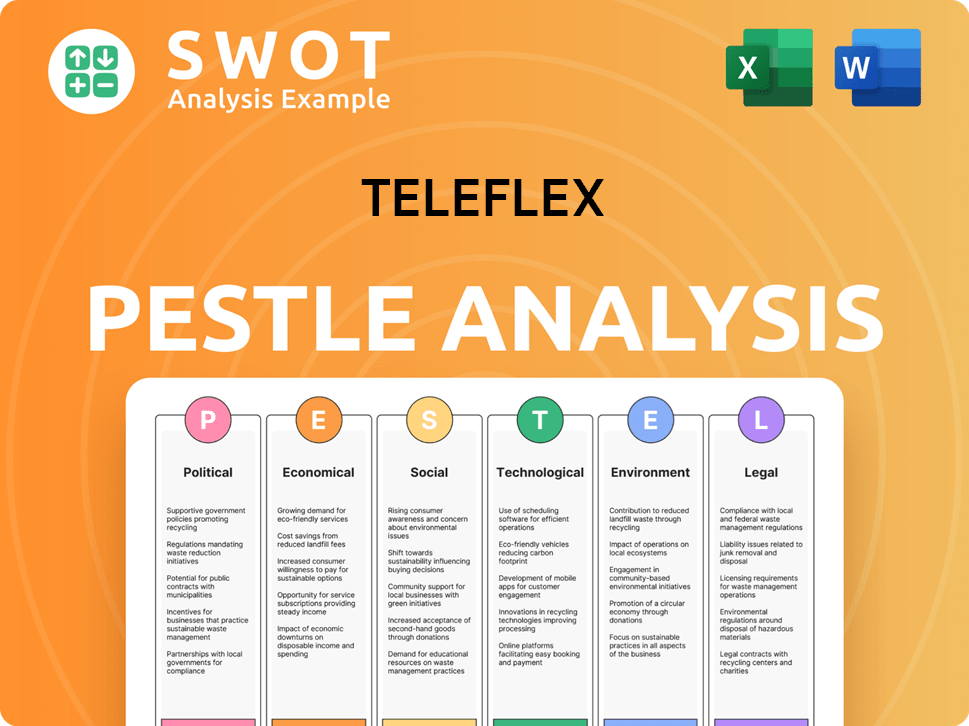
Teleflex PESTLE Analysis
- Covers All 6 PESTLE Categories
- No Research Needed – Save Hours of Work
- Built by Experts, Trusted by Consultants
- Instant Download, Ready to Use
- 100% Editable, Fully Customizable
Which Strategic Decisions Have Shaped Teleflex’s Business Model?
The journey of the Teleflex company has been marked by significant shifts and strategic moves. Initially established in 1943, the company began as a manufacturer of mechanical remote controls, primarily for the aviation industry. Over time, Teleflex diversified its operations, expanding into commercial, marine, and automotive markets before making a pivotal move into medical devices in the 1970s.
The 1990s witnessed a strategic focus on the medical sector, fueled by acquisitions that accelerated growth and enhanced its product offerings. Recent developments include the planned separation of Teleflex into two independent, publicly traded companies by mid-2026. This strategic move aims to streamline operations and sharpen management focus, leading to a more efficient business model.
Another key strategic initiative is the acquisition of Biotronik's Vascular Interventions business, expected to close by the end of Q3 2025. This acquisition is set to boost Teleflex's presence in the cath lab market and broaden its technology suite. These strategic moves are designed to position Teleflex for continued growth and innovation in the medical device industry.
Key Milestones
Founded in 1943, initially focused on aviation controls. Expanded into commercial, marine, and automotive markets in the 1950s and 1960s. Strategic shift into medical devices in the 1970s, leveraging engineering expertise.
Strategic Moves
Expansion into the medical device sector through acquisitions in the 1990s. Announced separation into two independent companies by mid-2026. Acquisition of Biotronik's Vascular Interventions business, expected to close by Q3 2025.
Competitive Edge
Diverse product portfolio across multiple therapeutic areas. Global presence with operations in over 150 countries. Strong customer relationships and continuous investment in R&D. Focus on acquiring devices under $1,000.
Financial Performance
RemainCo is projected to have over 6% constant currency revenue growth post-separation. The acquisition of Biotronik's Vascular Interventions business is expected to enhance global presence. The impact of tariffs is expected to be approximately $55 million in 2025.
Strategic Developments and Challenges
The planned separation of Teleflex into two companies aims to streamline operations and enhance management focus. The 'RemainCo' is expected to generate approximately $2.1 billion in revenue in 2024, while 'NewCo' is expected to generate around $1.4 billion. Challenges include softness in Interventional Urology revenues and a decline in the OEM business in Q1 2025.
- The acquisition of Biotronik's Vascular Interventions business is a key strategic move.
- The company faces challenges such as tariff impacts, expected to be $55 million in 2025.
- Teleflex's commitment to innovation is evident in product launches like the AC3 Range™ intra-aortic balloon pump.
- The company's global presence and diverse product portfolio contribute to its competitive advantage.
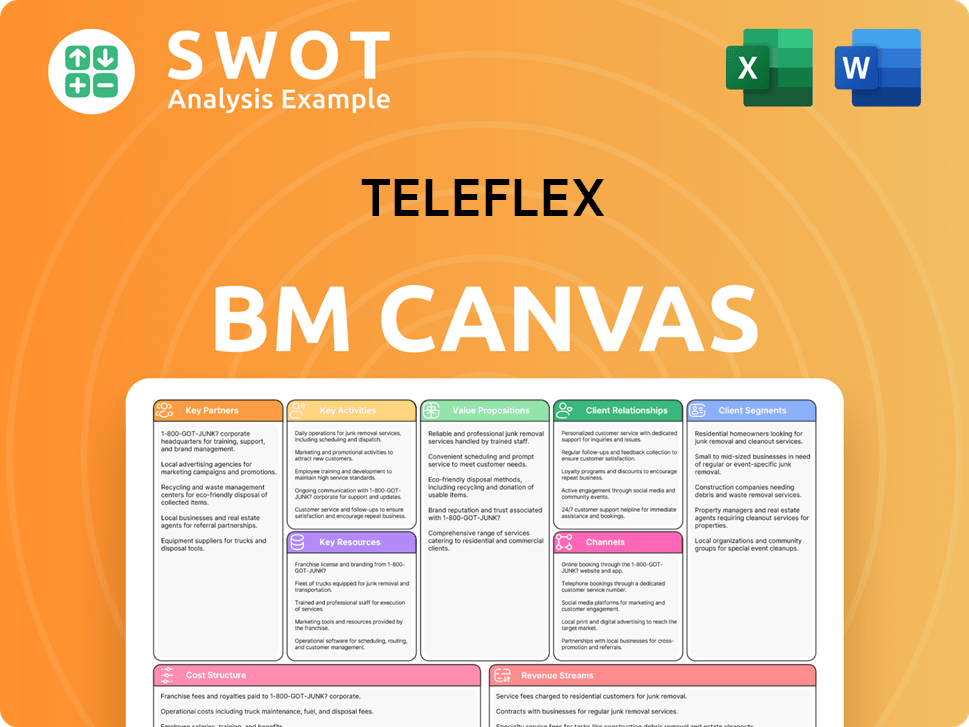
Teleflex Business Model Canvas
- Complete 9-Block Business Model Canvas
- Effortlessly Communicate Your Business Strategy
- Investor-Ready BMC Format
- 100% Editable and Customizable
- Clear and Structured Layout
How Is Teleflex Positioning Itself for Continued Success?
The Teleflex company holds a strong position in the medical device industry. Its diverse product portfolio and strategic focus on key growth areas drive this position. Teleflex medical operates in over 150 countries, demonstrating significant global reach. The company's strong brand reputation and long-standing relationships with healthcare providers contribute to customer loyalty, supporting its market position.
Several factors could impact Teleflex's operations or revenue. Intense competition from major players and regulatory risks, particularly changes in global regulations, pose challenges. The company has also faced revenue pressures in certain segments and complexities in executing its separation strategy. Despite these challenges, Teleflex is focused on strategic initiatives to sustain and expand its ability to make money.
Industry Position
Teleflex maintains a leading market position in central venous catheters (CVCs), holding over 50% market share in vascular access catheters. It benefits from innovations like patent-protected coating technology that reduces infection risk. The company's global presence and established relationships with healthcare providers enhance its market strength.
Risks and Headwinds
Key risks include competition from major players such as Medtronic and regulatory changes. The OEM business declined by 27% in Q1 2025, with a full-year decline expected at 10% to 12%. Tariffs are expected to impact costs by approximately $55 million in 2025. These factors create uncertainty for the Teleflex company.
Future Outlook
The planned separation into two publicly traded companies by mid-2026 is a significant move. RemainCo is projected to achieve constant currency revenue growth of more than 6% post-separation. The acquisition of Biotronik's Vascular Interventions business is also expected to contribute to growth.
Strategic Initiatives
Teleflex is focused on innovation, including new product introductions like the FDA 510(k) clearance for its AC3 Range™ intra-aortic balloon pump. The company anticipates UroLift to improve in 2026 as reimbursement stabilizes. The OEM business is expected to return to growth in 2026. Read more about the Growth Strategy of Teleflex.
Key Takeaways
Teleflex's future hinges on strategic initiatives and market dynamics. The company is navigating challenges while focusing on innovation and expansion. The separation into two companies and the Biotronik acquisition are key strategies for future growth.
- Strong market position in vascular access.
- Facing competition and regulatory risks.
- Focus on innovation and strategic acquisitions.
- Anticipated return to mid-single-digit top-line growth.
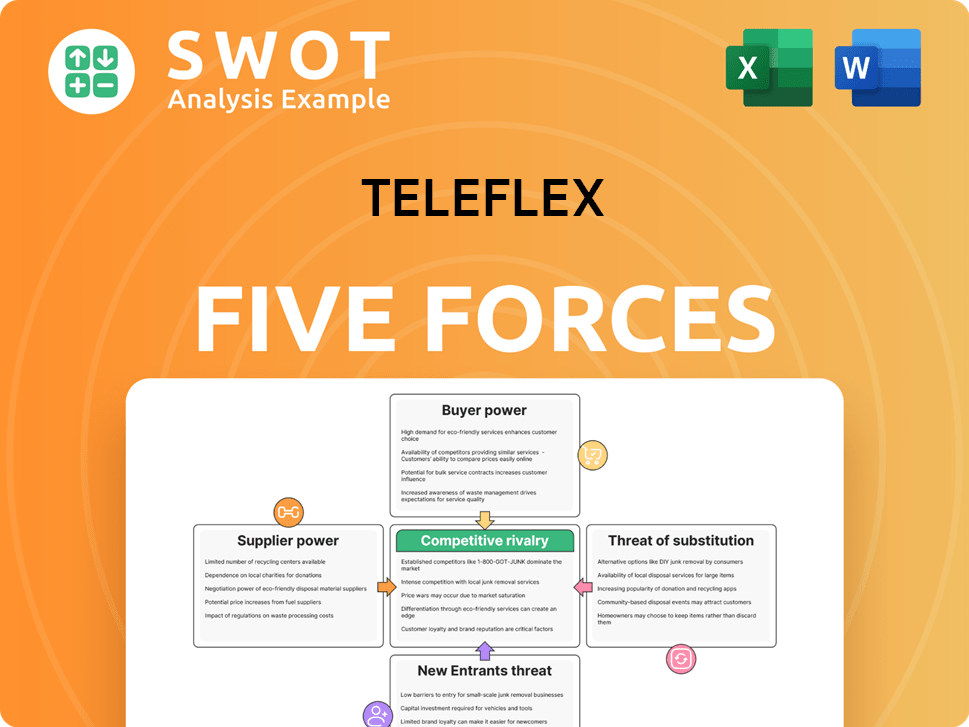
Teleflex Porter's Five Forces Analysis
- Covers All 5 Competitive Forces in Detail
- Structured for Consultants, Students, and Founders
- 100% Editable in Microsoft Word & Excel
- Instant Digital Download – Use Immediately
- Compatible with Mac & PC – Fully Unlocked
Related Blogs

- What are Mission Vision & Core Values of Teleflex Company?
- What is Competitive Landscape of Teleflex Company?
- What is Growth Strategy and Future Prospects of Teleflex Company?
- What is Sales and Marketing Strategy of Teleflex Company?
- What is Brief History of Teleflex Company?
- Who Owns Teleflex Company?
- What is Customer Demographics and Target Market of Teleflex Company?
Disclaimer
All information, articles, and product details provided on this website are for general informational and educational purposes only. We do not claim any ownership over, nor do we intend to infringe upon, any trademarks, copyrights, logos, brand names, or other intellectual property mentioned or depicted on this site. Such intellectual property remains the property of its respective owners, and any references here are made solely for identification or informational purposes, without implying any affiliation, endorsement, or partnership.
We make no representations or warranties, express or implied, regarding the accuracy, completeness, or suitability of any content or products presented. Nothing on this website should be construed as legal, tax, investment, financial, medical, or other professional advice. In addition, no part of this site—including articles or product references—constitutes a solicitation, recommendation, endorsement, advertisement, or offer to buy or sell any securities, franchises, or other financial instruments, particularly in jurisdictions where such activity would be unlawful.
All content is of a general nature and may not address the specific circumstances of any individual or entity. It is not a substitute for professional advice or services. Any actions you take based on the information provided here are strictly at your own risk. You accept full responsibility for any decisions or outcomes arising from your use of this website and agree to release us from any liability in connection with your use of, or reliance upon, the content or products found herein.