

Public Storage Bundle

Who Really Owns Public Storage?
Ever wondered who pulls the strings at the world's largest self-storage company? Public Storage, a giant in the real estate market, has a fascinating ownership structure that impacts its strategic direction and financial performance. From its humble beginnings to its current status as a market leader, understanding the Public Storage SWOT Analysis is key to unlocking its potential.

The story of Public Storage, from its founders B. Wayne Hughes and Kenneth Volk Jr., to its current dominance, reveals a dynamic evolution. As a leading player in the self-storage industry, understanding the Public Storage company's ownership is critical for investors and anyone interested in the real estate sector. This exploration will provide insights into the company's structure, influencing factors, and the key players who shape its future, including details on its headquarters, management team, and financial reports.
Who Founded Public Storage?
The origins of the Public Storage company trace back to August 1972, when it was founded by B. Wayne Hughes and Kenneth Volk Jr. Their initial vision centered on capitalizing on the growing demand for self-storage solutions. The company's early success laid the groundwork for its significant expansion and market dominance in the self-storage industry.
Hughes, a real estate developer, and Volk Jr., a major home developer, each contributed $25,000 to the initial $50,000 investment. They initially named the company 'Private Storage Spaces Inc.' before changing it to 'Public Storage' to align with the 'PS' acronym. This strategic move reflected their ambition to establish a publicly accessible and recognizable brand in the nascent self-storage market.
Their business model involved building storage warehouses as a temporary income source, with the anticipation of future land appreciation for redevelopment. This approach proved highly profitable, as storage units could be rented at rates comparable to apartments or office spaces, yet cost significantly less to construct and maintain, a key factor in the company's early financial success. This strategy led to rapid growth, with Public Storage opening 20 locations by 1974.

Early Strategy
The founders aimed to build storage warehouses as a temporary income stream, anticipating future land appreciation. This strategy proved lucrative, as storage units were rented at prices similar to apartments but cost less to build and maintain.
Financing Approach
Hughes favored real estate limited partnerships (RELPs) to finance new property acquisitions. Public Storage initially built warehouses and sold them to independent RELPs.
Early Growth
By 1974, just two years after its founding, Public Storage had built 20 locations. The company's expansion was fueled by a strong demand for self-storage solutions.
RELP Formation
In 1975, the company formed its own RELP, Public Storage Partners Ltd., which secured its first $3 million in investments two years later. This structure facilitated continued expansion.
Early Investor Returns
Early investors in these partnerships saw substantial returns, earning three to four times their initial investment due to increasing property values, high occupancy rates, and rising rental prices.
Expansion Funding
By the mid-1980s, Public Storage was raising between $200 million and $300 million in investments annually, showcasing its ability to attract significant capital for growth.
In 1973, Public Storage established a property management subsidiary, Public Storage Management Inc. Hughes's preference for alternative financing led to the use of real estate limited partnerships (RELPs) to fund acquisitions. The company initially constructed warehouses and sold them to independent RELPs for a development fee. This approach allowed Public Storage to expand rapidly, even during periods of high interest rates that slowed industry growth. Early investors in these partnerships enjoyed substantial returns, often multiplying their initial investments due to rising property values and high occupancy rates. Co-founder Kenneth Volk Jr. retired in the mid-1980s, with B. Wayne Hughes acquiring his interest. For more insights into the company's strategic growth, consider exploring the Growth Strategy of Public Storage.
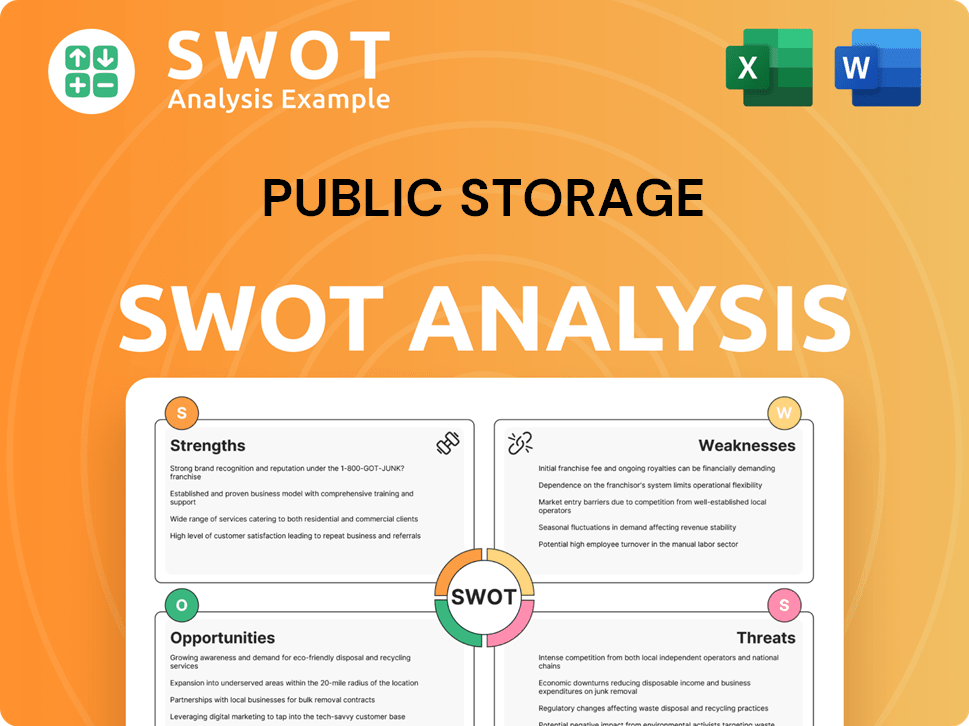
Public Storage SWOT Analysis
- Complete SWOT Breakdown
- Fully Customizable
- Editable in Excel & Word
- Professional Formatting
- Investor-Ready Format
How Has Public Storage’s Ownership Changed Over Time?
The evolution of Public Storage's ownership reflects its growth from a privately funded entity to a publicly traded real estate investment trust (REIT). A pivotal moment occurred in 1995 when Storage Equities Inc., a REIT founded by Public Storage in 1980, merged with Public Storage, consolidating various partnerships and companies under one entity. This strategic move simplified the structure and set the stage for further expansion. The initial Public Offering (IPO) in 1980 was a crucial step, providing the capital needed for significant growth in the self-storage market.
The company's ownership structure has been shaped by strategic acquisitions. In 2006, Public Storage acquired Shurgard Storage Centers for $5.5 billion, adding 624 locations to its portfolio. In 2023, Public Storage acquired Simply Self Storage from Blackstone Real Estate Income Trust for $2.2 billion, adding 127 facilities. These acquisitions have expanded its market presence and influenced its strategic direction.
| Ownership Category | Approximate Ownership (April 2025) | Key Holders |
|---|---|---|
| Institutional Investors | 80.49% | Vanguard Group Inc. (11.74%), BlackRock, Inc. (9.67%), State Street Corp. (5.92%) |
| Insiders | 8.93% | Tamara Hughes Gustavson (approx. 10%) |
| Retail Investors | 10.58% |
As of April 2025, Public Storage's ownership is heavily influenced by institutional investors, who hold a significant majority of the shares. This concentration of ownership, along with the presence of key individual shareholders like Tamara Hughes Gustavson, impacts the company's strategic decisions and corporate governance. Understanding the ownership structure is crucial for investors looking into the Revenue Streams & Business Model of Public Storage.

Key Takeaways on Public Storage Ownership
Public Storage's ownership structure is primarily influenced by institutional investors.
- Institutional investors hold approximately 80.49% of shares as of April 2025.
- Major institutional holders include Vanguard Group Inc. and BlackRock, Inc.
- Tamara Hughes Gustavson, a notable individual shareholder, holds approximately 10% of the stock.
- The company's strategic direction is influenced by large institutional holdings.
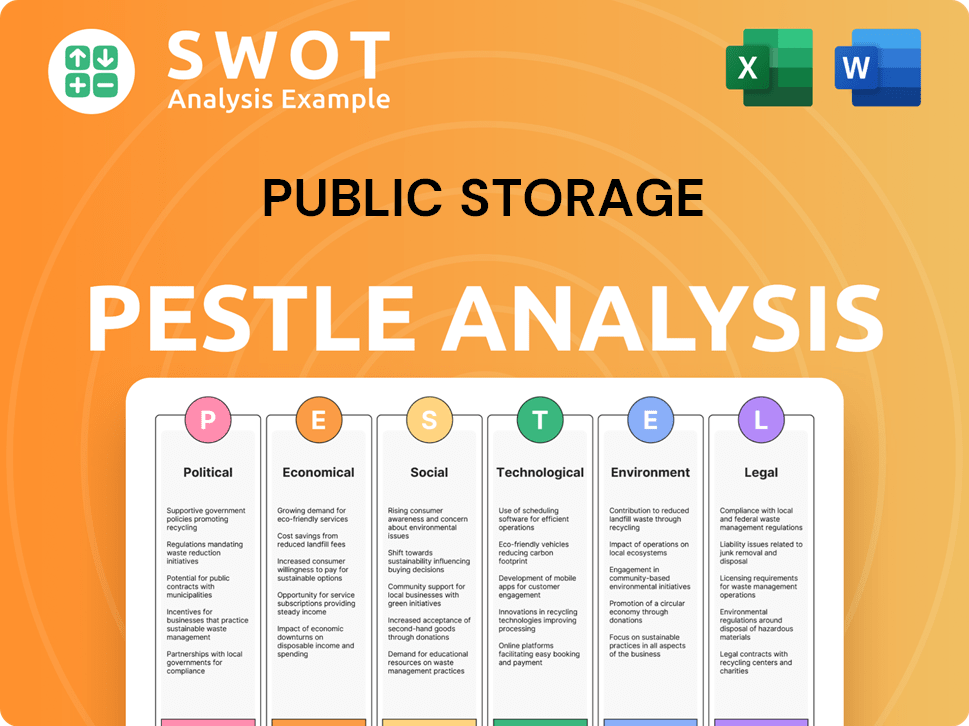
Public Storage PESTLE Analysis
- Covers All 6 PESTLE Categories
- No Research Needed – Save Hours of Work
- Built by Experts, Trusted by Consultants
- Instant Download, Ready to Use
- 100% Editable, Fully Customizable
Who Sits on Public Storage’s Board?
The Public Storage board of directors oversees the company's strategic direction and governance. While specific affiliations of current board members for 2024-2025 may vary, it is known that Tamara Hughes Gustavson, daughter of co-founder B. Wayne Hughes, is on the board. In late 2020, activist investor Elliott Management attempted to influence the board's composition, demonstrating the potential impact of shareholder activism on Public Storage company governance and strategic decisions. The board's role is crucial in guiding the Public Storage's operations and ensuring accountability to shareholders.
The composition of the board is crucial for the company's performance and strategic direction. The board's decisions can influence the company's financial performance and its ability to adapt to market changes. Understanding the board's structure and the influence of major shareholders is key to assessing the company's governance and long-term prospects. The board's decisions can impact the company's ability to compete effectively in the self-storage market and create value for its shareholders.
| Board Member | Role | Notes |
|---|---|---|
| Tamara Hughes Gustavson | Board Member | Daughter of co-founder B. Wayne Hughes |
| New Directors (Announced after Elliott Management's nomination) | Board Members | Three new directors were announced in response to activist investor pressure |
| Institutional Investors | Shareholders | Hold a significant percentage of shares, influencing management |
Public Storage ownership structure primarily follows a one-share-one-vote principle. The company's reorganization into an UPREIT structure in August 2023 primarily affected its tax structure and operational flexibility, rather than altering the voting power at the REIT level. Institutional investors hold approximately 80.49% of the shares as of April 2025, which gives them significant influence. Such influence can lead to engagement with company management on key issues, contributing to corporate governance and strategic planning. For more on how the company approaches its market, see the Marketing Strategy of Public Storage.
Voting Power and Influence
Institutional investors have considerable influence due to their substantial shareholdings.
- The voting structure generally adheres to the one-share-one-vote principle.
- Activist investors can push for changes in corporate strategy.
- The UPREIT structure primarily impacts tax and operational aspects.
- Board decisions impact the company's financial performance.
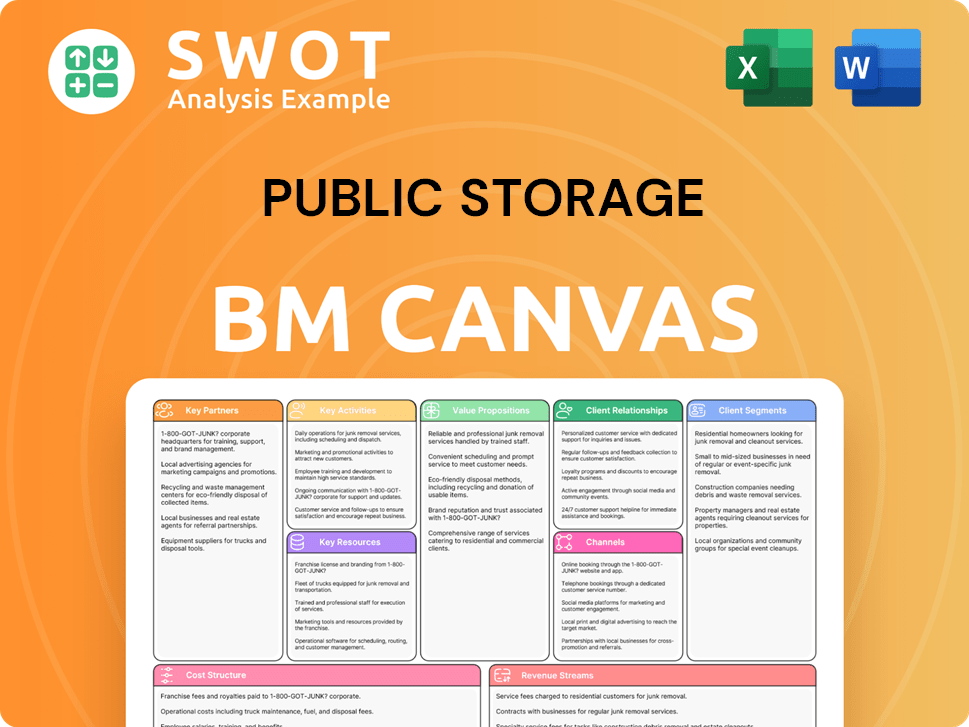
Public Storage Business Model Canvas
- Complete 9-Block Business Model Canvas
- Effortlessly Communicate Your Business Strategy
- Investor-Ready BMC Format
- 100% Editable and Customizable
- Clear and Structured Layout
What Recent Changes Have Shaped Public Storage’s Ownership Landscape?
Over the past few years, the focus of the Public Storage company has been on expanding its market presence through strategic acquisitions. A significant move in 2023 was the acquisition of Simply Self Storage from Blackstone Real Estate Income Trust for $2.2 billion. Following this, the company continued its acquisition strategy, purchasing or contracting to acquire nine additional self-storage facilities for $140.7 million. These actions highlight Public Storage's commitment to external growth, aimed at increasing cash flows by integrating new facilities into its existing portfolio.
The self-storage industry is undergoing a period of consolidation, driven by both public REITs and large private operators actively acquiring smaller, independently owned facilities. This trend is fueled by the fragmented nature of the industry, where the top five participants, including Public Storage, still account for a relatively small portion of the total self-storage space. This environment positions major players like Public Storage for further expansion and increased market influence. This consolidation trend is expected to continue, reshaping the competitive landscape of the self-storage market.
| Ownership Category | Ownership Percentage (April 2025) | Key Holders |
|---|---|---|
| Institutional | 80.49% | Vanguard Group Inc., BlackRock, Inc., State Street Corp. |
| Insiders | 8.93% | Management and Board Members |
| Retail | 10.58% | Individual Investors |
Regarding ownership trends, institutional ownership in Public Storage remains substantial, standing at approximately 80.49% as of April 2025. Major institutional investors such as Vanguard Group Inc., BlackRock, Inc., and State Street Corp. continue to hold significant stakes. These major institutional holdings are closely monitored as they can indicate shifts in investor sentiment. For more information on how the company is growing, you can read about the Growth Strategy of Public Storage.
 Acquisition Strategy
Public Storage consistently acquires self-storage facilities to expand its portfolio. This strategy enhances its market presence and financial performance. Recent acquisitions include Simply Self Storage and several other facilities, demonstrating a focus on external growth.
Industry Consolidation
The self-storage industry is consolidating, with larger players acquiring smaller operators. This trend increases the market share of major companies. This consolidation is driven by the fragmented nature of the self-storage market.
Ownership Structure
Institutional investors hold a significant majority stake in Public Storage. Insiders also have a notable ownership share. Retail investors make up a smaller percentage of the ownership structure.
Investor Focus
Investors are focused on operational efficiency and sustained growth. Public Storage's initiatives, such as the 'Property of Tomorrow' program, align with these expectations. Changes in institutional holdings are closely watched.
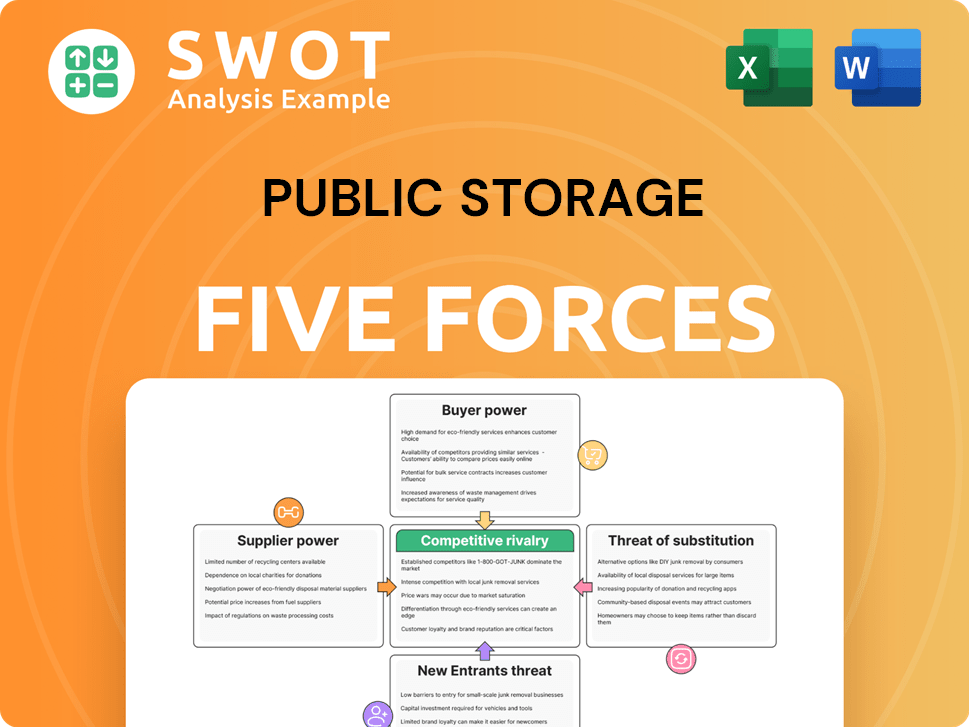
Public Storage Porter's Five Forces Analysis
- Covers All 5 Competitive Forces in Detail
- Structured for Consultants, Students, and Founders
- 100% Editable in Microsoft Word & Excel
- Instant Digital Download – Use Immediately
- Compatible with Mac & PC – Fully Unlocked
Related Blogs

- What are Mission Vision & Core Values of Public Storage Company?
- What is Competitive Landscape of Public Storage Company?
- What is Growth Strategy and Future Prospects of Public Storage Company?
- How Does Public Storage Company Work?
- What is Sales and Marketing Strategy of Public Storage Company?
- What is Brief History of Public Storage Company?
- What is Customer Demographics and Target Market of Public Storage Company?
Disclaimer
All information, articles, and product details provided on this website are for general informational and educational purposes only. We do not claim any ownership over, nor do we intend to infringe upon, any trademarks, copyrights, logos, brand names, or other intellectual property mentioned or depicted on this site. Such intellectual property remains the property of its respective owners, and any references here are made solely for identification or informational purposes, without implying any affiliation, endorsement, or partnership.
We make no representations or warranties, express or implied, regarding the accuracy, completeness, or suitability of any content or products presented. Nothing on this website should be construed as legal, tax, investment, financial, medical, or other professional advice. In addition, no part of this site—including articles or product references—constitutes a solicitation, recommendation, endorsement, advertisement, or offer to buy or sell any securities, franchises, or other financial instruments, particularly in jurisdictions where such activity would be unlawful.
All content is of a general nature and may not address the specific circumstances of any individual or entity. It is not a substitute for professional advice or services. Any actions you take based on the information provided here are strictly at your own risk. You accept full responsibility for any decisions or outcomes arising from your use of this website and agree to release us from any liability in connection with your use of, or reliance upon, the content or products found herein.