

Polaris Bundle

How Well Does Polaris Know Its Customers?
In the dynamic world of powersports, understanding your customer is paramount, and few companies exemplify this better than Polaris. From its humble beginnings in 1954 to its current status as an industry leader, Polaris has continuously adapted to meet the evolving needs of its diverse customer base. This exploration delves into the Polaris SWOT Analysis to understand the company's strategies.

This analysis will dissect the customer demographics and Polaris target market, providing insights into Polaris company's strategic approach. We'll examine market segmentation, customer profile characteristics, and target audience analysis to understand who buys Polaris off-road vehicles, their customer income levels, and Polaris customer geographic location. Furthermore, we will explore Polaris customer buying behavior, the Polaris marketing strategy for target audience, and the role of Polaris product user personas in shaping the company's success, especially in light of the current market challenges and the projected headwinds for 2025.
Who Are Polaris’s Main Customers?
Understanding the customer demographics and Polaris target market is crucial for analyzing the company's performance. The company's diverse product portfolio, ranging from off-road vehicles (ORVs) to motorcycles and marine products, caters to a broad spectrum of consumers, businesses (B2B), and government agencies. This segmentation is key to developing effective marketing strategies and assessing the company's growth potential, as highlighted in a recent analysis of the Growth Strategy of Polaris.
The primary customer segments for the company are largely shaped by its product offerings. In 2024, the Off Road segment, which includes ORVs and snowmobiles, accounted for the largest portion of sales at 79%. The On Road segment, encompassing motorcycles, contributed 14%, while the Marine segment made up 7% of total sales. Each segment has distinct customer profiles, influencing the company's approach to product development and marketing.
The company's success hinges on accurately identifying and understanding its customer profile. This involves analyzing factors such as age, income, lifestyle, and geographic location to tailor products and marketing efforts effectively. By focusing on these key areas, the company can better meet the needs of its customers and maintain its position in the market.
 B2C Recreational Customers
The B2C segment primarily targets affluent consumers who are less affected by economic downturns, as powersports vehicles often represent discretionary purchases. These customers are driven by a desire for outdoor experiences and active lifestyles, aligning with the growing adventure tourism market. The company's focus on this segment is evident in its Polaris Adventures business.
B2B and B2G Customers
For utility-focused off-road vehicles, the company serves commercial users and government agencies (B2B and B2G). These customers prioritize durability, performance, and functionality for tasks such as farming, construction, and land management. This segment has shown more resilience compared to recreational markets.

Market Dynamics and Customer Behavior
The company's target market has experienced shifts influenced by economic conditions. In 2024, North American ORV retail sales remained flat at 805,000 units, but snowmobile unit retail sales for the 2024-2025 season were down by low-forties percent. The Marine segment also saw significant decreases in unit sales.
- The company maintains market share leadership in the ORV segment and in pontoons.
- The company holds a solid No. 2 position in snowmobiles and heavyweight motorcycles.
- The company continues to innovate, including electrification initiatives, to cater to evolving customer demands.
- The company focuses on expanding its presence in the market.
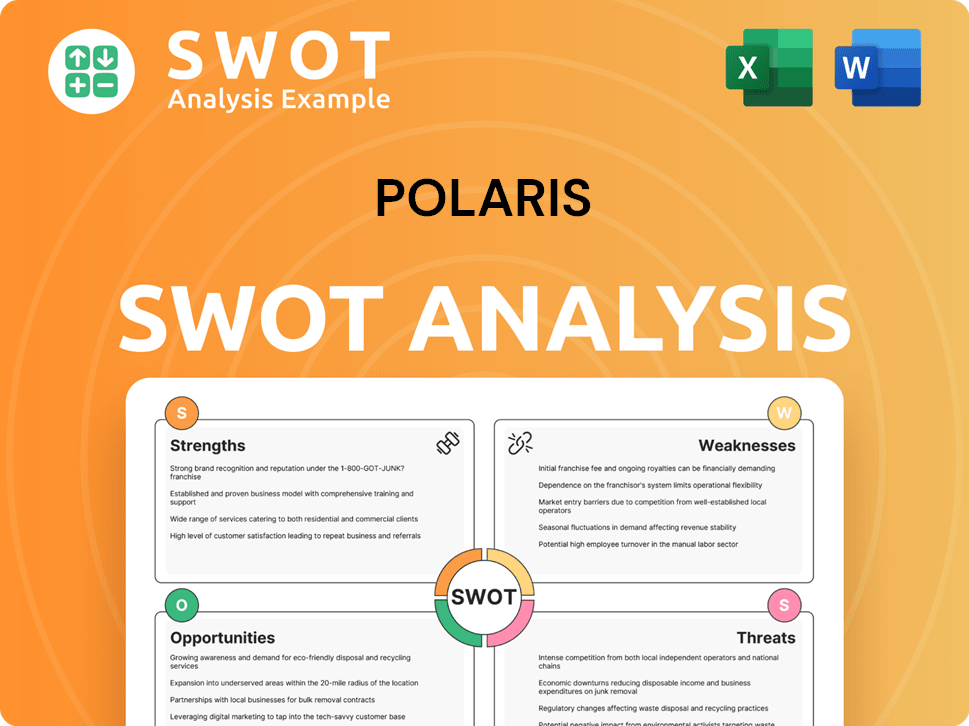
Polaris SWOT Analysis
- Complete SWOT Breakdown
- Fully Customizable
- Editable in Excel & Word
- Professional Formatting
- Investor-Ready Format
What Do Polaris’s Customers Want?
Understanding the customer needs and preferences is crucial for the success of any company, and for the company, this is no exception. The company's diverse customer base drives a variety of needs, motivations, and preferences that directly influence their purchasing decisions. The company's ability to meet these needs through product innovation, marketing, and customer service helps to maintain its market position.
For recreational users, the desire for adventure, freedom, and enriching outdoor experiences is often the primary driver. Commercial and government clients, on the other hand, prioritize practical needs and functionality. The company tailors its marketing by highlighting the specific benefits and features relevant to each segment, whether it's the thrill of a Slingshot moto-roadster or the utility of a RANGER.
The company's approach to customer needs is reflected in its product development and marketing strategies. By actively listening to customer feedback and emphasizing 'rider-driven innovation', the company aims to meet the evolving demands of its diverse customer base. This approach is also evident in the Growth Strategy of Polaris, which focuses on product innovation and customer satisfaction.
Customer Needs and Preferences
The company's customer base can be segmented into recreational and commercial users, each with distinct needs and preferences. Recreational users are driven by aspirational and psychological factors, seeking adventure and high-performance products. Commercial and government clients prioritize durability, functionality, and the ability to operate in rugged environments. The company addresses these needs through product features, such as advanced suspension, powerful engines, and integrated technology like RIDE COMMAND.
-
Recreational Users:
- Driven by the desire for adventure and outdoor experiences.
- Seek high-performance, reliable, and innovative products.
- Prioritize features like advanced suspension and integrated technology.
-
Commercial and Government Clients:
- Prioritize durability, towing capacity, and cargo solutions.
- Need vehicles that can operate in rugged environments.
- Focus on practical needs and functionality.
-
Usage Patterns:
- Recreational riders use vehicles for trail riding and events.
- Commercial users rely on vehicles for daily tasks and heavy-duty work.
-
Loyalty and Customer Experience:
- Loyalty built on product reliability, brand reputation, and overall experience.
- The company emphasizes 'rider-driven innovation' to inform product development.
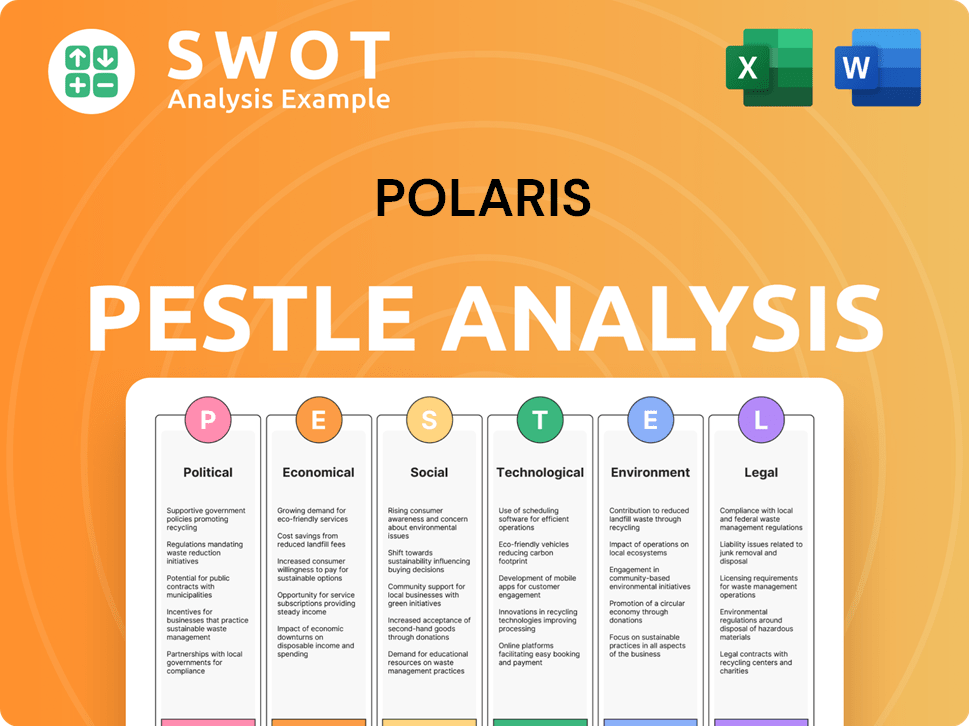
Polaris PESTLE Analysis
- Covers All 6 PESTLE Categories
- No Research Needed – Save Hours of Work
- Built by Experts, Trusted by Consultants
- Instant Download, Ready to Use
- 100% Editable, Fully Customizable
Where does Polaris operate?
The geographical market presence of the [Company Name] is primarily centered in North America, with a significant global footprint. The company operates in nearly 100 countries, but its strongest market share and brand recognition are within North America. In the fourth quarter of 2024, North America accounted for the majority of sales, highlighting its importance to the company's overall performance.
In the fourth quarter of 2024, North America represented 84% of the total sales, amounting to $1,481 million. International sales made up 16% of the total sales, at $274 million. The United States is the largest market within North America, with a notable decrease in sales in 2024 across all segments. The company strategically adapts its offerings to suit regional needs, ensuring it can cater to different customer preferences worldwide.
The company's approach to market segmentation involves tailoring products and marketing strategies to specific regional needs. For instance, snowmobile sales are concentrated in regions with consistent snowfall, while off-road vehicles have a broader appeal. The company also serves niche markets, such as the European auto market with products like Aixam quadricycles and Goupil electric vehicles. This strategy helps the company to effectively reach its target audience.

North American Dominance
North America is the primary market for the company, accounting for a significant portion of its sales. In Q4 2024, North America represented 84% of total sales. This dominance highlights the importance of the North American market for the company's overall financial performance.
International Presence
While North America is the primary focus, the company also has a presence in international markets. International sales accounted for 16% of total sales in Q4 2024. The company continues to focus on expanding its presence in international markets.
United States Market
The United States is the largest market within North America for the company. Sales in the U.S. experienced a decrease in 2024. The company's sales in the U.S. are affected by market dynamics and consumer behavior.
Canadian Market
Canada is another key market for the company, particularly for snowmobile sales. Sales in Canada also saw a decline, mainly due to reduced snowmobile shipments. The company maintains a strong presence in the 'snowbelt regions' of the United States and Canada.
Market Dynamics and Inventory Management
The company actively manages dealer inventory in response to market conditions. Planned shipment reductions were implemented in Q4 2024 due to a subdued retail environment. The company anticipates these challenges to continue into 2025, particularly in the snow and marine markets.
Product and Market Adaptation
The company tailors its products and marketing to suit specific regional needs. This includes adapting product features and models to suit regional demands. For example, the company serves niche auto markets in Europe with products like Aixam quadricycles and Goupil electric vehicles.
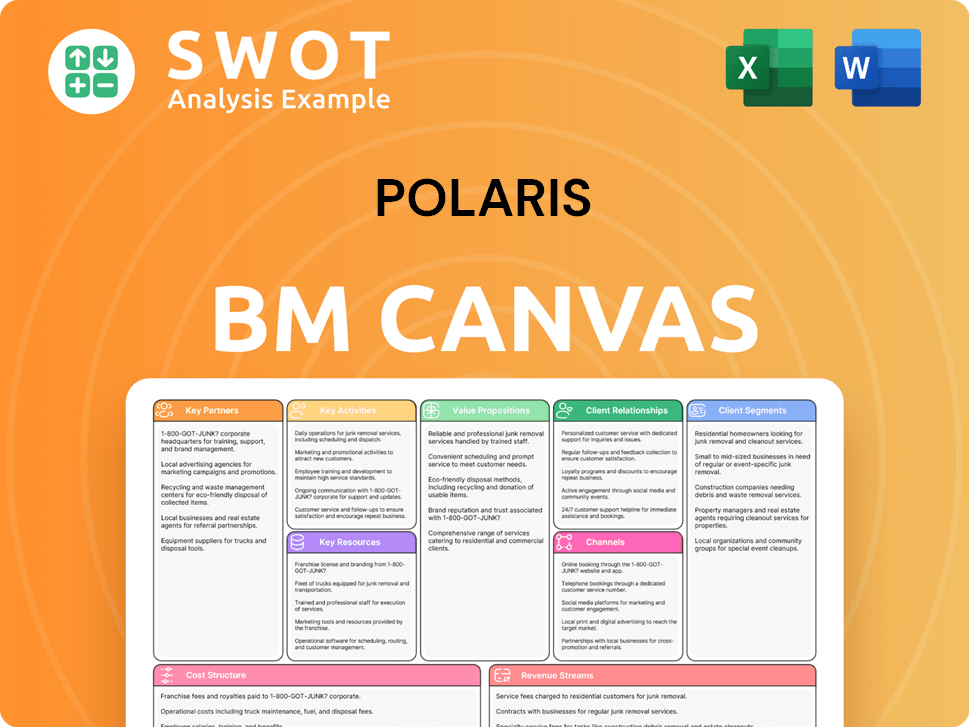
Polaris Business Model Canvas
- Complete 9-Block Business Model Canvas
- Effortlessly Communicate Your Business Strategy
- Investor-Ready BMC Format
- 100% Editable and Customizable
- Clear and Structured Layout
How Does Polaris Win & Keep Customers?
The company employs a comprehensive strategy for both acquiring and retaining customers, focusing on innovation, diverse marketing channels, and strong dealer relationships. Their approach is designed to attract new customers while ensuring existing ones remain loyal. This involves continuous product development, strategic marketing, and a commitment to customer satisfaction and safety.
A key aspect of the strategy is product innovation. The introduction of new models and enhancements across various product lines, such as the RZR Pro lineup, RANGER models, and the Indian Motorcycle Scout lineup, fuels demand and attracts new buyers. This focus on innovation extends to the expansion of ATV offerings with new models featuring upgrades like LED lighting and improved storage, directly addressing specific rider needs.
Marketing efforts are multifaceted, utilizing digital platforms, traditional media, social media, and influencer engagement. Partnering with local outfitters through the Polaris Adventures business provides experiential marketing opportunities, allowing potential customers to engage with their vehicles. By the end of 2024, Polaris Adventures had over 250 locations and facilitated over 1,750,000 rides, demonstrating the effectiveness of this approach in reaching diverse groups of people.
Product Innovation
Continuous introduction of new models and upgrades, such as the redesigned RZR Pro lineup and new ATV models. This stimulates demand and appeals to a wide range of customers. The company's commitment to innovation is a core driver of customer acquisition and retention.
Marketing Channels
Utilizing a mix of digital platforms, traditional media, and social media, including influencer engagement. The Polaris Adventures business, with over 250 locations, provides experiential marketing, attracting potential customers. This multi-channel approach enhances brand awareness.
Dealer Network and Sales Tactics
Maintaining strong relationships with dealers and actively managing dealer inventory to align with retail demand. In Q4 2024, planned shipment reductions helped manage dealer inventory in a soft retail environment. The company also uses programs like the pre-order SnowCheck program for snowmobiles.
Customer Retention Strategies
Focusing on high-quality products, robust after-sales service, and a comprehensive portfolio of parts, garments, and accessories (PG&A). The 'Geared for Good' report highlights efforts in product design with environmental impact in mind. The company aims to provide the 'best customer experience'.
The company's approach to customer acquisition and retention is multifaceted, focusing on innovation, strategic marketing, and strong dealer relationships. The company's focus on understanding customer needs and continually innovating suggests an underlying strategy to build long-term customer relationships and lifetime value. For more details, you can explore the Marketing Strategy of Polaris.
Market Segmentation
The company likely segments its market based on factors such as age, income, lifestyle, and geographic location to tailor its products and marketing efforts. Understanding the customer demographics is crucial for effective market segmentation.
Customer Profile
Creating detailed customer profiles helps the company understand its target audience better. This includes analyzing their needs, preferences, and buying behaviors. This enables the company to create highly targeted marketing campaigns.
Target Audience Analysis
Analyzing the Polaris target market involves identifying the specific groups of people most likely to purchase their products. This analysis informs the development of marketing strategies and product offerings. The company uses data to refine its target audience.
Customer Buying Behavior
Understanding Polaris customer buying behavior is key to optimizing sales strategies. This includes analyzing how customers research products, make purchasing decisions, and interact with the brand. The company uses this data to improve customer experience.
Market Research
Continuous market research is essential for understanding the evolving needs and preferences of its customers. This helps the company to stay ahead of the competition. This includes gathering data on Polaris customer income levels and geographic locations.
Competitor Analysis
Analyzing competitors provides insights into their strategies and target markets. This helps the company to differentiate its products and services. Understanding Polaris competitor analysis demographics is crucial for competitive advantage.
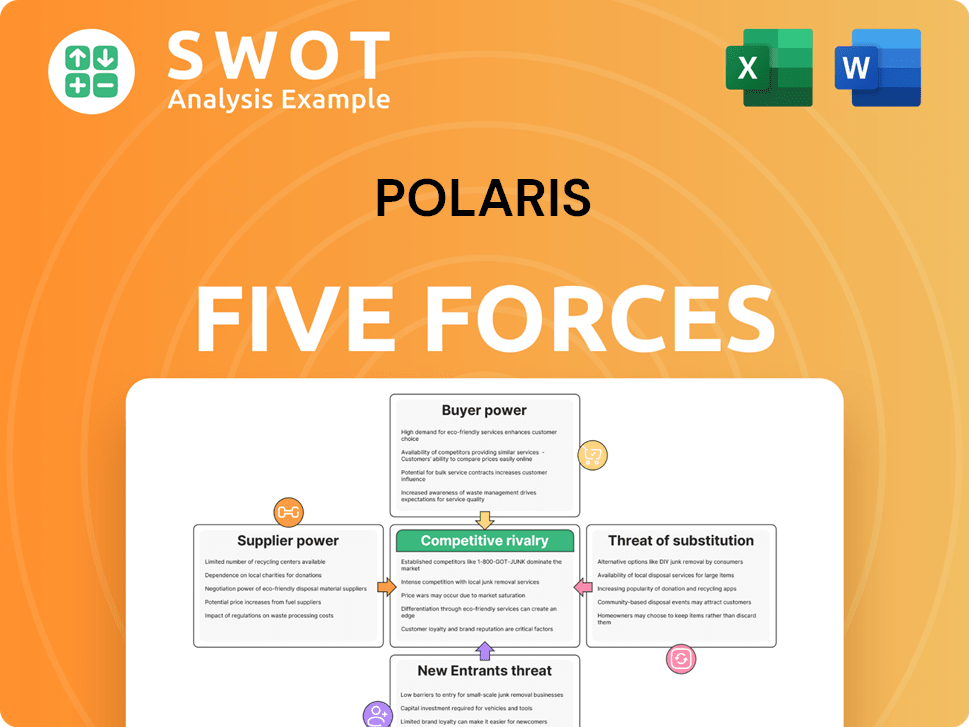
Polaris Porter's Five Forces Analysis
- Covers All 5 Competitive Forces in Detail
- Structured for Consultants, Students, and Founders
- 100% Editable in Microsoft Word & Excel
- Instant Digital Download – Use Immediately
- Compatible with Mac & PC – Fully Unlocked
Related Blogs

- What are Mission Vision & Core Values of Polaris Company?
- What is Competitive Landscape of Polaris Company?
- What is Growth Strategy and Future Prospects of Polaris Company?
- How Does Polaris Company Work?
- What is Sales and Marketing Strategy of Polaris Company?
- What is Brief History of Polaris Company?
- Who Owns Polaris Company?
Disclaimer
All information, articles, and product details provided on this website are for general informational and educational purposes only. We do not claim any ownership over, nor do we intend to infringe upon, any trademarks, copyrights, logos, brand names, or other intellectual property mentioned or depicted on this site. Such intellectual property remains the property of its respective owners, and any references here are made solely for identification or informational purposes, without implying any affiliation, endorsement, or partnership.
We make no representations or warranties, express or implied, regarding the accuracy, completeness, or suitability of any content or products presented. Nothing on this website should be construed as legal, tax, investment, financial, medical, or other professional advice. In addition, no part of this site—including articles or product references—constitutes a solicitation, recommendation, endorsement, advertisement, or offer to buy or sell any securities, franchises, or other financial instruments, particularly in jurisdictions where such activity would be unlawful.
All content is of a general nature and may not address the specific circumstances of any individual or entity. It is not a substitute for professional advice or services. Any actions you take based on the information provided here are strictly at your own risk. You accept full responsibility for any decisions or outcomes arising from your use of this website and agree to release us from any liability in connection with your use of, or reliance upon, the content or products found herein.