

United Parcel Service Bundle

How Does United Parcel Service Thrive in the Global Logistics Arena?
United Parcel Service (UPS) isn't just a shipping company; it's a global powerhouse, moving billions of packages annually. With 2024 revenues exceeding $91 billion, UPS's influence on international commerce is undeniable. But how does this logistics giant actually work, from its iconic brown trucks to its complex network of hubs and services?

Understanding United Parcel Service SWOT Analysis is crucial for investors, customers, and industry watchers alike. This article will dissect the core of UPS operations, revealing how it manages package delivery, freight transportation, and supply chain solutions across over 220 countries. We'll explore the strategies that have solidified UPS's position, providing insights into its financial performance and future prospects within the competitive logistics landscape.
What Are the Key Operations Driving United Parcel Service’s Success?
United Parcel Service (UPS) creates value through its extensive global network and diverse logistics solutions. The company's core focuses on reliable and efficient package delivery, serving a broad spectrum of customers, from individuals to large corporations. UPS operations encompass domestic and international package delivery, freight transportation, and comprehensive supply chain management.
The company leverages a vast physical infrastructure and technological innovation to enhance operational efficiency. This includes a massive airline and a fleet of alternative fuel vehicles. UPS has invested heavily in advanced tracking systems and route optimization software. This commitment extends to exploring emerging solutions like drones and autonomous vehicles.
UPS's supply chain is meticulously managed, supported by strategic partnerships and a robust distribution network that spans over 220 countries and territories. Its integrated network allows for seamless coordination across air, ground, and sea transportation. This integrated approach, combined with its strong brand reputation for reliability and efficiency, translates into significant customer benefits.
 Core Offerings
UPS offers a wide array of services. These include domestic and international package delivery, freight transportation, and supply chain management. The company also provides distribution, contract logistics, and customs brokerage services. These services cater to a diverse customer base, from individual consumers to large businesses.
Operational Infrastructure
UPS utilizes a vast infrastructure to support its operations. This includes one of the largest airlines and fleets of alternative fuel vehicles. The company's network consists of numerous hubs and ground facilities. The Worldport air hub in Louisville, Kentucky, processes approximately 416,000 pieces per hour.
Technological Innovation
UPS is committed to technological advancements to improve efficiency. This includes advanced tracking systems, route optimization software, and real-time data analytics. The company is also exploring emerging technologies like drones and autonomous vehicles. These innovations help to reduce transit times and minimize costs.
Customer Benefits
UPS provides several benefits to its customers through its integrated network. Customers have visibility and control over their shipments. They also benefit from timely deliveries and a wide array of value-added services. UPS's ability to handle complex logistics further differentiates its offerings.

Key Differentiators of UPS
UPS distinguishes itself through its integrated network, strong brand reputation, and comprehensive service offerings. The company's ability to handle complex logistics, from temperature-controlled healthcare shipments to large-scale freight, sets it apart. This integrated approach allows for seamless coordination across air, ground, and sea transportation.
- Integrated Network: Seamless coordination across air, ground, and sea.
- Brand Reputation: Strong reputation for reliability and efficiency.
- Value-Added Services: Offers customs brokerage and e-commerce solutions.
- Logistics Expertise: Handles complex logistics, including temperature-controlled shipments.
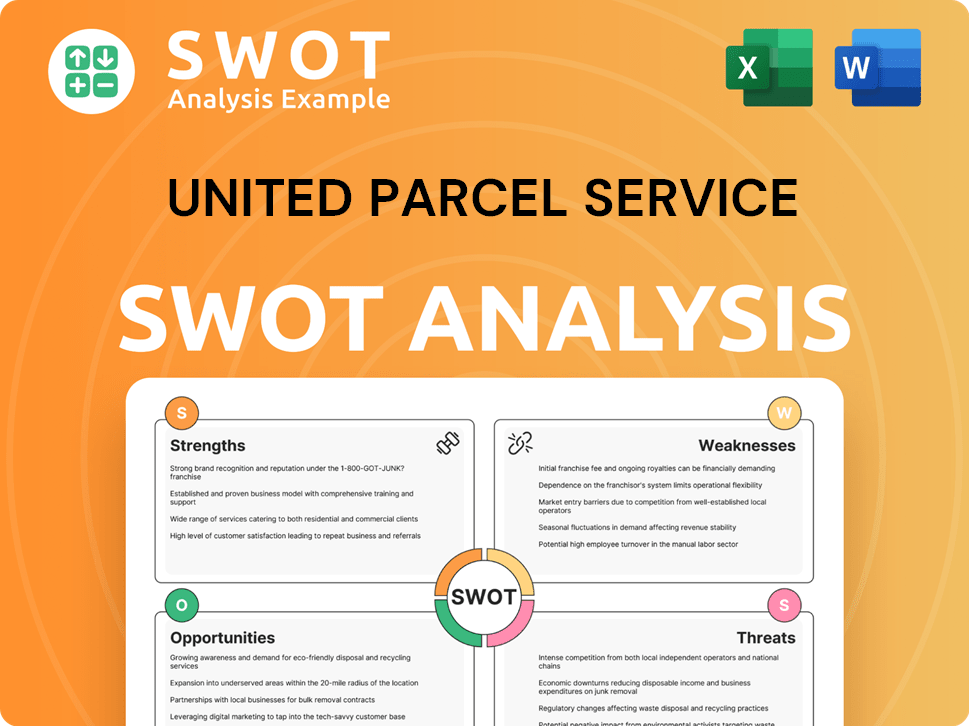
United Parcel Service SWOT Analysis
- Complete SWOT Breakdown
- Fully Customizable
- Editable in Excel & Word
- Professional Formatting
- Investor-Ready Format
How Does United Parcel Service Make Money?
Understanding the financial dynamics of United Parcel Service (UPS) is crucial for grasping its operational model. The company's revenue streams and monetization strategies are multifaceted, reflecting its global reach and diverse service offerings. This analysis delves into the key revenue segments and how UPS generates income.
In fiscal year 2024, UPS reported consolidated revenues of $91.1 billion. This financial performance underscores the company's significant presence in the package delivery and logistics sectors. Analyzing these revenue streams provides insights into the company's strategic focus and market positioning.
UPS generates revenue primarily through three segments: U.S. Domestic Package, International Package, and Supply Chain Solutions. Each segment contributes significantly to the company's overall financial performance, reflecting the breadth of its services and global footprint.
Revenue Breakdown by Segment
The U.S. Domestic Package segment is the largest revenue generator for UPS. The International Package segment and Supply Chain Solutions also contribute significantly to the company's financial performance. These segments highlight the company's diverse service offerings and global reach.
- U.S. Domestic Package: In 2024, this segment generated $60.38 billion, accounting for approximately 66.3% of total revenue. This segment focuses on time-definite, guaranteed small package delivery services within the United States.
- International Package: This segment contributed $17.96 billion in 2024, representing about 19.72% of total revenue. It encompasses small package delivery services across the global network.
- Supply Chain Solutions: This segment, including transportation, distribution, contract logistics, and customs brokerage, generated $12.73 billion in revenue in 2024, making up approximately 13.98% of total revenue. The Logistics sub-segment saw an 8.6% year-over-year growth, reaching $6.437 billion.
UPS employs several monetization strategies to maximize revenue. These strategies include tiered pricing for different service levels and fees for specialized services. The company's Digital Access Program (DAP) is a notable monetization strategy, generating substantial revenue.
Monetization Strategies
UPS utilizes various strategies to generate revenue, including tiered pricing and specialized services. The Digital Access Program (DAP) is a key component of its monetization efforts, particularly benefiting small and medium-sized businesses (SMBs). Understanding these strategies provides insight into how the Marketing Strategy of United Parcel Service drives revenue.
- Tiered Pricing: UPS offers different service levels (e.g., next-day air vs. ground shipping) with varying prices.
- Specialized Services: Fees are charged for services like hazardous materials handling and specific delivery options.
- Digital Access Program (DAP): This program generated $3.3 billion in global revenue in 2024, a 17% year-over-year increase. DAP offers discounted shipping rates, e-commerce platform integration, and flexible shipping options, particularly benefiting SMBs, which accounted for 28.9% of UPS's total U.S. volume in Q4 2024.
- Strategic Adjustments: UPS is adapting its revenue mix, such as insourcing UPS SurePost and reducing volume with its largest customer, Amazon, to focus on more profitable business.
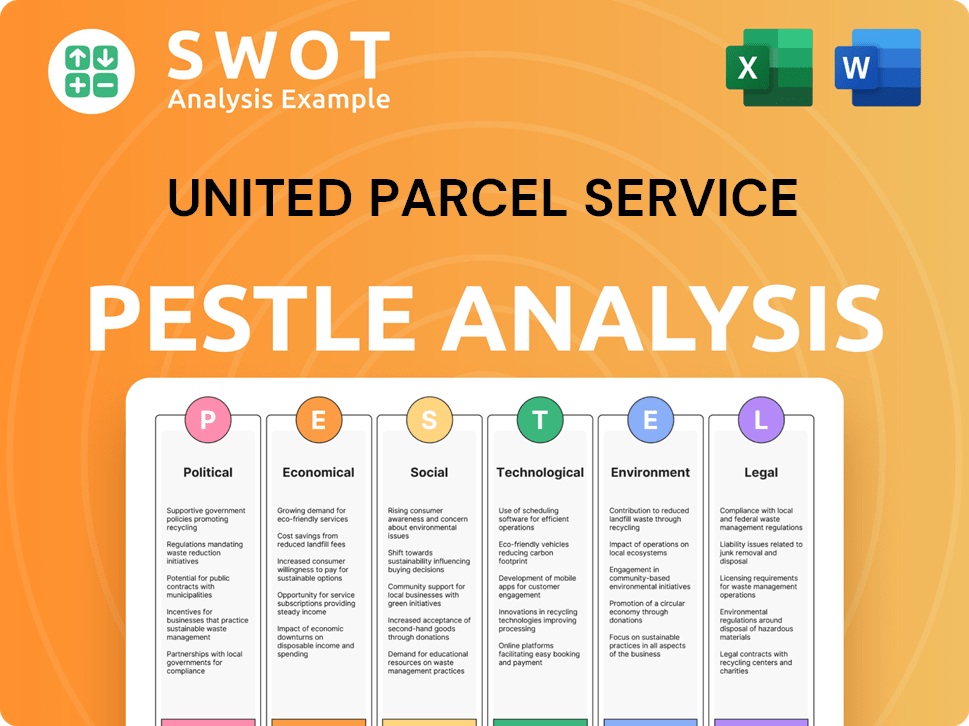
United Parcel Service PESTLE Analysis
- Covers All 6 PESTLE Categories
- No Research Needed – Save Hours of Work
- Built by Experts, Trusted by Consultants
- Instant Download, Ready to Use
- 100% Editable, Fully Customizable
Which Strategic Decisions Have Shaped United Parcel Service’s Business Model?
Throughout its history, United Parcel Service (UPS) has demonstrated a remarkable ability to adapt and evolve within the dynamic logistics landscape. Strategic moves and continuous innovation have been crucial to its success. In 2024 and early 2025, UPS has focused on digital transformation, operational efficiency, and strategic partnerships to maintain its competitive edge.
Key milestones include advancements in digital technology and significant restructuring efforts. UPS has navigated challenges such as macroeconomic conditions, fluctuating fuel prices, and increased competition from major retailers expanding their private delivery networks. These challenges have prompted strategic shifts, including a reduction in delivery volume for a key customer and internal restructuring to boost efficiency.
The company's competitive advantages are rooted in its strong brand recognition, extensive global network, and continuous technological innovation. UPS leverages its iconic brand, advanced tracking systems, and a diverse range of services to cater to various customer needs. Its commitment to sustainability also enhances its brand and appeals to environmentally conscious customers.
Key Milestones
In 2024, UPS made significant strides in its digital transformation, particularly with the evolution of its Digital Access Program (DAP) and the deployment of RFID tagging technology to improve visibility for retailers. UPS reported a return to revenue and profit growth in Q3 2024 after a challenging 18-month period.
Strategic Moves
To address market challenges, UPS initiated multi-year 'efficiency reimagined' initiatives, aiming to save approximately $1.0 billion through process redesign. A critical strategic move in early 2025 was the decision to reduce delivery volume for its largest customer, Amazon, by more than 50% by the second half of 2026. Additionally, UPS insourced 100% of its UPS SurePost product, effective January 1, 2025.
Competitive Edge
UPS's competitive advantages include its strong brand recognition and extensive global network, spanning over 220 countries. The company continues to invest in advanced tracking systems, route optimization, and emerging technologies. Its diverse service offerings and commitment to sustainability also enhance its market position.
Future Outlook
UPS is focusing on higher-margin business, optimizing its network, and embracing digital transformation to maintain its leadership in the evolving logistics industry. The company announced plans to cut 20,000 jobs and close 73 facilities in 2025 as part of its restructuring efforts. For more insights into the company's financial performance, consider reading about Owners & Shareholders of United Parcel Service.
Operational and Market Challenges
UPS faces challenges from macroeconomic conditions, fluctuating fuel prices, and increasing competition. The company is responding with efficiency initiatives and strategic adjustments. These challenges and responses are critical for understanding how UPS operations are evolving.
- Competition: Increasing competition from large retailers like Amazon and Walmart.
- Efficiency Initiatives: Multi-year 'efficiency reimagined' initiatives to save $1.0 billion.
- Restructuring: Plans to cut 20,000 jobs and close 73 facilities in 2025.
- Strategic Partnerships: Focusing on higher-margin business and optimizing its network.
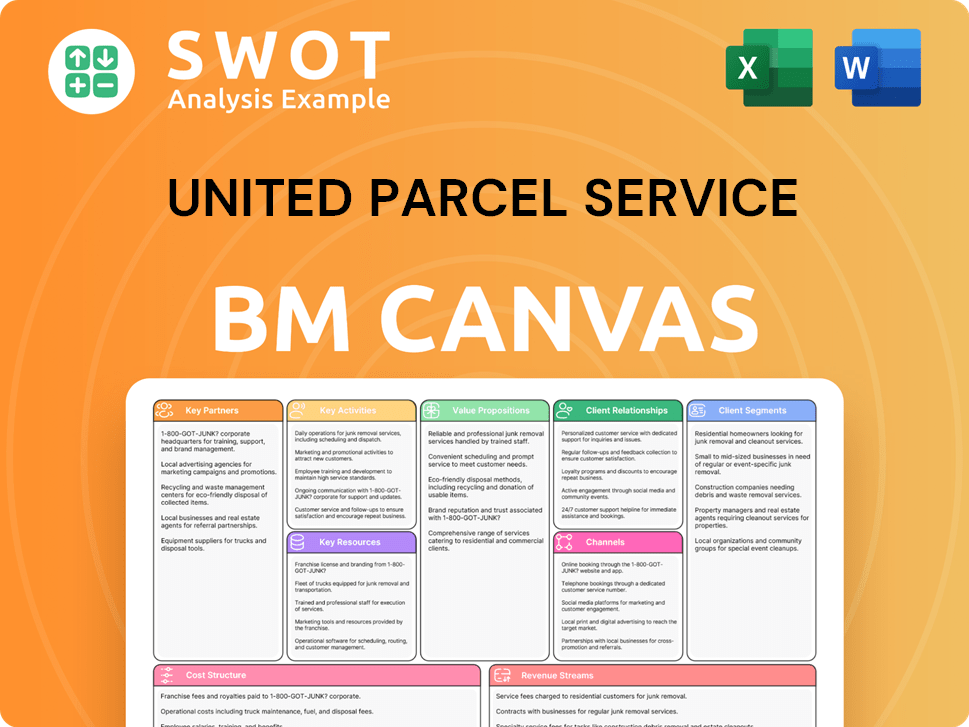
United Parcel Service Business Model Canvas
- Complete 9-Block Business Model Canvas
- Effortlessly Communicate Your Business Strategy
- Investor-Ready BMC Format
- 100% Editable and Customizable
- Clear and Structured Layout
How Is United Parcel Service Positioning Itself for Continued Success?
United Parcel Service (UPS) holds a strong position in the package delivery and logistics industry. It operates in over 220 countries and territories. In 2024, the company delivered an average of 22.4 million packages daily, totaling 5.7 billion packages for the year.
However, UPS faces challenges, including intense competition and risks such as regulatory changes and economic fluctuations. The company's decision to reduce delivery volume for its largest customer, Amazon, presents both challenges and opportunities for improved profitability. For more insights, explore the Target Market of United Parcel Service.
Industry Position
UPS is a leading global package delivery and logistics company, known for reliability. It competes with major players like FedEx, DHL, and Amazon Logistics. In 2024, the company delivered 5.7 billion packages worldwide.
Risks and Headwinds
Key risks include regulatory changes, particularly those affecting global trade, and economic fluctuations. Rising fuel costs and increased competition also pose ongoing challenges. Reducing delivery volume for Amazon presents a risk of lost revenue.
Future Outlook
UPS is implementing strategic initiatives to sustain and expand profitability. For 2025, the company anticipates approximately $89.0 billion in consolidated revenue. They are focusing on innovation, and customer-centric solutions.
Strategic Initiatives
Initiatives include reconfiguring the U.S. network and launching 'efficiency reimagined' programs. UPS aims to reduce Amazon volume and expand healthcare capabilities. Long-term targets for 2026 include consolidated revenue between $108 billion and $114 billion.
Key Financial Data and Projections
For 2025, UPS projects consolidated revenue of approximately $89.0 billion with an operating margin of around 10.8%. Capital expenditures are planned at about $3.5 billion, with dividend payments of around $5.5 billion. The company is also planning share repurchases of around $1.0 billion in 2025.
- $89.0 billion - Projected consolidated revenue for 2025.
- 10.8% - Expected operating margin for 2025.
- $3.5 billion - Planned capital expenditures in 2025.
- $5.5 billion - Dividend payments planned for 2025.
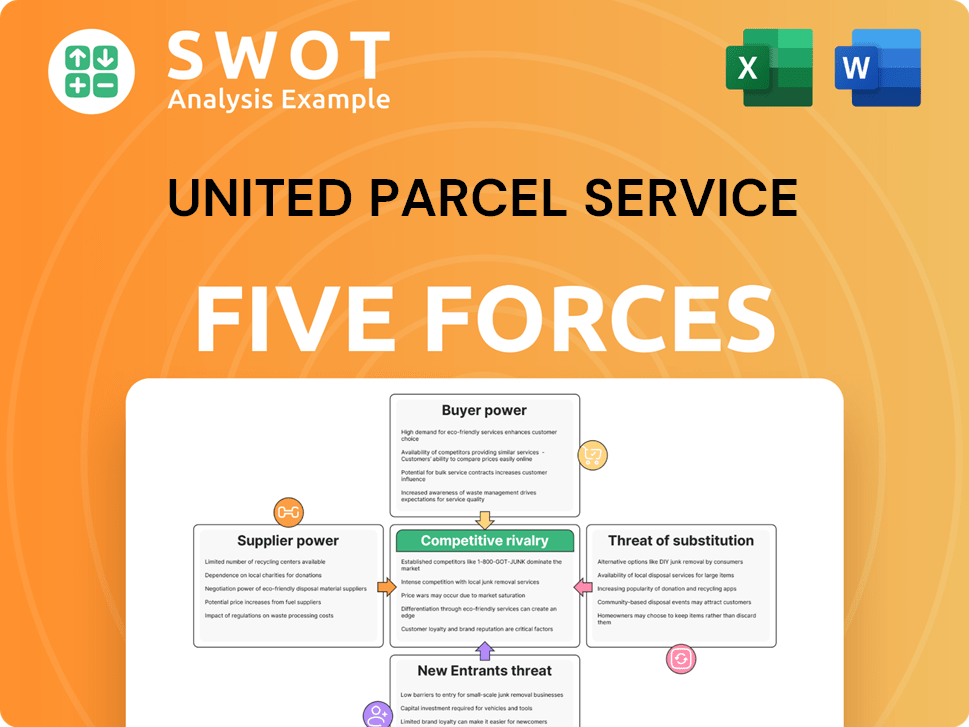
United Parcel Service Porter's Five Forces Analysis
- Covers All 5 Competitive Forces in Detail
- Structured for Consultants, Students, and Founders
- 100% Editable in Microsoft Word & Excel
- Instant Digital Download – Use Immediately
- Compatible with Mac & PC – Fully Unlocked
Related Blogs

- What are Mission Vision & Core Values of United Parcel Service Company?
- What is Competitive Landscape of United Parcel Service Company?
- What is Growth Strategy and Future Prospects of United Parcel Service Company?
- What is Sales and Marketing Strategy of United Parcel Service Company?
- What is Brief History of United Parcel Service Company?
- Who Owns United Parcel Service Company?
- What is Customer Demographics and Target Market of United Parcel Service Company?
Disclaimer
All information, articles, and product details provided on this website are for general informational and educational purposes only. We do not claim any ownership over, nor do we intend to infringe upon, any trademarks, copyrights, logos, brand names, or other intellectual property mentioned or depicted on this site. Such intellectual property remains the property of its respective owners, and any references here are made solely for identification or informational purposes, without implying any affiliation, endorsement, or partnership.
We make no representations or warranties, express or implied, regarding the accuracy, completeness, or suitability of any content or products presented. Nothing on this website should be construed as legal, tax, investment, financial, medical, or other professional advice. In addition, no part of this site—including articles or product references—constitutes a solicitation, recommendation, endorsement, advertisement, or offer to buy or sell any securities, franchises, or other financial instruments, particularly in jurisdictions where such activity would be unlawful.
All content is of a general nature and may not address the specific circumstances of any individual or entity. It is not a substitute for professional advice or services. Any actions you take based on the information provided here are strictly at your own risk. You accept full responsibility for any decisions or outcomes arising from your use of this website and agree to release us from any liability in connection with your use of, or reliance upon, the content or products found herein.